Category: Activism

  • Kicked Out but Not Silenced: The African American Pastor Who Roared Back at the Georgia General Assembly

    Kicked Out but Not Silenced: The African American Pastor Who Roared Back at the Georgia General Assembly

    African Methodist Episcopal Bishop Henry McNeil Turner
    Ardent defender of African American rights, Bishop Henry McNeil Turner

    I often find myself imagining what life was like for the ancestors I research. Whether I’m tracing the African Diasporan roots of a client’s lineage or tending to my own family tree, I have a persistent yearning to understand and feel more than names and dates. I want to get a sense of their resilience, to know the determination that carried them through trials, and even to picture their everyday and ordinary activities.

    To get me into the time and place, I recommend that novice to expert ancestral and genealogy researchers spend the quality time to go beyond the online family tree services. It is absolutely necessary to utilize government data, community news, and any oral history. For instance, pair census and street directories with employment and civic engagement. In the case of my fifth great-grandfather, Issac H. Anderson (1835 – 1906), his amazing life is highlighted by overcoming slavery to become a prominent businessman, religious and educational leader. It was his significant election to the Georgia Senate in 1867 that opened the door for me to learn about the unprecedented and perilous times for him and 32 other Black male pioneers. They were named the “Original 33, ” Black men who were among the first elected legislators in the United States.

    “Original 33” marker to honor the Black men elected to the Georgia General Assembly in 1867

    Following ancestor Anderson’s life led me to his fellow Georgia Senator, African Methodist Episcopal Church Bishiop Henry McNeil Turner (1834 – 1915).

    Faith and Fire

    One hundred and fifty-seven years ago this month (Sept. 3, 1868), a newly elected Georgia State Senator, delivered a “fiery” speech to his Republican Party colleagues who unanimously voted to expel the 33 Black members based on the color of their skin. Upon the start of the 1868 Georgia legislative session, the white lawmakers immediately expelled the delegation of Black men based on the color of their skin and their slave lineage. Bishop Turner officially addressed his remarks to the Speaker of the House.


    Rev. Henry McNeal Turner’s famous speech to the Georgia General Assembly 1868

    Excerpts of Bishop Turner’s remarks

    “Mr. Speaker: Before proceeding to argue this question upon its intrinsic merits, I wish the members                                                                                                                      of this House to understand the position that I take. I hold that I am a member of this body. Therefore,                                                                                                                sir, I shall neither fawn nor cringe before any party, nor stoop to beg them for my rights. Some of my                                                                                                                    colored fellow members, in the course of their remarks, took occasion to appeal to the sympathies of                                                                                                                      members on the opposite side, and to eulogize their character for magnanimity. It reminds me very                                                                                                                      much, sir, of slaves begging under the lash. I am here to demand my rights and to hurl thunderbolts                                                                                                                      at the men who would dare to cross the threshold of my manhood. There is an old aphorism which                                                                                                                        says, “”fight the devil with fire,” and if I should observe the rule in this instance, I wish gentlemen to                                                                                                                        understand that it is but fighting them with their own weapon.”

    And

    “Whose legislature is this? Is it a white man’s legislature, or is it a black man’s legislature? Who voted for                                                                                                              a constitutional convention, in obedience to the mandate of the Congress of the United States? Who first                                                                                                              rallied around the standard of Reconstruction? Who set the ball of loyalty rolling in the state of Georgia?                                                                                                              And whose voice was heard on the hills and in the valleys of this state? It was the voice of the brawny armed                                                                                                        Negro, with the few humanitarian hearted white men who came to our assistance. I claim the honor, sir, of                                                                                                          having been the instrument of convincing hundreds yea, thousands of white men, that to reconstruct under                                                                                                        the measures of the United States Congress was the safest and the best course for the interest of the state.”

    ‘Am I not a man?’

    Bishop Turner continued with, “The great question, sir, is this: Am I a man? If I am such, I claim the rights of a man. Am I not a man because I happen to be of a darker hue than honorable gentlemen around me? ”

    He ended his lengthy manuscript and spoken word in a summary commitment to receive justice from another source for what the expulsion from the Georgia House and Senate. “You may expel us, gentlemen, by your votes, today; but, while you do it, remember that there is a just God in Heaven, whose All-Seeing Eye beholds alike the acts of the oppressor and the oppressed, and who, despite the machinations of the wicked, never fails to vindicate the cause of Justice, and the sanctity of His own handiwork.”

    Justice restored

    The men took their cases to the federal and state high courts. In June 1869, the Georgia Supreme Court rules that the Black men were allowed to hold a public office. Although my ancestor Anderson was not restored to his seat due to a technicality involving a perceived conflict, 27 of the 33 men were placed in their seats by U.S. General Alfred Terry. The newly installed Black men made a huge difference in enacting Georgia laws, including establishing the public school system.

    Original 33 Decision of the Georgia Supreme Court in 1869

    Needed info for ancestry researchers

    The actions of Bishop Turner deeply shaped the human rights path of my ancestor, Anderson. Though Anderson achieved prominence as a businessman, co-founder of Lane College in Jackson, Tennessee, and a founding leader of the Christian Methodist Episcopal Church, he never wavered in his activism. He supported  college students in their peaceful protests and helped countless Black Georgians find safe passage to new lives in Tennessee, Arkansas, and Mississippi.

    Discovering Turner as Anderson’s close colleague highlighted not only my ancestor’s choices after the turbulent Reconstruction years of 1868–1870 but also the broader struggle they remained committed to wage together. For today’s ancestry researchers, the lesson is clear: Just as neighbors listed in census records can reveal hidden family ties, the colleagues and allies of our ancestors—whether in business, politics, civic life, or education—can unlock powerful insights into their purpose and movements. By tracing these networks, we move closer to understanding the full story of those who came before us.

    Remember what our ancestor left us

    In the end, our African Diasporan ancestors’ stories are rarely one-sided. The stories born from the lives of our ancestor are woven with the lives of neighbors, friends, and business, church, civic colleagues. By following those tracks, we honor our ancestors’ journeys and importantly, uncover the deeper legacy they left us.

  • Our Creative, Progressive Ancestor: Mama Helen

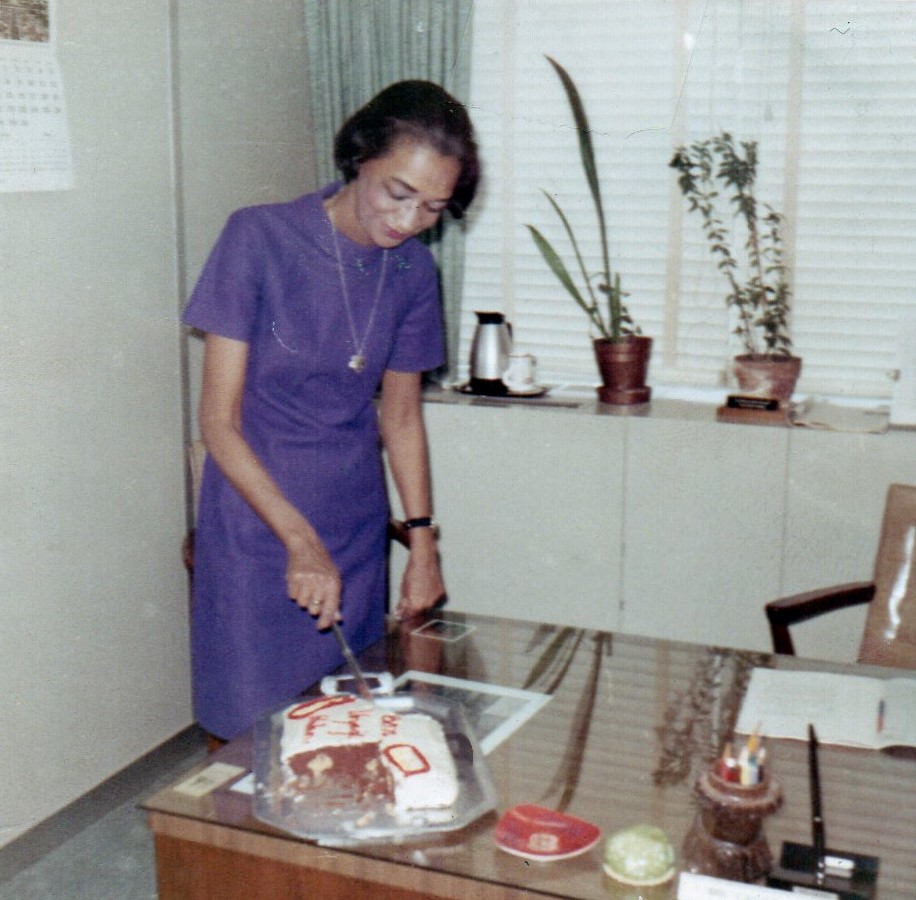
    The forever Actress, Musician, Clothing Designer, Seamstress/Tailor, Theatre Director, Opera lover … our Grandmother “Mama Helen” Mary Wilkes Owen Douthy, Omaha, Nebraska 1963
    Mama Helen’s Omaha (Nebraska) Central High School yearbook photograph, Class of 1935.
    Mama Helen retired from SAC Headquarters, Offutt Air Force Base in 1969.

    To summarize my maternal grandmother’s life: She did the most.

    In the winter months during 1963, my Maternal Grandmother, Helen Mary Wilkes (and also spelled Wilks), was donning a thinly clad garment and acting in the Greek tragedy, “Antigone.” That in of itself is nothing spectacular.

    That is, except that “Mama Helen” (as were told by her to call her), in 1963 was also a mother of adult children and a high school student while working as an unnamed “Hidden Figure” at the Strategic Air Command Headquarters, Offutt Air Force Base in nearby Bellevue, Nebraska. She was not supposed to be a “brain” at Offutt where she worked as administrative assistant to the scientists. She was actually an astute mathematician with an amazing intellect with exemplary secretarial skills.

    Mama Helen was not supposed to be on the theatre stage at her age, 45, in a supporting role to help build her acting repertoire. She was not supposed to understand the Greek language and read Latin. She was not supposed to be old enough to be the mother of the play’s director. After all, she was a black woman who should have been content to remain hidden as a white-collar worker albeit with tremendous skills outside of the workplace. I often traveled with her from North Omaha to theatres around the city and developed my love for Latin, global travels and writing.

    Thankfully, Mama Helen was never content being confined to what the so-called societal norms were in Omaha and across the nation. She would always tell me about her travels around the world. She was the super volunteer for the Presbyterian Church (U.S.A.). She played the organs at various churches on Sunday, often for no pay as she considered it her tithe to the church and unto God. Monies were stretched in the household, according to my mother, Angeline Cecil Owen Wead, the oldest of six children born in five years to Mama Helen and Grandpa Eugene Owen, II. Mama Helen was mostly the single parent in their household as my grandfather was off to build his hopes of a Hollywood career as a dancer and singer.

    Thankfully, the village that was led by our Great-Grandmother Edna Lou Wilks Robinson, worked. Mama Helen received significant assistance from Grandmother Robinson.

    In later years, Mama Helen was voted into the prestigious Omaha Central High School Hall of Fame. In this tribute to Mama Helen when she was inducted in the Hall of Fame that also honors Warren and Susie Buffett, my Dad, Dr. Rodney S. Wead, countless athletic, political, academic, world leaders and more, Mama Helen was remembered:

    “Helen loved music and the arts and volunteered with Opera Omaha, Omaha Community Playhouse, Center Stage, and Chanticleer Theater. She served on the Nebraska Arts Council and Omaha’s Human Relations Board.

    Helen passed away in 2008 at the age of 90.”

    Upon Mama Helen’s retirement, she devoted her time to a program that she earlier developed to help single women develop skills to become secretaries, assistants and other related jobs inside of offices. She conducted the classes at a local community center.

    Create a social media post honoring your ancestor

    Steps to help you to share stories about your ancestors

    1. Walk with your ancestors by researching their lives.
    2. Narrow down your work to focus on one ancestor.
    3. Once you locate periodicals, broadcast reports, historical data on military cards, death certificates and more about your ancestor, take the time to capture where the information leads you to build the rest of the story.
    4. Honor your ancestor. Take a moment and offer a wonderful prayer for her/his walk before you. Look for similarities between your life and the ancestor’s.
    5. Share your results so that others may benefit from their stories. It also helps to establish your interests in activities.
    6. Repeat steps 1 – 5.