Category: Ancestry database

  • Unlock Hidden Family History Gems with these Free Genealogy Resources in Libraries

    Unlock Hidden Family History Gems with these Free Genealogy Resources in Libraries

    Welcome all genealogy enthusiasts in search of African American family histories.

    Whether you are a newbie to the African Diaspora trail searching or a veteran who can quickly guide through genealogy online searches.

    Let’s get started:

    My all-time favorite source: Public Libraries

    For those who know, it’s your county library system.

    Since I am based in the Atlanta area, I regularly utilize the Fulton County Library System that serves Atlanta and 12 other cities. It includes the historic Auburn Avenue Research Library on African American Culture and History. The collection was a trailblazer among library systems in the United States when became the first public library in the Southeast to provide archival and reference materials that focused on the historical aspects of African American culture. In 2016, it re-opened after a $20 million renovation.

    I am also a member of the DeKalb County Library System,  which is located in the metro Atlanta area.  My unique setting is that I have an Atlanta address while being situated in DeKalb County. Why are libraries my all-time favorite genealogy sources? It’s simple. Libraries are as close as down the street from your home and are long-time collectors and organizers of information that are useful to the general community. Holding residence in a community allows most persons to receive a “free” library card and that leads to access to other free online sites such as Ancestry.com, HeritageHub, Census.gov and thousands of more.

    Libraries offer free and fee-based genealogy researchers, lectures, linkages with genealogical societies, affinity groups that include ancestry researchers and myriads of other free and special offerings. Other notable library sources for African American ancestry researchers include:

    Allen County Public Library, Fort Wayne, Indiana. Its Fred J. Reynolds Historical Genealogy Department is a centerpiece of the library with special collections of African American and Native American genealogies.   Wikipedia describes this historic collection of genealogy materials best. The Allen County Public Library houses  “the largest public genealogy department in North America, home to more than 350,000 printed volumes and 513,000 items of microfilm and microfiche.[4][5] Only the Family History Library in Salt Lake City, a private institution, is larger.[6] Allen County Public Library is also a partner of WeRelate, a collaborative online genealogy database currently providing access to over one million records and two million person pages.”

    One of my favorite quasi private/public libraries to visit is the National Museum of African American History & Culture Library. Spoiler alert: It takes 2 – 3 days to fully tour and experience the museum and library. It is focused on African Diaspora and African American culture, history, and lots of displays. I especially appreciate its collaboration with an ancestry research service and the U.S. Census to offer genealogy and family history assistance.

    The National Archives Black History collections are my epic winners for original, unusual, and special research in areas that include photographs, military, culture, and state, regional mega libraries and archives. Its online resources offer federal and non-federal associations, groups, agencies.

    The U.S. Library of Congress, Washington, DC. This free public library is a collection of libraries within libraries. Its African American History Online resources are phenomenal in that many of the documents are originals, or primary, as it is notated in the library collections. Its extensive pictorial, other artifacts, books, audio and video recordings, and so many more rare resources are widely available through the LOC.

    Denver Public Library, Denver, CO’s Blair-Caldwell African American Research Library  is the creation of the city’s first African American Mayor, Wellington Webb and his wife, Wilma Webb. They wanted to highlight the history of African Americans in the American West. From the couple’s 1999 conception of it, the library collection opened in 2003 and serves as a research library. It states as its mission, to “collect and preserve the history and culture of African Americans in Colorado and throughout the Rocky Mountain West.”

    The Schomberg Center for Research in Black Culture is the New York Public Library’s research library. Named for Afro-Puerto Rican Scholar, Arturo Alfonso Schomburg, the library is situated in the Harlem neighborhood of Manhattan, New York City. The massive library and archive collections has five separate divisions that provide superior data, visuals, and other resources for African Diaspora descendants who are interested in global historical facts. The library is also known for hostings celebrity and local creative artists, art exhibitions, theatrical events, and notable discussions.


    Other Public Libraries featuring African Diaspora Research, Archives

    The point of this blog is to heighten your interest in utilizing research libraries to gain free resources. Please search for great research opportunities in special collections in both public and private libraries.

    Bonus freebie

    The National Genealogical Society offers a free membership for senior citizens 65 years and older. The membership value is up to $100. Check out how to take advantage of this offering:


    Happy researching!



  • Unlocking Your Family’s Past: A Beginner’s Guide to Ancestry Research

    Begin your online ancestry research with joy
    The ancestry research journey often begins online

    Congratulations!

    You are joining millions of individuals around the globe who are beginning their exciting discoveries of families’ histories.

    You are in good company whether you are just getting started or dabbled a bit in genealogy. Ancestry research is a popular and engaging hobby for many genealogy seekers, gaining even more momentum over the last decade as accessible online resources.  Today, one of the largest ancestry research sites reports some 3 million subscribers searching for 15 million ancestors. Another genealogical network claims another 27 million ancestors in its organization.

    Ancestry tracing of your family’s lineage will satisfy more than your curiosity. It is proven to offer comfort, relief, joy, pride, and many positive attributes in the uncovering of the histories of family members often never known. The discoveries also offer many somber and sober moments as our loved ones often had colorful lives. You will see mirrors of yourself and other family members. The rewards of researching family histories bring great rewards.

    Let’s get started. This post will show you the way.

    First: Set a goal of the essential research you wish to achieve. When I got started with my family’s research, my goal was to learn more about the maternal grandfather that I did not grow up with. I was born in Omaha, Nebraska and my grandfather, Eugene Owen, Sr., lived approximately 1,533 miles away in Los Angeles, California.   I also wanted to learn everything about my paternal grandfather who fled Helena, Arkansas after the race killings in 1919. After many years — prior to the ample offerings of online ancestry research — I achieved my initial goals. Keep in mind that your research should be essential to your intended results. You may be interested in building a family tree, learning about your ethnic heritage, or perhaps delving into a specific ancestor’s life story?

    Next: Invest in research time both online and offline. This website, goodgenesgenealogyservices.com, and many others offer you access to records. Your county library system, historical societies, archives, family, friends, city tours, and so many resources are available to help fill in the blanks for your ancestry research. Your online records search should yield information to confirm birth, marriage and death certificates. Consult the U.S. Census data for your initial search.

    Next: On this site, you can build your family tree. Start with the basics that include your name, date of birth, and other any other relatives’ basic information. Your tree will begin to build itself. Your next steps will be to check in your tree to learn of any updates.

    Finally: The exciting part begins with the family puzzle pieces coming together.  On your family tree, remember to be flexible and open to unexpected discoveries.

    It’s a long and winding journey, yet the results are how you will honor and preserve your family’s legacy.


  • The U.S. slave population in 1860

    This is an official United States government record.

  • The forgotten stories of “Black Magnolias” from Oakland Cemetery

    First in a series

    Jihan Hurse, guide, Atlanta, GA.’s Oakland Cemetery’s “Black Magnolias” tour


    Atlanta, GA — On a chilly Saturday winter morning, Oakland Cemetery’s “Black Magnolias” Tour Guide and Author Jihan Hurse, excitedly gives highlights of the Black women who lie among its 70,000 “residents” in the city’s historic cemetery.

    The hour allotted for the tour was not enough time for all of the stories about accomplished Black women who are buried in Oakland Cemetery. Yet, the Black Magnolias tour was a refreshing collection of insight into the lives of Black women who were quiet and major influencers in the Atlanta region, Georgia and nationwide. Along the multiple paths laden mostly with bricks from days gone by, there were periodic stops at the chosen grave sites of many women who were doctors, lawyers, entrepreneurs, mothers, wives, educators and skilled technicians.

    The Black Magnolias story at Oakland Center is grounded in the fortitude of laundry or washerwomen whose citywide protest resulted in violence, arrests, intimidation and ultimately, a major victory for the Black women who refused to return to work unless their financial and work life demands were met. Their well-organized strike involved some 3,000 Black laundresses and it nearly imperiled the 1881 World’s Fair in Atlanta.

    Former slaves strike for better pay and work conditions in 1881.


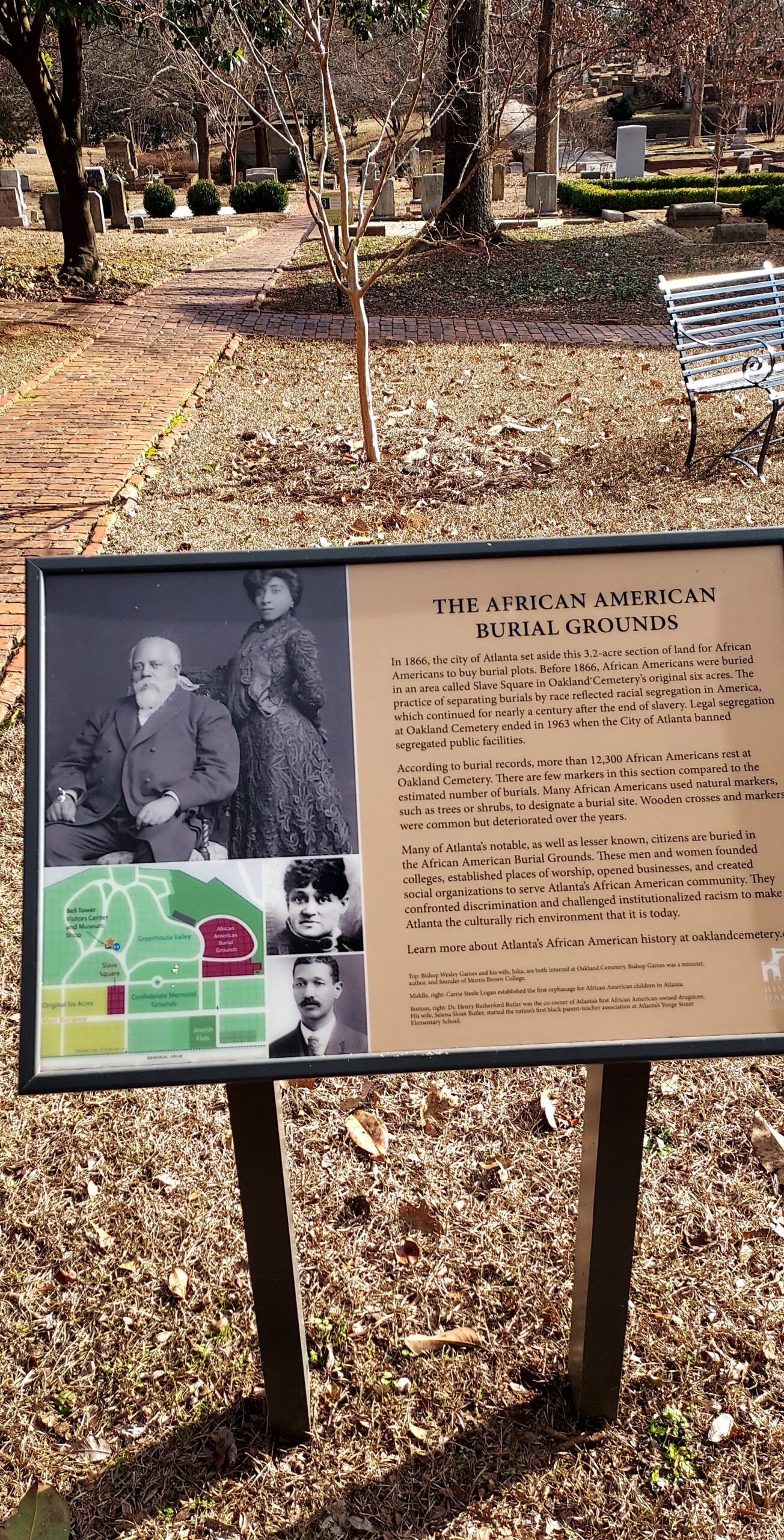
    While praising the domestic workers’ brave and labor market altering stance, Hurse strategically showcased other Black women whose legacies are integral to the success of the Atlanta area, Georgia and the nation. Despite the achievements that stretch beyond racial and geographical boundaries, most of the 12,000 African Americans — including approximately 1,800 slaves — are buried at Oakland in segregated sections known as the African American, Slave and Potters sections.

    There are also exceptions to the burial rules of segregating whites, Blacks and Jewish deceased persons from one another. When whites sought permissions to move the burial area initially designated for Black slaves, the graves were moved to the back of the cemetery. Some natural markers such as stones and sticks were not preserved. When that relocation was completed, some families such as the Boylstons asked for an additional set of permissions and that was to bury their “domestic worker,” Catherine Holmes, alongside their family members, according to Hurse. Elise Boylston had a special fondness for “Caty” and the young Boylston lady authored work that included her slave. By the 1960s, Blacks were not segregated to one area or two areas of the cemetery

    The grave marker for “Caty” Holmes, a “domestic worker” in the Boylston household, is left. This is a partial view of the extensive Boylston plot in the former Slave section of Oakland Cemetery.


    A dozen other Black Magnolias were pointed out by Hurse as significant based on a range of qualities such as the first Black lady buried in Oakland Cemetery, to the sisters who established the first hospital with 15 beds that was available to Black patients.

    Below is the grave site of Estella Henderson was an attorney, an author of books on race relations and was recognized by U.S. President William Howard Taft. Her sister, Dr. Blanche Beatrice Bowman Thompson, was a doctor whose practice pioneered specialty work for Black medical professionals in Georgia.


    Future blogs will highlight the historical women of Oakland Cemetery. For those interested in the many stories of the Black men and women buried in Oakland Cemetery, the virtual tour is found through this service:

    Good Genes Genealogy Services encourages readers of this blog to investigate similar historical stories in cemeteries that bear great stories such as those found at the Oakland Cemetery in Atlanta.


    The 48-acre cemetery that is also considered a city park. The Oakland Cemetery Foundation conducts several tours each year, including a handful devoted to honoring Black history and women’s history.


  • @pinterest is the site for the genealogy hobbyists

    Join my group board, Wead Write Away Black Genealogy on Pinterest! https://pin.it/4RaHXQJ

  • Freebie Friday!

    Freebie Friday!

    Photo by Sindre Stru00f8m on Pexels.com

    Free Databases at Ancestry.Com

    Courtesy of http://www.searchforancestors.com/ancestryfreebies.html


    Photo by Ketut Subiyanto on Pexels.com

    Ancestry.com Free Collection.

    Ancestry.com is a premium subscription-based genealogy website with over 8 billion genealogy records, most of which are online images of original documents. In addition, Ancestry has more than 35 million user-submitted family trees, which include photographs, written stories, and scanned documents.

    One of Ancestry’s best kept secrets is that they also have over 1,300 always-free databases. To view these free records, you may be asked to sign up for a free account, but the account is free, no strings attached. You do not need a free trial to view these records.

    The free databases are available to search at the Ancestry site at Ancestry.com Free Index Collection.Ancestry.com Free Collection Search


    First Name
     
    Last Name
                      Any                    USA                 AL                 AK                 AZ                 AR                 CA                 CO                 CT                 DE                 DC                 FL                 GA                 HI                 ID                 IL                 IN                 IA                 KS                 KY                 LA                 ME                 MD                 MA                 MI                 MN                 MS                 MO                 MT                 NE                 NV                 NH                 NJ                 NM                 NY                 NC                 ND                 OH                 OK                 OR                 PA                 RI                 SC                 SD                 TN                 TX                 UT                 VT                 VA                 WA                 WV                 WI                 WY                 —                 CAN                 AB                 BC                 MB                 NB                 NF                 NT                 NS                 TT                 ON                 PE                 QC                 SK                 YT                  —                 INTL               
    Locality

    Although this database is called the Free Index, it actually includes indexes as well as images. This Free Index Search contains all the free Ancestry.com record databases but does not include the very popular Family Trees.

    Below is a list of the most popular Ancestry free databases. Scroll down to see some of the the free Ancestry databases that are listed by country and state.