Category: Genealogy Research

  • A Brush with History: My 1977 Encounter with Alex Haley

    A Brush with History: My 1977 Encounter with Alex Haley

    It was pure serendipity. In 1977, while I was a sophomore at Clark College (now Clark Atlanta University) in Atlanta, I obtained a cherished autograph from a U.S. Coast Guard veteran turned legendary journalist and author: Alex Haley, the man who penned Roots: The Saga of an American Family. 

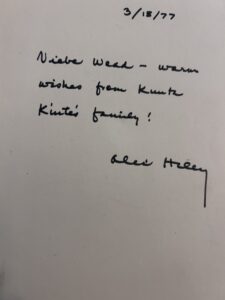
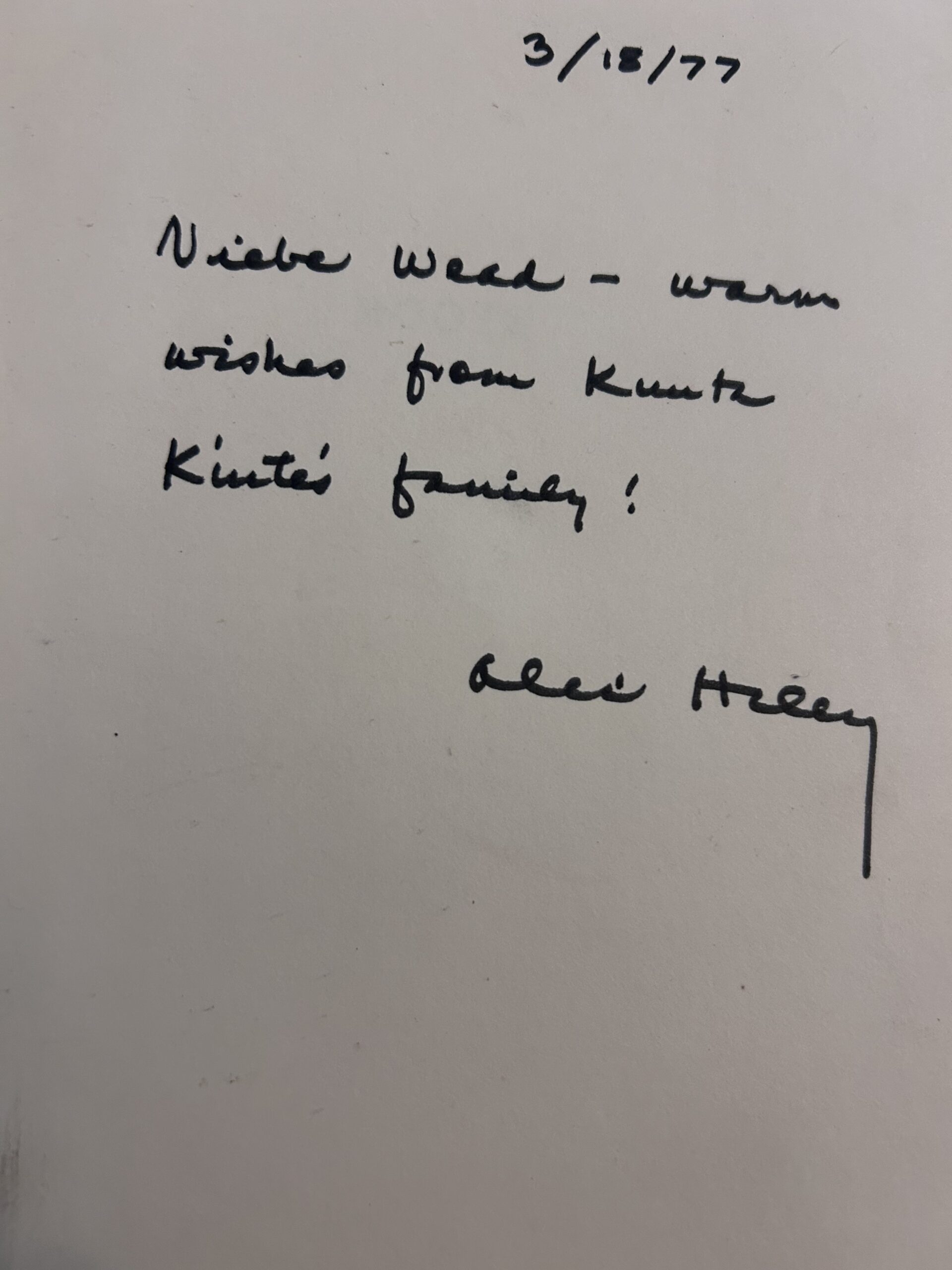
    Autograph from Alex Haley
    Handwritten note from Alex Haley to Nieve Wead

    My middle name, Lineve, was shortened into the nickname “Nieve,” which is how Haley addressed me in his note. Just a month after our encounter, he received a Pulitzer Prize, earning a special citation for Roots as “the story of a Black family from its origins in Africa through seven generations to the present day in America.”

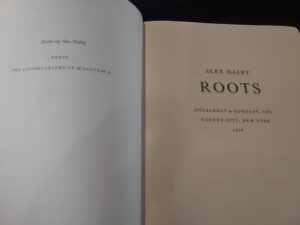
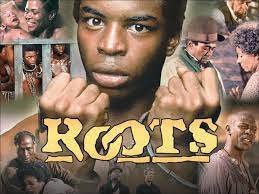
    Roots title pageROOTS

    The Phenomenon of Roots

    Today, there are few people who haven’t heard of, read, or watched Haley’s deeply moving masterpiece. Released in 1976, Roots spent a staggering 46 weeks on the New York Times Bestseller list.

    The novel chronicled the life of Kunta Kinte, an 18th-century Mandinka man captured in his West African homeland and trafficked to North America. From there, it took readers through the painful, violent, yet remarkably resilient lives of Kunta Kinte’s descendants in the United States. What made the book so revolutionary at the time was the revelation that these descendants included Haley himself.

    Haley was a prolific researcher and writer. His massive literary success didn’t stop with the original book and its groundbreaking initial television adaptation with the Roots Miniseries that aired in January 1977.  For eight consecutive nights in my dormitory, Merner Hall, on Clark College’s campus, we were tuned into the impactful video story of our new champion family. I recall how I vowed to follow Alex Haley’s path in locating my long-lost family in Africa and other places around the world. The final chapters of his story were later adapted into the 1979 TV miniseries, Roots: The Next Generations.

    Inspiration Amid Controversy

    Like thousands of people around the world, I was instantly inspired to research my own African American genealogy. However, the book’s massive success also brought intense scrutiny. A highly regarded historian challenged Haley’s findings, claiming he could not have located the exact village where Kunta Kinte was born. In response to the widespread criticism, Haley gracefully defended his work by reminding the public that he had written a “factional” or “historical novel”—a blend of deep historical research and narrative storytelling.

    Looking back, the lessons I learned from that moment as a college student were numerous:

    • Respect the Grind: Always respect and give credence to the grueling, lengthy work of genealogical researchers, writers, and producers.
    • Trust, but Verify: This is always the order of the day for genealogists, especially those of us engaged in African Diaspora research.
    • Context Matters: The timing of Roots was incredibly noteworthy, arriving just as Jimmy Carter was inaugurated as U.S. President in January 1977, a time of profound national reflection.
    • Endless Stories: There are millions of stories waiting to be uncovered that allow us to accurately piece together our African Diaspora ancestry.

    My 30-Year Nudge

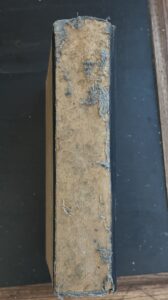
    Pictured below is my original copy of Roots. As you can see, I simply wore it out from reading and re-reading it so many times.

    While Alex Haley gave me the inspiration to vigorously research my family’s roots back in 1976, it ultimately took me 30 years to act on that great nudge. Today, I can proudly boast several hundred newly discovered family members on our family tree. My family tree now stretches back 13 generations across both my maternal and paternal sides, tracing our lines through Switzerland, Africa, Ireland, Germany, Missouri, Mississippi, Georgia, Virginia, North Carolina, and beyond.

    The journey takes time—but the reward is looking history right in the face.

    My worn off book binding from the Roots book

  • Extra Extra! One of My Favorite Places to Search African Diaspora Ancestry

    Extra Extra! One of My Favorite Places to Search African Diaspora Ancestry

    One of my favorite places to search for African Diaspora ancestry is the U.S., African American Newspapers, 1829 – 1947 collection. It is one of the few research sources where I willingly become distracted.

    I often begin with a specific objective—a person, a family, or another subject that needs solving. Yet often I find myself reading entire newspaper pages. The articles, advertisements, editorials, and community announcements provide a rich understanding of the times in which our ancestors lived.

    Sometimes the most valuable discoveries have nothing to do with the individual I originally set out to find.

    A Unique “Census” for Black Folk

    The African American newspaper collection serves as a critical research center for locating information about African Diaspora relatives who can otherwise be difficult to trace through traditional records. More importantly, these newspapers reveal how Black individuals and communities lived, worked, worshipped, celebrated, and persevered during some of the most challenging periods in American history.

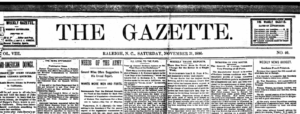
    While researching the life of Rev. LeGrand Lee “L.L.” Thomas (born September 1865 in Bishopville, South Carolina, and died April 13, 1917, in Manning, South Carolina), I encountered several fascinating articles in  The Gazette on Nov. 21, 1896.

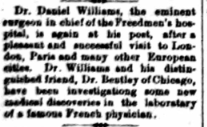
    One brief article reported that pioneering physician Dr. Daniel Hale Williams was traveling to Europe with another Black physician to study medical advancements.

    In just a few lines, I learned two important facts. First, Dr. Williams was serving as chief of Freedmen’s Hospital (now Howard University Hospital) . Second, he was traveling internationally in pursuit of medical knowledge and professional development. Those details transformed him from a historical name into a living; ambitious professional engaged with the wider world.

    Other articles in the same issue contained a complete listing of Black attendees at a “Colored State Fair” near Raleigh, North Carolina. To a genealogist, such a list can function almost like a community census, documenting individuals who may not appear elsewhere in records of the era.

    Then another article captured my attention.

    “Col. A.B. Andrews Thinks Well of the Colored Race”

    The headline alone was enough to stop me.

    The article was not an advertisement. Instead, it appeared among reports about the Colored State Fair and other community news. Naturally, I wondered why a former Confederate colonel would feel compelled to publicly express such sentiments in a Black newspaper.

    Researching Col. A.B. Andrews did not fully answer my question, but I did learn that he:

    • Served as a Confederate cavalry officer;
    • Worked as a railroad executive;
    • Was trained as an engineer before the Civil War;
    • Saw active battlefield service; and
    • Contributed significantly to North Carolina’s transportation network after the war.

    Although his motivations remain unclear, the article offered a fascinating glimpse into the complex racial and social dynamics of the late nineteenth century.

    Why the Black Press Matters

    Beginning with the founding of Freedom’s Journal in 1827, hundreds of Black newspapers chronicled the lives, aspirations, achievements, migrations, and struggles of African Americans.

    Period Approximate Number
    Before the Civil War (1827–1861) About 30 Black newspapers were established. (OUPblog)
    By 1880 About 30 Black newspapers were operating nationally. (The New Yorker)
    By the start of World War I (1914–1917) Around 300 Black newspapers were being published. (The New Yorker)
    Entire history of the Black press More than 3,000 African American newspapers, magazines, and presses have existed since 1827. (Encyclopedia)

    For family historians and professional genealogists, these newspapers preserve stories and personal details that often cannot be found elsewhere. I grew up in Omaha, Nebraska and Chicago, Illinois. I was fortunate that the weekly Omaha Star newspaper was my anchor as a young person who longed to read news about Black people in my community and around the world. The same was true of the Chicago Defender newspaper, an iconic brand in the African American newspaper sector. I am fortunate to brag that I have published articles in both of these historic, dynamic papers that well-serve and served our communities.

    By the beginning of World War I, approximately 300 Black newspapers were being published throughout the United States. Over the course of U.S.  history, more than 3,000 Black newspapers, magazines, and presses have existed.

    These sacred publications documented:

    • Births and deaths;
    • Athletic feats;
    • Marriages and anniversaries;
    • Church activities;
    • School achievements;
    • Business ventures;
    • Military service;
    • Social events;
    • Community leadership; and
    • Migration patterns.

    For many African American families, Black newspapers preserve the only surviving evidence that an ancestor lived, worked, worshipped, or contributed to a community.

    A Funny Thing Happened on the Way to the Search

    I eventually located the information I sought regarding Rev. Thomas’s wife. However, the search produced much more than I expected.

    Because Rev. Thomas was a well-known minister in the Raleigh community, the newspaper references extended far beyond him. The searches revealed family members, church activities, community events, and social networks connected to his life.

    Once again, the lesson was clear. Sometimes we search for one person and discover an entire community.

    That is the beauty of African Diaspora genealogy research. The records do not simply tell us where our ancestors lived. They tell us how they lived. Occasionally, we are introduced to people and stories we never expected to find.


    zza


  • The Sensitive Plant at Ghana’s Last Bath

    The Sensitive Plant at Ghana’s Last Bath

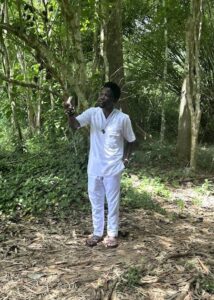
    Our prolific tour guide, Devine at the Last Bath, Assin Manso, Ghana
    Our prolific tour guide, Devine at the Last Bath, Assin Manso, Ghana


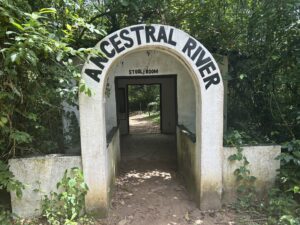
    It was an unexpected discovery along the winding, sometimes muddy path leading to what is solemnly known as the Last Bath in Ghana.

    Just moments earlier, our guide, Devine, was sharing rhythmic and powerful stories of survival of the men and women whose lives were violently uprooted centuries ago and forced toward an uncertain future across the Atlantic Ocean. His voice carried through the trees as he recounted the journeys of those who passed through this place in chains.

    Then, as Devine’s leather sandals were striding down the lightly muddy path, he stopped.

    The World’s “First” Security System

    Kneeling beside a place in the path, he pointed to a small patch of greenery and invited several of us to gather around.

    “This,” Devine said with a comforting smile, “was the first security system.”

    With the gentle touch of his finger, the tiny plant immediately recoiled. Its delicate leaves folded inward as though retreating from the world. Devine explained that the plant, commonly known as the Sensitive Plant (Mimosa pudica), would slowly reopen several minutes later. According to the stories that he shared, the plant’s sudden movements was an alert system for those who may have “disturbed the area.”

    “It was a secret system the ancestors used to protect their lands. We still have it here.” He said that if it were not for the grass that has grown up around the special plants, the visitors would be walking on the Sensitive Plant on the way to the actual river of the Last Bath.

    “They know that they have seven minutes to catch up with them. After seven minutes it opens back fully and they lose the trail,” explained Devine.

    He said the ancestors “were using it as their secret motion sensors. Whenever the ancestors came out to see the plant closed, they knew that something” been there. There is nothing on this earth that is invented by anyone else. Today, you are seeing the proof of our intelligence”.

    He referred to the plants as being the equivalent to the modern Ring Door security device: “The most amazing thing is that the security system itself was invented by an African American woman.” He was referring to Marie Van Brittan Brown, an African American nurse, co-invented the first home security system in 1966 with her husband, Albert L. Brown, an electronics technician.

    The demonstration lasted only a few seconds, but its symbolism lingered much longer.

    Standing at Assin Manso’s Last Bath, a place where countless Africans endured unimaginable loss before beginning the final stage of their forced journey to the coast, I could not ignore the metaphor. Generations of African Diaspora families have carried memories that folded inward for protection. Through genealogy, oral history, and return journeys to places such as Ghana, those memories slowly begin to open again.

    The Last Bath

    More than 100 miles from Accra, Ghana’s capital city, lies the community of Assin Manso, home to one of the most emotionally significant sites in Ghana’s remembrance landscape. Located within the Assin Manso Ancestral Slave River Park, the Last Bath marks one of the final inland transfer points for many enslaved Africans before their forced march to the slave dungeons at Cape Coast and Elmina.

    Here, according to historical accounts, captives were brought to the river to bathe before continuing toward the coast. For many, it would be their last physical contact with the interior lands of Africa before boarding ships bound for the Americas and the Caribbean.

    We reached the river entry point.  We slowly and assuredly walked down the path to the waiting arms of our guide, who had gotten in the waist high water.  The water, he observed was higher than in previous years. While the waters were rolling, there was a striking peace.  Birds sing from a distance. The trees seemed to welcome its visitors as the branches were swaying gently in the warm breeze. Most of the visitors entered the river, including this writer. It is a cleansing and connecting feeling to African ancestors like no other experience while in this region of Ghana.

    Beneath the somberness rests the weight of countless untold stories that would never be known for their lives were lost either through death along the hundreds of miles of marching to an unknown fate, or through the separation and ultimate travel across the Atlantic Ocean to reach lands they never knew.

    Lessons from a Small Plant

    As the leaves of the Sensitive Plant gradually reopened, our guide reflected on the lessons it offers visitors:

    • Memory can be hidden but not lost.
    • Trauma may cause individuals, families, and communities to close themselves in self-protection.
    • Healing often happens slowly, one layer at a time.
    • What appears dormant may still be very much alive.

    Whether those meanings are found in nature itself or assigned through human reflection hardly matters. At Assin Manso, the symbolism feels undeniable.

    For descendants of the African Diaspora, family history often unfolds in much the same way. Names disappear. Stories fade. Connections seem lost. Yet many symbols such as a documents, oral histories, conversations, DNA matches, or a long journey across the ocean, touches the past and awakens memories  that may been long folded away.

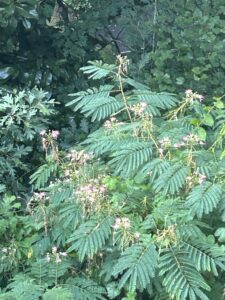
    Interesting finding was right in my backyard. When comparing the look of the Mimosa pudica, I noticed that the leaves of one tree always blooms into a pattern that is identical to Assin Manso’s Secretive Plant. Without any scientific or other professional explanation, it appears the plant was transplanted to my backyard tree.

    My backyard tree is in full bloom as a Mimosa plant descendant
    My backyard tree is in full bloom as a Mimosa plant descendant

    Like the Sensitive Plant, those stories begin to open again.

  • A Genealogist’s Packing List: Traveling Across Continents in Search of History

    A Genealogist’s Packing List: Traveling Across Continents in Search of History

    Ninety-degree heat. Forty-eight-degree cold.

    That was the reality of my journey from Accra, Ghana, to Amsterdam, the Netherlands.

    What Do You Pack for Research Across Two Continents?

    One day, I was standing under the warm West African sun in temperatures reaching 32°C (90°F). Just six hours later, I stepped off a plane into Amsterdam’s chilly spring air of 9°C (48°F), arriving at the start of the country’s largest national celebration—King’s Day.

    As I prepared for this international journey from the United States, packing became more than deciding what clothes to wear. I thought of the two continents, multiple climates, different cultural norms, and my optimistic research agenda centered on the African Diaspora and the history of the Trans-Atlantic Slave Trade.

    My international travel goals were straightforward:

    • Actively participate in mission work with my church colleagues that focused on delivery of our donated goods and service at an orphanage, school, and village in Ghana.
    • Conduct historical and genealogical research related to the African Diaspora and the Trans-Atlantic Slave Trade.
    • Experience the people, culture, and history of each destination with a focus on safety and being respectful of local customs.

    My so-called challenge was to fit everything needed for ministry, research, tourism, and everyday life into a manageable number of two checked and two carry on bags.

    What follows are the lessons I learned—and the items I am glad I packed.

    Pack Like a Researcher

    Since 2010 when I first visited Rwanda, Africa as part of my doctoral studies, I learned that research travel requires a different mindset than vacation travel. Whether visiting archives, museums, cemeteries, historical sites, or cultural sites like the botanical gardens in Ghana, researchers need tools that allow us to capture information quickly and accurately.

    My research essentials:

    • Smartphone with extra storage and internet access
    • Energy converters for plugs and other gadgets
    • Portable chargers
    • Large and small/thin notebooks and pens
    • Small cross-body bag
    • Digital copies of my passport and travel documents
    • Archive contact information and copies of permission documents to conduct research (know the protocols)
    • Cloud storage access for photos and notes
    • Activate the Whatsapp feature for telephonic and texting communication
    • Monies budgeted for copying, scanning, and other document preservation

    My two days of research in Ghana at Public Records and Archives Administration Department (PRAAD) generated hundreds of photographs, documents, and observations. I reserved some and had many scanned by the PRAAD team and delivered to me via my Whatsapp because the documents were not deliverable through my email. In Amsterdam, the celebration of King’s Day precluded me from conducting research at its libraries that stored the historical  records I was seeking. However, I was able to gather sufficient visual content related to the Trans-Atlantic Slave Trade. A future writing will delve into this with more detail.

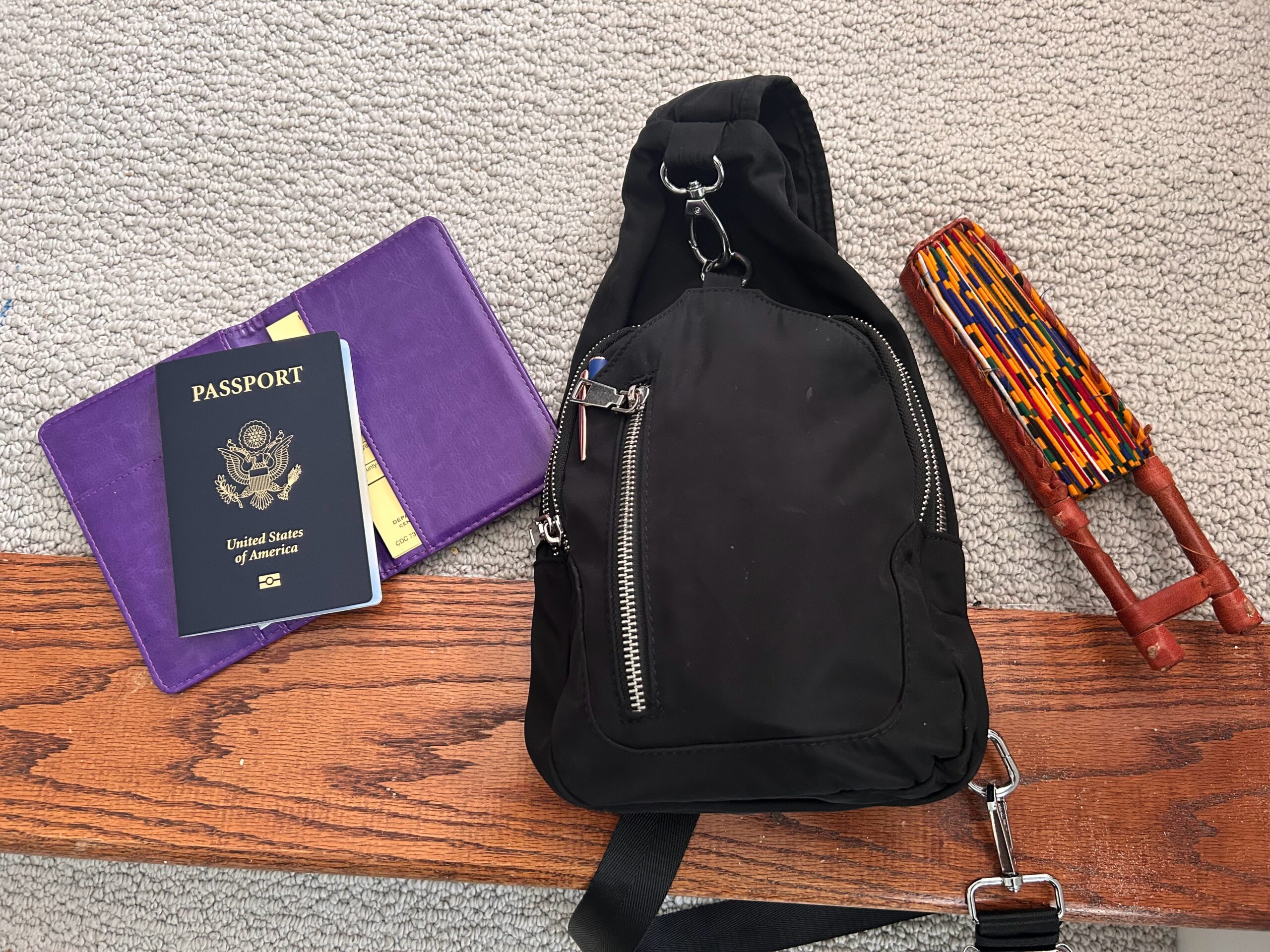
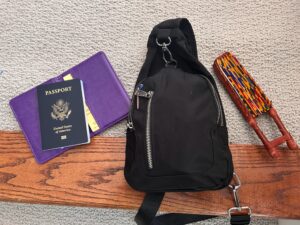
    Besides your passport, researchers should be well-armed with the essential travel items including the cross-body and a Ghanian made hand fan.
    Besides your passport, researchers should be well-armed with the essential travel items including the cross-body and a Ghanian made hand fan.

    In all, being organized matters.

    Essentials:

    • Medical vaccinations and travel medicine (if needed), forms
    • Lightweight shirts and blouses
    • Compression socks
    • Convertible travel pants — preferably blue, black, white, tan
    • Light sweater or fleece — preferably fleece
    • Rain-resistant jacket
    • Comfortable walking shoes — my preference are Crocs
    • One outfit suitable for dressy formal occasions

    Pack for the unexpected

    I learned this lesson many years ago while on a mission trip in Costa Rica: Never pack your suitcase completely full. As a research traveler, I inevitably return with books, documents, maps, gifts and souvenirs that help me remember the story.  The extra space I left in my luggage proved invaluable.  Once I brought a foldable suitcase. Another time, while in Japan, I purchased a suitcase. It was much cheaper to buy it there than in the United States.

    Great lessons

    I packed far more than clothing, my United States passport, and other travel gear. I packed my high curiosity about the once heavily traveled ship route between the Gold Coast on West Africa and the Netherlands. Those dealings resulted in the most lucrative aspect of the Trans-Atlantic Slave Trade. I packed patience and profound faith to follow history wherever it led. My luggage helped me move between continents. Those internal qualities helped me move between centuries.


  • “Uncovering African Roots: The Fascinating Link Between Twin Births and Ancestry Heritage” Keywords: Twin births, African roots, Heritage, African heritage, Genetic link, Ancestry DNA

    “Uncovering African Roots: The Fascinating Link Between Twin Births and Ancestry Heritage” Keywords: Twin births, African roots, Heritage, African heritage, Genetic link, Ancestry DNA

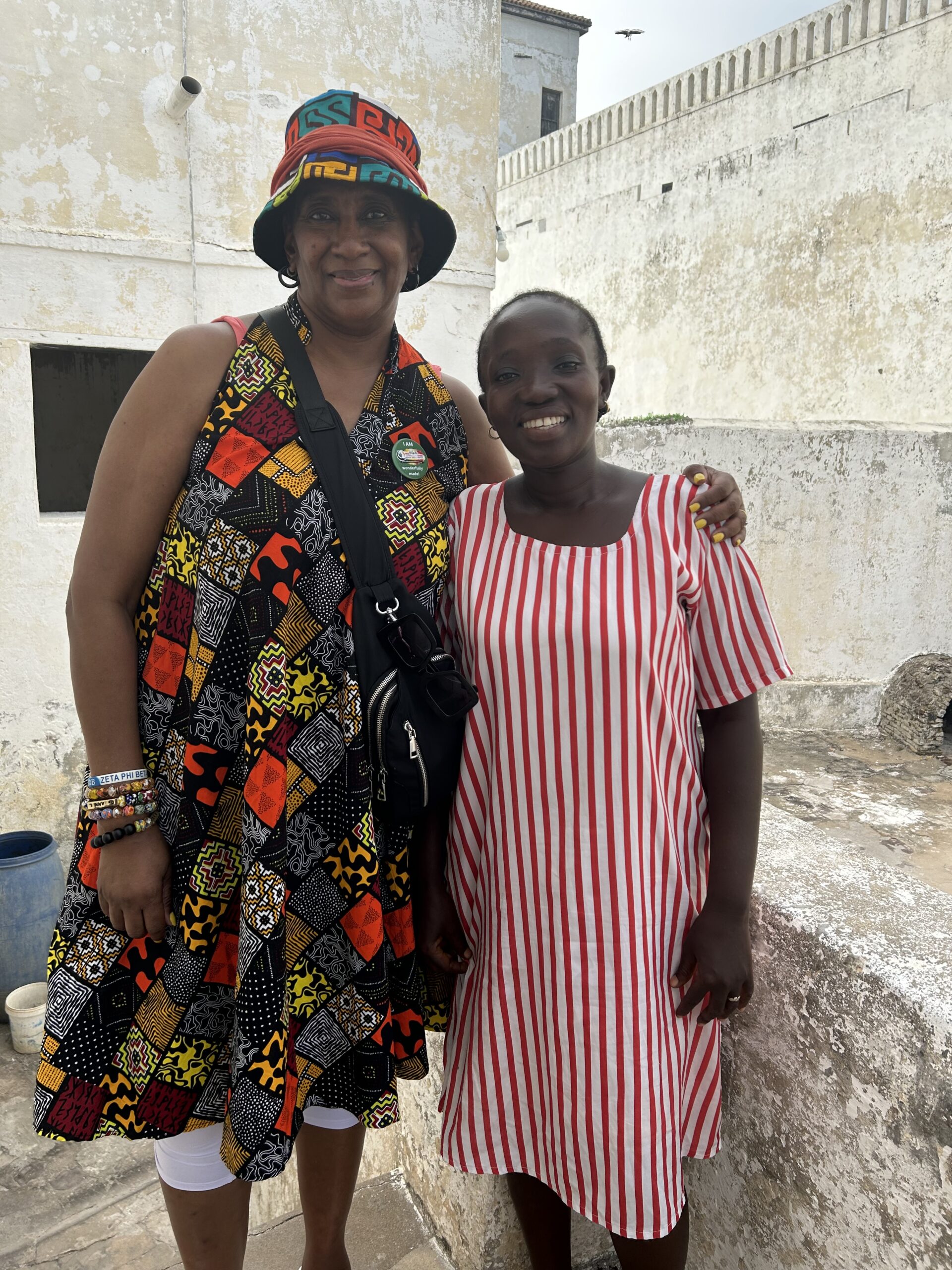
    Mothers of fraternal twin children: From left, Blog Author Ann aka Ama (born on Saturday)  and "Abena" (born on Tuesday) at Elmina (Ghana) Slave Dungeon
    Mothers of fraternal twin children: From left, Blog Author Ann aka Ama (born on Saturday) and “Abena” (born on Tuesday) at Elmina (Ghana) Slave Dungeon

    Who knew that giving births to fraternal twins would be a strong linkage to connecting African Diasporan families? Do twins “run in your family?”

    In African diasporan genealogy, I’ve found several clues that live within me as a fraternal twin mother, and within so many other African, African American, Brazilian, Caribbean women.  In short, twin births are the highest among Black women in these regions of the world. By contrast, fraternal twin births are low in Europe and the lowest in East Asia.

    I’ve been curious about the birth of twins since my boy and girl set were born some forty years ago at Georgia Baptist Hospital in Atlanta, Georgia USA.  Each time I’ve visited Africa since 2010, I’ve met mothers of twins, family members of twins, and of course, twins. The intersting feature is that often fraternal Black twins — that is, not identical ones — do not necessarily have similar outward features. I have a sense that some combinations of people are twins and that is how I often make such connections on USA, Caribbean and African soils.  On an April 2026 visit to Ghana’s Elmina community, I easily located a mother of fraternal twin children (pictured, on right). She, too, had a boy and girl twin who were soon to celebrate a milestone birthday.

    Diaspora Connection

    The same regions in West Africa known for higher twinning rates are also regions where many our enslaved Africans ancestors were trafficked from. It is interesting that elevated rates of fraternal twins among African-descended populations in the U.S., Caribbean, and Brazil. I met groups of people from northeast Ghana who are connected to Brazil.

    This is more than a statistic—it is continuity. Even after the forced enslaved passages across the Atlantic Ocean where we are still piecing together generations of separations, something remained.

    Fraternal twinning that is mostly linked to West African ancestry is a huge genealogy search clue. This inherited trait traveled across generations during the Trans-Atlantic Slave Trade and still appears in families today. For genealogists that include me, and for all family researchers, twin births are helping to trace maternal lines.

    This means that we can reconnect with our ancestors through another familial linkage and remind us that even when records are long gone, our fraternal twin ancestry leaves a wonderful mark.

    Twins as Genealogical Clues

    As we comb through government and other historical records, be on the look out for the following clues about your family that will likely help to further identify African geographical and genealogical linkages:

    • Two children listed with the same age and date of birth in early Census records;
    • Probate, plantation, church and other social documents referring to “twins”;
    • Oral family stories about the “two born together”; and
    • Repeated twin births on maternal sides of our families.

    I’ve located twins on my paternal and maternal family lines based on the connection of birth dates. It is shoring up my family’s linkage to West Africa.

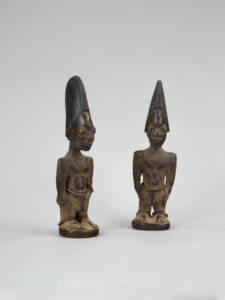
    In most of West Africa, the birth of twins is considered a significant sign from the gods. Amongst the Yoruba they are thought to bring good luck -- St. Louis Art Museum
    In most of West Africa, the birth of twins is considered a significant sign from the gods. Amongst the Yoruba they are thought to bring good luck — St. Louis Art Museum

    More Than a Coincidence

    For those who are interested in the science of twinning, fraternal twins happen when a woman releases more than one egg during ovulation. Research shows this occurs more often in some West African populations than anywhere else in the world. That means it may not be random when repeated twin births occur in a family line—especially across generations.  Our ancestors and today’s Black families often remark that “twins skip a generation” or something similar when explaining the phenomenon of twin births within families.

    For instance, my maternal grandmother gave birth to fraternal twin daughters. Skipping a generation, I birthed fraternal twin children — John and Jocelyn.

    Several recent studies track twin births in West Africa. According to a study of data from 135 countries by the University of Oxford’s Christiaan Monden and his colleagues published in 2020, the Ivory Coast had a rate of 24.9 twins for every 1,000 births during 2010 – 2015.   The report found that Ghana and South Sudan had the second-highest twinning rate, each with 24.8 twins per 1,000 deliveries, followed by Liechtenstein on 24.7 per 1,000. About 1.6 million twins are now born worldwide each year.

    “The twinning rate in Africa is so high because of the high number of dizygotic twins – twins born from two separate eggs – born there.” He continued, “This is most likely to be due to genetic differences between the African population and other populations,” explained researcher Monden.

    Next steps

    We spend our time in genealogy and ancestry research searching for what was lost.  Things and people are not really lost, all are simply unrecognized.

    Twin births remind us that our ancestors left patterns, traits, and living evidence of who they were and where they came from. Even in the absence of records, the body remembers.

    Our stories are told in pairs.


  • “Unlocking Your Roots: Mastering Ancestry and Genealogy Searches for a Strong Sense of Belonging”

    I belong to several ancestry and genealogy research groups, chats, organizations, and regularly participate in training sessions. This aids in my development as a genealogist specializing in African Diasporan family searches.

    One of my favorite organizations is the Afro-American Historical and Genealogical Society, Inc., especially the metro Atlanta chapter. Here’s a sample of the great connections you are provided by AAHGS when you join the organization:


    21 JUL 2024(pictorial generated by AI)


    These events are provided as a courtesy to our AAHGS Metro Atlanta members but are not the responsibility of our chapter.


    Timelines for Genealogy, Dottie Baugh

    Mon Jul 22nd

    Presented by Charlotte County Genealogical Society
    10:30am ET

    All classes are free and open to the public. For a Zoom link, send an email to President@ccgsi.org

    For details see www.ccgsi.org


    The Homestead Act, with Ranger, Amber Kirkendall, Homestead National Historic Park

    Mon Jul 22nd

    Presented by Heritage Seekers Genealogy Club
    7:30pm ET

    Ranger, Amber Kirkendall, Homestead National Historic Park

    This is a Zoom virtual meeting. To get a link to attend, you must:
    – be a paid member, or
    – subscribe to our email list at https://heritageseekersar.com/subscribe/ or
    – follow us on Facebook at https://www.facebook.com/heritageseekersar.club

    Zoom link available closer to the event – See the website!

    For details see heritageseekersar.com/


    Pins & Needles: Adding Social Media to Your Genealogy Repertoire

    Mon Jul 22nd

    Presented by Plainfield Area Public Library
    8:00pm ET

    Many of us have used Facebook to find distant cousins and former high school friends. Join us for a fun session on using sites like Pinterest, Flickr, Instagram and more to locate, identify and share ancestors.

    This is a virtual program. Login information will be sent when you register for the program

    For details see plainfieldpubliclibrary.librarymarket.com/event/virtual-pins-needles-adding-social-media-your-genealogy-repertoire-65597


    Researching LGBTQ Genealogy, with Stewart Traiman

    Mon Jul 22nd

    Presented by Denver Public Library
    8:00pm ET

    Lesbian, Gay, Bisexual, Trans, and Queer folk have always been a part of our history and family stories. Our trees’ confirmed bachelor or spinster aunt may not have been single. Perhaps they did have partners but there is no legal documentation or family acknowledgment. This class will explore census, newspapers, obituaries, military records, photographs, phone books, and archives for clues on our ancestor’s sexuality. We will also explore LGBTQ History and many individual stories giving context to the available records. Discovering our LGBTQ ancestors’ stories and inviting them back into our trees will enrich our entire family history.

    For details see www.denverlibrary.org/event/researching-lgbtq-genealogy


    Beginning Ancestry by Scott Jones

    Tue Jul 23rd

    Presented by Los Angeles FamilySearch Center
    2:00pm ET

    What and where?

    For details see churchofjesuschrist.zoom.us/j/95462341725?pwd=dmxZaWNGR1hpWVlCM1lYaHBENERLdz09#successlBSaWtyS0pwSDJxdz09%23success


    Using the FamilySearch Catalog by Clark Jenkins

    Tue Jul 23rd

    Presented by Los Angeles FamilySearch Center
    5:00pm ET

    Learn how to search the entire FamilySearch database using the Catalog. This will include searching indexed and unindexed records, book titles and authors, and keyword searches. Learn how to navigate through unindexed record collections to find digitized original records.

    For details see churchofjesuschrist.zoom.us/j/95462341725?pwd=dmxZaWNGR1hpWVlCM1lYaHBENERLdz09#successlBSaWtyS0pwSDJxdz09%23success


    What’s the Tea in Your Family Tree?

    Tue Jul 23rd

    Presented by Charlotte Mecklenburg Library / West Boulevard Library
    6:00pm ET

    Unearth secrets, reveal truths, and explore the colorful stories hidden within your ancestral lineage.

    This is a HYBRID program, so you can attend in-person at West Boulevard Library or online via Zoom.

    *Registration Required* Registration begins the first day of the month.

    For details see cmlibrary.bibliocommons.com/events/664e02e3e3e1ee30003fe2c7


    Genealogy for Beginners: Census records and obituaries

    Tue Jul 23rd

    Presented by Cincinnati Public Library / Pleasant Ridge
    6:30pm ET

    Census records and obituaries are the most popular and easiest to find genealogical records. Learn how to search for and use these records when digging into your family history.

    This event will be in person at the Pleasant Ridge Branch and also live streamed over Zoom. The Zoom link will be shared a few hours before the program starts.

    Registration is required to receive the Zoom link.

    For details see cincinnatilibrary.bibliocommons.com/events/65d74df01e57af280037c162


    Finding and Using City Directories for Genealogy – Fourth Tuesday Genealogy Series

    Tue Jul 23rd

    Presented by The Erie Society for Genealogical Research
    7:00pm ET

    Fourth Tuesday Genealogy Series: Session is repeated via Zoom at 7 p.m. For handouts and to register for the session go to: events.erielibrary.org/ and search for genealogy.

    23 Jul 2024: Finding and Using City Directories for Genealogy: Information which might be found in city and county directories. What you might be missing in these resources. Locating city directories. Hints for using city directories. Abbreviations. Other historical directories.

    For details see www.genealogyerie.org/p/Calendar/event/Finding-and-Using-City-Directories-for-Genealogy-387


    The Genealogist’s Google Search Methodology

    Tue Jul 23rd

    Presented by Louisville Genealogical Society
    1:00pm ET

    Presented by Lisa Louise Cooke

    It’s a new decade, so if you think you know how to Google, think again! Technology changes rapidly and keeping our search skills updated and sharp is key to search success. Come learn the latest Google Search Methodology for Genealogy. You’ll hear about the latest and best search innovations and learn the process that will dramatically improve your genealogical search results. These skills can be used with all associated Google tools.

    Free but REGISTRATION REQUIRED at www.kylgs.org


    Genealogy Quick Start TV – LIVE with Andre Kearns

    Tue Jul 23rd

    Presented by Genealogy Quick Start TV
    8:00pm ET

    Fact or Fiction: Which assumptions are you making about your family history? In “Getting Past Your Assumptions” provide a method for understanding the truth of family-lore. Then our special guest Andre Kearns will dive deeply into the assumptions we make with 1870 census in “Emancipating the Stories of Blended Families in the 1870 Census”

    JOIN Live from our YouTube Channel or Facebook Page, LIVE every other Tuesday @ 8:00 PM ET
    www.youtube.com/@GenealogyQuickStart/streams

    This is an interactive genealogy TV show, not a genealogy webinar. We invite you to chat, comment, and ask questions.

    For details see www.facebook.com/events/1011977810605274/


    Introduction to Genealogy

    Tue Jul 23rd

    Presented by Plano Public Library / Haggard Library
    8:00pm ET

    Learn the basics of common genealogical research tools and techniques.

    For details see plano-cep.bc.sirsidynix.net/event/introduction-to-genealogy-2/


    Latest Updates to the MyHeritage Mobile App, with Gilad Katz

    Tue Jul 23rd

    Presented by Legacy Family Tree Webinars
    2:00pm ET

    More and more, people are preferring to use their mobile devices to access their favorite software and services — and genealogists shouldn’t be left behind. MyHeritage continues to improve the genealogy-on-the-go experience from the MyHeritage mobile app, making it easier than ever to manage your family tree and conduct research from the palm of your hand. In this session, Gilad Katz, Senior Product Manager at MyHeritage, will show you the latest developments in the mobile app.

    For details see familytreewebinars.com/webinar/latest-updates-to-the-myheritage-mobile-app/


    Stories Behind the Stars – World War II Heroes

    Tue Jul 23rd

    Presented by the Cobb County Genealogical Society
    7:00pm ET

    CCGS Board member Loren Plisco volunteers with Stories Behind the Stars, a nonprofit organization dedicated to researching and writing the stories of over 421,000 Americans who sacrificed their lives in World War II. The stories will reside in memorials on Fold3 and will be linked to memorials on FindAGrave. This project is supported by Ancestry, Newspapers.com, Fold3, Together We Served, and other organizations. To date, hundreds of volunteers have written approximately 40,000 stories, with the ambitious goal to complete all of the stories by the end of 2025, which marks the anniversary of the end of World War II.

    Register online here: us06web.zoom.us/meeting/register/tZ0sduygrTMtE9a-Tw82s-BdPUeWY60wWyiO#/registration

    For details see cobbgagensoc.org/


    TOTS – Tech on Tuesdays You Can Never Have Too Many Backups — Backups, Data Preservation and Back Blaze

    Tue Jul 23rd

    Presented by The Colorado Genealogy Society
    9:00pm ET

    For details see us02web.zoom.us/meeting/register/tZwsf–urjotH9Hp3pmcJZvhz6Vh5Yvs2rKt


    Working with DNA Matches: Beginning to Sort Your Matches

    Tue Jul 23rd

    Presented by The Genealogy Center at Allen County Public Library
    2:30pm ET

    In this introductory session, we will learn to work with your genetic cousin matches from an autosomal DNA test. We will learn how to determine your familial relationship to your DNA matches (beginning with known relatives) and begin to sort your matches into groups based on the connecting ancestors that you share. Presented by Sara Allen.

    For details see acpl.libnet.info/event/11055953


    Imaging by Clark Jenkins

    Wed Jul 24th

    Presented by Los Angeles FamilySearch Center
    5:00pm ET

    How to look up images in FamilySearch?

    For details see churchofjesuschrist.zoom.us/j/95462341725?pwd=dmxZaWNGR1hpWVlCM1lYaHBENERLdz09#successlBSaWtyS0pwSDJxdz09%23success


    Writing Family Stories Within FamilySearch by Holly Jones

    Wed Jul 24th

    Presented by Los Angeles FamilySearch Center
    2:00pm ET

    Writing your personal and family stories.

    For details see churchofjesuschrist.zoom.us/j/95462341725?pwd=dmxZaWNGR1hpWVlCM1lYaHBENERLdz09#successlBSaWtyS0pwSDJxdz09%23success


    Getting Around the Missing 1890 Census, Part 1, with Sara Cochran

    Wed Jul 24th

    Presented by Fountaindale Public Library
    12:00pm ET

    Sara Cochran, the Skeleton Whisperer, will help you strategize and gather tips for success in locating your family in other records between the 1880 and 1900 Federal censuses.

    The loss of the 1890 Federal census is a source of great frustration for American Genealogists, but all hope is not lost! Sara Cochran, the Skeleton Whisperer, will help you strategize and gather tips for success in locating your family in other records between the 1880 and 1900 Federal censuses. This is part one of a two-session series.

    This program is available in a Zoom webinar format. A link and handout will be sent a day before the event. A reminder will be sent an hour before the event.

    For details see communico.fountaindale.org/event/9545900


    Periodicals for Genealogy

    Wed Jul 24th

    Presented by Midwest Genealogy Center at Mid-Continent Public Library
    7:30pm ET

    Learn how to search for and use periodicals at the Midwest Genealogy Center and other libraries, as another resource in your genealogy research. This is a beginner-level class. This class will be held in person as well as virtually via Zoom simultaneously. Registration is required and closes one hour before the start of the program. Please indicate whether you will be attending in person or virtually when registering. An email address is required when registering to attend on Zoom. All start times are Central Standard Time.

    For details see www.mymcpl.org/events/98202/periodicals-genealogy-hybrid


    From the Grassroots Roundtable: Preserving Places and Stories in the East Tennessee Black Community

    Presented by East Tennessee History Center
    12:00pm ET

    Please join our esteemed panelists as they consider their contributions to the preservation of spaces and stories in their home communities, whether through ensuring the Black community’s history and family connections are shared and/or buildings themselves are saved and reused. They will also share their dreams of next steps and share insights on conducting community projects.

    Pre-registration is required, both for in-person or for Zoom.

    For details see www.easttnhistory.org/event/advanced-genealogy/


    Preserving Family Memories: Audio Recordings

    Wed Jul 24th

    Presented by Dallas Public Library
    3:00pm ET

    The sound of a loved one’s voice = irreplaceable family memories. Learn how to digitize and preserve your audio recordings stored on cassette tapes, microcassette tapes and LPs. Hear from one of Dallas Public Library’s A/V librarians on how to edit your audio, and share your precious family memories using the Heritage Lab located on the 8th floor of the J. Erik Jonsson Central Library.

    This Genealogy & History program is available both in-person at the J. Erik Jonsson Central Library, 8th floor AND online via Zoom.

    Please register in advance.

    For details see dallaslibrary.librarymarket.com/event/preserving-family-memories-audio-recordings-366192


    African American Research Workshop

    Wed Jul 24th

    Presented by Oakland Family History Library
    9:00 PM Eastern

    This is an ongoing, free, hands-on research workshop comprised of African Americans, also referred to as Black or Afro-American, or those who harmonize with Sub-Saharan Africa, with ancestry, citizenship, or residency in the United States. The workshop is an interactive exchange of research tools, methods and systems, and discussions necessary for progress at individual levels of family histories and genealogies impacted by the 16th Century removal of Africans to America as slaves.
    For a Zoom link to the virtual workshop, churchofjesuschrist.zoom.us/j/98525123399?pwd=WFptb0RWSDk5UjdHVGhtNXl3NkZadz09#success

    For additional information E-Mail: pat4gene@gmail.com
    or go to
    www.familysearch.org/en/wiki/Oakland_California_FamilySearch_Library/Learning_Center_Descriptions#African_American_Research_Workshop


    Preserving Family History

    Thu Jul 25th

    Presented by Lake County Public Library
    2:30pm ET

    Have you ever wondered how to take care of those old photographs, scrapbooks, and stories passed down from generation to generation? This session has got you covered. Join Jeremy Pekarek, Archivist at Indiana University Northwest, to learn more about best practices involving proper housing techniques, documentation, and digital materials.

    For details see www.lcplin.org/event/9176704


    25+ Free Genealogy Sites

    Thu Jul 25th

    Presented by St. Louis County Library
    7:30pm ET

    Explore how to access and use several free websites for your family history research.

    Registration opens June1, 2024. Registration required. Participants will receive Zoom information immediately after registering.

    For details see slcl.events.mylibrary.digital/event?id=96470


    Ancestry.com, a Premier Website, Online Class: Great tips for finding your families, and editing photos, and using Storymaker Studio

    Thu Jul 25th

    Presented by Riverton Utah FamilySearch Center
    9:00pm ET

    Presented by R. Ray

    Ancestry.com, the Premier Family History Website. Ancestry.com has partnered with FamilySearch to easily share family tree records and information. Over 60 billion records (~6 times as many as FamilySearch has) makes it easier to find your families. Over 10 billion of those records come from FamilySearch so, you will see those records too.

    To attend the online classes, you will need to register. It is recommended that you review the class handouts before attending the class by viewing them online or by printing them. Handouts available at www.familysearch.org/en/wiki/Riverton_Utah_FamilySearch_Center/Online_Classes

    Register at churchofjesuschrist.zoom.us/meeting/register/tJAkd-muqDgpHdbGtkUcRX5VLxKL2IzeMAJK

    For details see www.familysearch.org/en/wiki/Riverton_Utah_FamilySearch_Center/Online_Classes


    Facebook Workshop for Genealogists

    Thu Jul 25th

    Presented by Mount Vernon Genealogical Society
    1:00pm ET

    Instructor: Jo Pearson

    Unlock the power of Facebook for your genealogy research! Learn how to create and manage a genealogy-focused Facebook page or group, best practices for posting and sharing, and how to use Facebook events to organize virtual meetups or collaborative research sessions.

    TO REGISTER: Please send an email with your name and phone number, the class date and title, to Amy Breedlove at albreedlove@comcast.net
    Thank you.

    Once you’ve registered, a reminder email will be sent to you a few days ahead of the class with the zoom link and any handouts, etc.

    For details see www.mvgenealogy.org/


    How to Use Newspapers for Genealogy

    Thu Jul 25th

    Presented by Cuyahoga County Public Library
    7:00pm ET

    Tips and tricks on using newspapers in your genealogy research.

    A meeting link will be emailed to registered participants approximately one hour prior to the start of the program. Staff will be available for help with connecting to Zoom and technical issues beginning 15 minutes prior to the program. You will need a device with audio and/or video and an internet connection to join.

    For details see attend.cuyahogalibrary.org/event/10366070


    The Why, Where, When, What and How of Lineage and Hereditary Societies, with Christine Cohen

    Thu Jul 25th

    Presented by Marin County Genealogical Society
    10:00pm ET

    Why should you join a lineage society? How do you join a lineage society? What activities do they perform? What member benefits are available? Are DNA test results a membership option?

    The Genealogical Society General meetings are open to the public, with no admission fee. Feel free to drop in! Bring your friends as everyone is welcome. Come early and ask your burning genealogical questions of other members before the meeting.

    The public is welcome to attend all of our virtual meetings. Contact info@maringensoc.org for more information.

    Please register in advance.

    For details see www.maringensoc.org/event-5756426


    Genealogy in Teaching

    Fri Jul 26th

    Presented by CALS Central Arkansas Library System
    1:00pm ET

    Learn how to use genealogy databases and other resources to teach language arts, science, and math as well as social studies.

    This is a hybrid event; the in-person class will take place in Meeting Room B at the Fletcher Library. Virtual attendees will access the class via Zoom.

    If you wish to attend virtually, you must register to receive the Zoom link to join the class.

    Please email at digital@cals.org or call 1.501.320.5724 if you have any questions.

    For details see events.cals.org/event/10666775


     Military Records at TSLAC

    Fri Jul 26th

    Presented by Texas State Library and Archives Commission
    9:00am ET Find out how to locate Texas military service records at TSLAC.

    The Archives and Information Services Division offers a suite of research webinar recordings on-demand throughout the year. The start date listed here is the date the webinar will be first available.

    For details see www.tsl.texas.gov/arc/workshops


    8 Tips for Using AI as Your Genealogy Assistant

    Fri Jul 26th

    Presented by Bay Area Genealogical Society
    8:00pm ET

    Speaker: Dana Leeds. AI can help you complete many tasks faster than you can on your own. This makes it an incredible time-saver. It can also help you get more out of the records you find. But where do you start? And what can it help you with?

    This presentation will highlight eight areas where AI can be a patient and knowledgeable assistant, supporting you in both your genealogy research and daily tasks. In your genealogy work, AI can help you summarize information, extract and visualize data, write engaging family history narratives, convert handwritten documents into searchable text, and illustrate your family story. Additionally, AI can assist you with daily tasks such as tech troubleshooting, saving you valuable time. Join us and discover the various ways AI can help you be more efficient and effective in your pursuits!

    For details see www.txbayareagen.org/?page_id=5


    Genealogical Research & Writing: Are You a Saint, Sinner, or Bumfuzzled Soul?, with Elizabeth Shown Mills, CG, CGL (members only)

    Fri Jul 26th

    Presented by Legacy Family Tree Webinars
    (members only) (VIRTUAL)
    2:00pm ET

    As researchers, family historians, compilers, bloggers, or writers of other ilk, genealogists face legal and ethical perils they often do not anticipate. This crash course offers practical guidance to enhance your skills and keep you safe as you explore history, reconstruct lives, and “write up” your findings. While the issues are serious—from the legal issue of copyright to the ethical issue of plagiarism—the lessons are taught with a light heart and humor.

    For details see familytreewebinars.com/webinar/genealogical-research-writing-are-you-a-saint-sinner-or-bumfuzzled-soul/


    Reeling ‘Em in with Cousin Bait: 10 Ways to Connect with Family, with Cheri Hudson Passey

    Sat Jul 27th

    Presented by Polk County Genealogy Speaker Series
    10:00am ET

    Want to connect with those who may have information about your family? Learn 10 strategies to help you connect and collaborate with family members, including creating “Cousin Bait.”

    This is a hybrid virtual program. The presenter will appear virtually, but guests are invited to join us at the History Center to participate in the Zoom. For Zoom details, contact the Polk County History Center at (863) 534-4386 or ShannonGraham@polk-county.net.

    For details see www.polk-county.net/events/reeling-em-in-with-cousin-bait-10-ways-to-connect-with-family-genealogy-speaker-series/


    Discovering Your Ancestors – Series 1 with Janet Camarata

    Sat Jul 27th

    Presented by Puget Sound Genealogical Society
    1:30pm ET

    Genealogy is an enriching and rewarding way to discover our own families through their written records, photographs and artifacts. Tracing our ancestral roots expands our understanding of history and how they lived in earlier generations. The individual pieces of the family jigsaw puzzle consists of vital records, censuses, land records, immigration, naturalization, military records, church histories, taxes, court and courthouse records, DNA and much more. The tools and techniques used by genealogists today are extensive and include the Internet, specific genealogy programs and websites, i.e. Ancestry and FamilySearch. Learn in a computer environment the resources available online and off-line to investigate the various jigsaw puzzle pieces that document your ancestors’ lives.
    This class will focus on Strategic Searching, Sources & Citations, Cemetery Research.
    This will be a hybrid class with in person at the Sylvan Way Library and on Zoom. The Zoom link will be posted on our website an our Facebook page on July 26.

    For details see www.psgsociety.org


    How to Read Old Handwriting, with Lisa Lisson

    Sat Jul 27th

    Presented by Capital District Genealogical Society
    1:00pm ET

    Struggling to read those old historical documents? Gain invaluable insights and practical strategies for deciphering your ancestors’ records, allowing you to uncover hidden stories and connect with your heritage in ways you never thought possible. From understanding the evolution of handwriting styles to employing innovative techniques for enhancing legibility, this talk promises to equip you with the skills and confidence needed to navigate the rich tapestry of your family’s history. Don’t miss this opportunity to sharpen your genealogical prowess and forge deeper connections with your roots!

    Non-members may register starting on the 16th of the month (space permitting). Non-Members must create a free CDGS account before they can register. You only need to create an account once, as you can login to that account to register for future presentations.

    For details see www.capitaldistrictgenealogicalsociety.org/


    FamilySearch Overview – Everything You Don’t Know But Should

    Sat Jul 27th

    Presented by San Mateo County Genealogical Society
    1:30pm ET

    FamilySearch has done a lot of improvements and changes over the past few years. Did you know you can get free consultations from them now? Do you know where to look for the latest catalog information? Have checked out the maps of what cemeteries your relatives are in? Come listen to an overview of what FamilySearch has changed lately and how you can use it to make sure you get the most out of FamilySearch. You can learn about the community groups and guided research all now available on FamilySearch. Join Pamela Brigham for this presentation on FamilySearch.

    Please register in advance

    For details see www.smcgs.org/


    Join the International Genealogical Community with Year-Round RootsTech, with James Tanner

    Sun Jul 28th

    Presented by BYU Library / Family History Sunday Classes
    5:30pm ET

    The BYU Family History Library presents virtual Sunday classes for anyone interested in family history! Classes are free and everyone is welcome.

    No registration required. Click the link “Join Live Class” at the URL below, where you’ll also find the upcoming class calendar, as well as their library of previously recorded virtual classes. All free!

    The Zoom link for Sunday Classes at the scheduled time is
    https://byu.zoom.us/j/97185943513?pwd=IgbedZiLURYMxnPxlkWolxQNK6iEGd.1

    For details see https://familyhistory.lib.byu.edu/learning/webinars


    —

    “Discovering Our Ancestors, Our History and Ourselves-TOGETHER”


    Afro-American Historical and Genealogical Society, Inc.
    Metro- Atlanta Chapter

    www.aahgsatl.org
  • Uncovering Family History: Tracing⁤ Ancestors via U.S. Government Photos

    Uncovering Family History: Tracing⁤ Ancestors via U.S. Government Photos

    This photo in a Kentucky food line during the Great Depression was taken by skilled, award-winning photographer, Gordon Parks. He worked for the federal government as part of a massive pictorial project. Gordon specialized in showing Black life in ways never before displayed.

    Delving into⁤ the Past: Uncovering Family History through U.S. Government ‌Photos


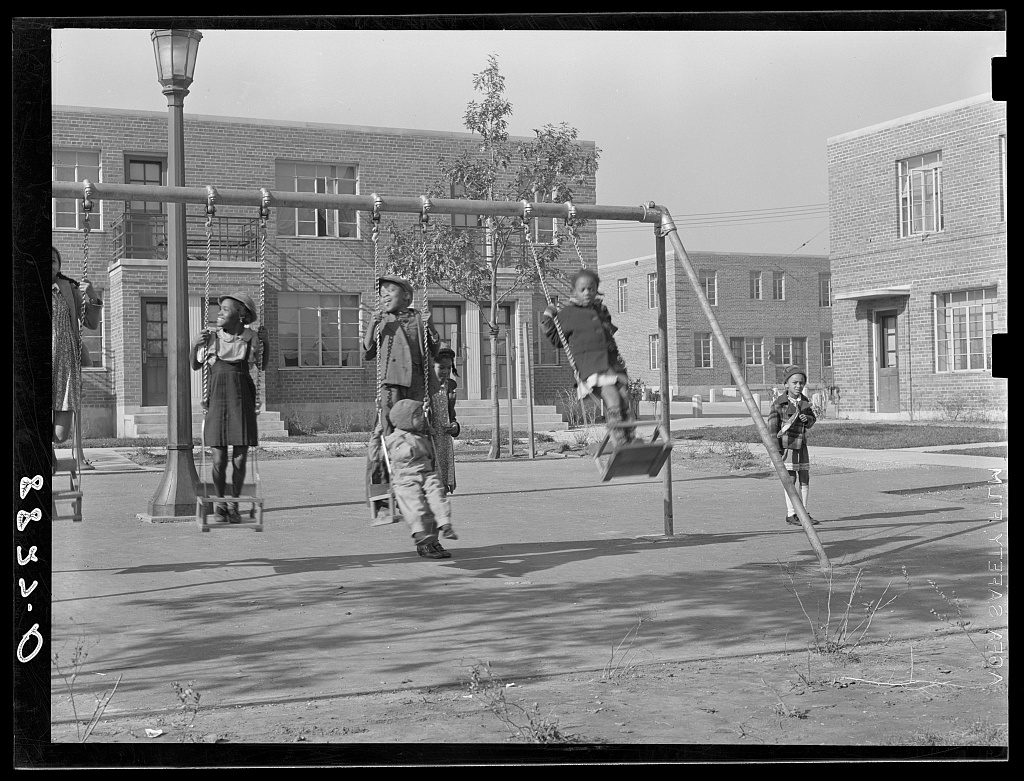
    Picture this: You can locate your hard-to-find or perhaps unknown ancestors or important family landmarks through the free pictorial archives of the United States government. I found my father’s childhood home, Logan Fontenelle Homes in Omaha, Nebraska. Once my Dad saw it, he recalled where his neighbors lived and some of the children in the picture found below:

    Children at play in 1938 at the newly opened Logan Fontenelle Homes in Omaha, Nebraska
    Logan Fontenelle Homes, Omaha, Nebraska, as captured in 1938 by the U.S. Farm Security Administration/Office of War Information

    Not only did this photograph prompt my Dad to zero in on the housing development his family (Mom, brother, sister, and grandmother) moved into a few years after this photo was taken, it provided a guide to additional legacy conversations.  Thanks to the ambitious nationwide pictorial project by the U.S. Government in the 1930s and 1940s, finding relatives — especially African American ancestors — can prove rewarding.

    The backstory that explains the photographs

    This blog will give you tips on how to narrow your searches to sites that likely hold images of your ancestors. I located my relatives in the photographs taken in the 1930s and 1940s by photographers employed by the Farm Security Administration and Office of War Information. It was an ambitious project that had multiple goals. One was to employ individuals during a time of desperate unemployment woes of the Great Depression and post-World War II.

    When it comes to tracing your family history,⁣ there are a multitude of resources available to you. One often-overlooked source of ‍valuable ⁤information is U.S. government photos. From census records to military photos, these images can provide⁢ a unique glimpse into the lives of ‌your ancestors. By⁢ delving into the past through these official images, you can uncover hidden ⁤stories and connections that may have been⁣ lost to time.

    The FSA and the OWI collectively produced approximately 175,000 black-and-white film negatives and 1,600 color photographs during the 1930s and 1940s. The separate agencies’ work was designed to display life during the Depression, Dust Bowl and in the post War World II era.


    Tips on how to locate ancestors through pictures

    • Suggestions on search leads are street names in towns, schools, famous persons, employment, transportation, summer fun and many more topics that may have passed through generations such as relatives catching fish with their bare hands in Eatonton, Ga. Guess what? I found photos proving this was true.

    The caption reads: “Negroes catching small catfish with their hands. Bait to be used in shoals of Little River near Eatonton, Georgia”


    • Closely study the photographs for bonus features such as names (often photographer Gordon Parks identified his subjects by names), locations, and occupations or themes.
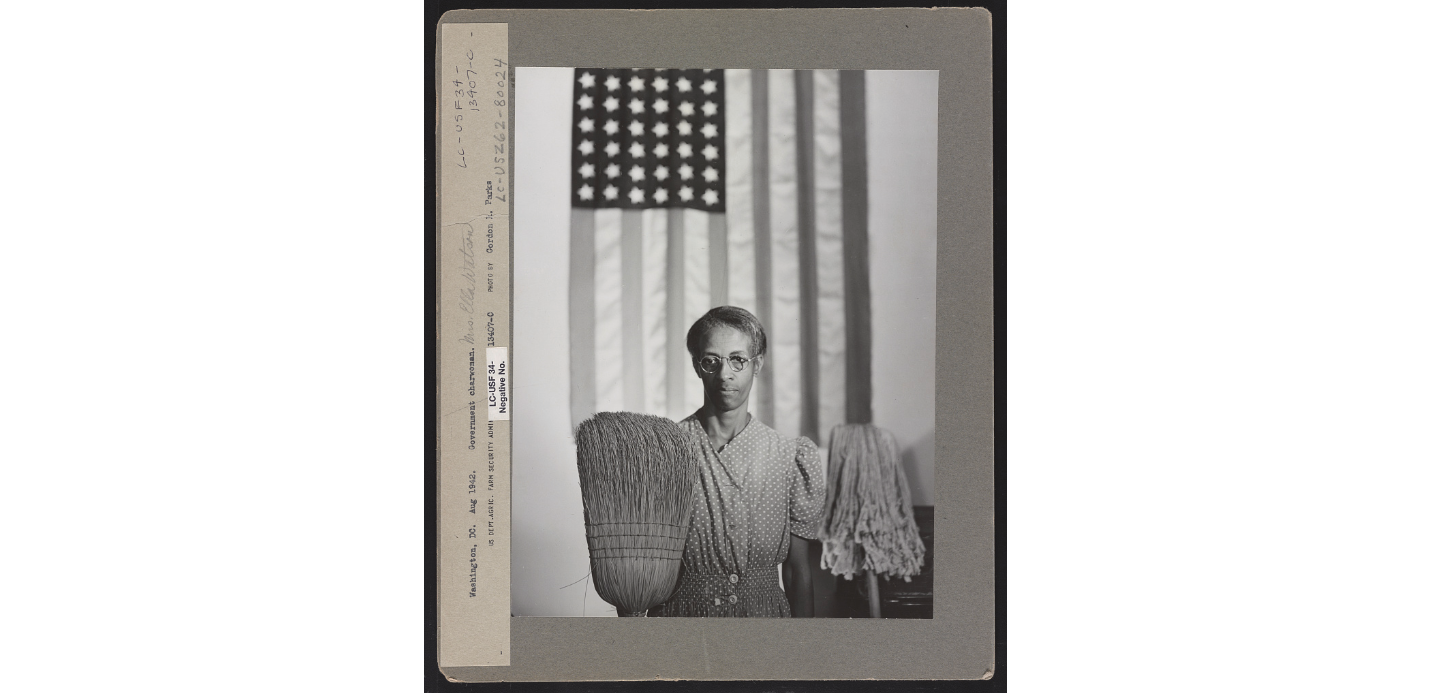
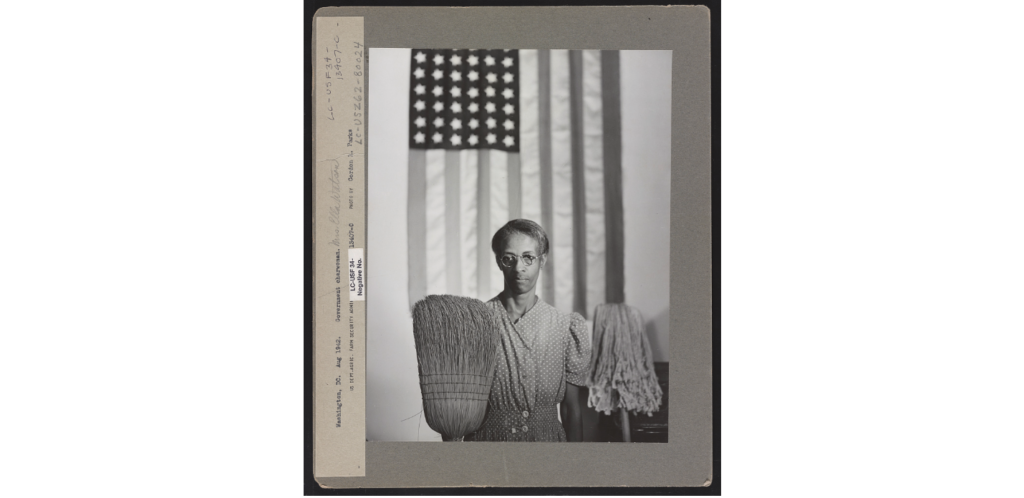
    Chairwoman, a photograph by Gordon Parks, 1942, Washington, D.C.
    This iconic photograph aka “American Gothic” was taken by Gordon Parks as part of the Farm Security Administration and the Office of War Information

    What’s important about this photograph is the name of the subject, Ella Watson, and her occupation, charwoman. A charwoman cleans houses and offices for her wages.


    Additional Research Tips from the Library of Congress

    Unprinted negatives: You can search for “Untitled” to see images that did not come with a caption card bearing a title and are presumed not to have been printed. Most unprinted negatives simply have “Untitled” as their caption. Some have titles based on similar images that appear to have related content.

    To view images that have a hole punched in them (an early method the agency used to indicate the negative should not be printed), you can search “hole punch.”

    For insight on FSA selection of images to be printed, see: Fleischhauer, Carl. “Selecting Photographs for the FSA/OWI Print File: a Photo-Assignment Case Study: John Vachon’s Documentation of the Roanoke Farms Resettlement Project, Halifax County, North Carolina, April 1938” (25 June 2020). [pdf, 7.8 mb], http://www.loc.gov/rr/print/coll/Vachon_FSA-1938-RoanokeFarms.pdf.

    Browse by Topic: Select from the Subject Index categories: Alphabetical listing or Classfication Number listing

    FSA/OWI Written Records: View a description of the written records and a digitized selection of the documents

    For a video overview of the collection, see “Documenting America, 1935-1943: The Farm Security Administration/Office of War Information Photo Collection.”

    Here’s how a typical search appears

    When you locate a photograph on the joint websites, beside the image, there is a lot of great information that can aid in locating ard-to-find relatives:

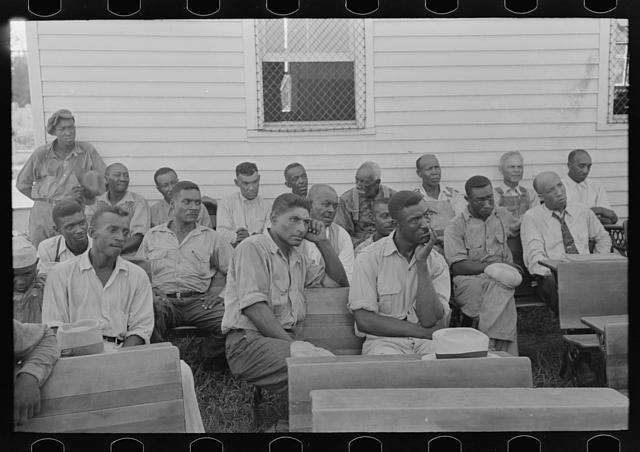
    Negro clients listening to visiting public health official, Southeast Missouri Farms. La Forge, Missouri

    Unearthing All Hidden Connections

    As you delve into locating family members through the U.S. government photos, use the free offerings as a launch or compliment to the images and artifacts in the basements, attics, garages, and other storage areas of your senior relatives. Ask about photographs and piece together fascinating stories.

    A creative use is to link the government photographs with the other timelines in your family. Collect and arrange photographs in chronological order and begin with a lively narrative to bring your ancestors to life. Also, look for family resemblances in the government-supplied photographs.

    Finally, note that this is another resource to match up information found in military records, the U.S. Census, passports, audio and video captures, and more.

  • Uncovering ⁤the History of Dallas’ ‌Freedmen’s Cemetery

    Uncovering ⁤the History of Dallas’ ‌Freedmen’s Cemetery

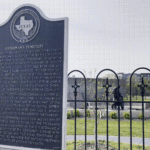
    Texas Red granite archway marks the entrance to the Freedmen’s Cemetery Memorial. Two niches, located on either side of the arch, are adorned with life-size bronze figures (one in each niche). The free-standing figure on the left of the entrance, the so-called “Sentinel” or “Warrior,” is dressed in clothes inspired by the Benin culture of West Africa. Text source: Freedman’s Cemetery Memorial (Dallas, TX) · Contemporary Monuments to the Slave Past (slaverymonuments.org). Source of all images in GGGS blog: thelesters.co)


    Uncovering the History of Dallas’ Freedmen’s Cemetery

    You can hear and feel the heartbeat of Dallas, Texas, as feet and vehicle traffic is nearby the renovated burial grounds that house the remains of between 5,000 and 7,000 slaves, former slaves, freed Blacks, and their descendants. Here lies the historic territory known ​as the Freedmen’s Cemetery. ‍

    It is a sacred site with history that dates to the 186os when the first Black slaves were buried on what was then known as “Freedman’s” town, a place founded by Blacks in the 1850s. The giant arch that is at today’s entry gate to Freedmen’s Cemetery, was the original site that welcomed its residents to the “Freedman’s” community.

    Cemeteries, especially those containing the histories of Blacks whose pasts are often forgotten, buried in the historical documents and long forgotten in the storytelling about ancestors.  The Freedmen’s Cemetery is a place where stories of struggle, triumph whisper through the winds to tell its special history of its enduring spirit of a community.

    Exploring the Origins​⁢ of Dallas’ ⁤Freedmen’s ​Cemetery

    During and after the U.S. Civil War, Black slaves and freed ones settled in many areas away from their enslavers and Texas was once the most plentiful state for such “free towns” or “free colonies.” The Freedmen’s‌ Cemetery in Dallas was created to provide a dignified burial⁤ place.  It was an active burial site between 1869 through 1907, remaining completed supported by Freeman’s town. The area was approximately a mile long in the community of Deep Ellum, Dallas.

    The cemetery somehow became forg

    otten. In the mid-1940s, the city of Dallas and the federal highway system, built the North Central Expressway and it cut right through the cemetery. The local authorities removed the gravestones and covered the remainder of the center with what became a city park. Some 50 years later in the summer of 1990, the Freedmen’s Cemetery burial ground was “found” after a park renovation. Shortly after, more than 800 marked graves were found. Some 1,200 unmarked graves were found and relocated.

    It was also in 1990 that the Freedman’s Cemetery Memorial was created to honor those that were buried. The remembrances brought about community healing.  Today, the

    cemetery memorial connects a cemetery tour in Uptown, Dallas, and sits near the Emanu-El Cemetery, the Calvary Cemetery, and the Greenwood Cemetery.  Since 1992, Freedmen’s Cemetery is a Dallas Landmark .  It has been a part of the State Historic Marker program in Texas since 1993.


    Preserving ​the Legacy and bringing Healing ⁤

    According to the North Dallas Cultural Center’s “Freedmen’s Memorial: A Place for Healing”:

    “Freedman’s Cemetery was one of the largest Freedman Cemeteries in the Country. It was established as a burial ground for Dallas’ early African American population in 1861. The site represents the remnants of the once-thriving North Dallas community which from the Civil War to the 1970s was the largest segregated African American enclave in Dallas and one of the largest in the United States.”


  • Documenting the Boyhood Hometown of a Legendary Jazz Musician

    Documenting the Boyhood Hometown of a Legendary Jazz Musician

    A recent visit to East St. Louis, I’ll., yielded highs and lows.

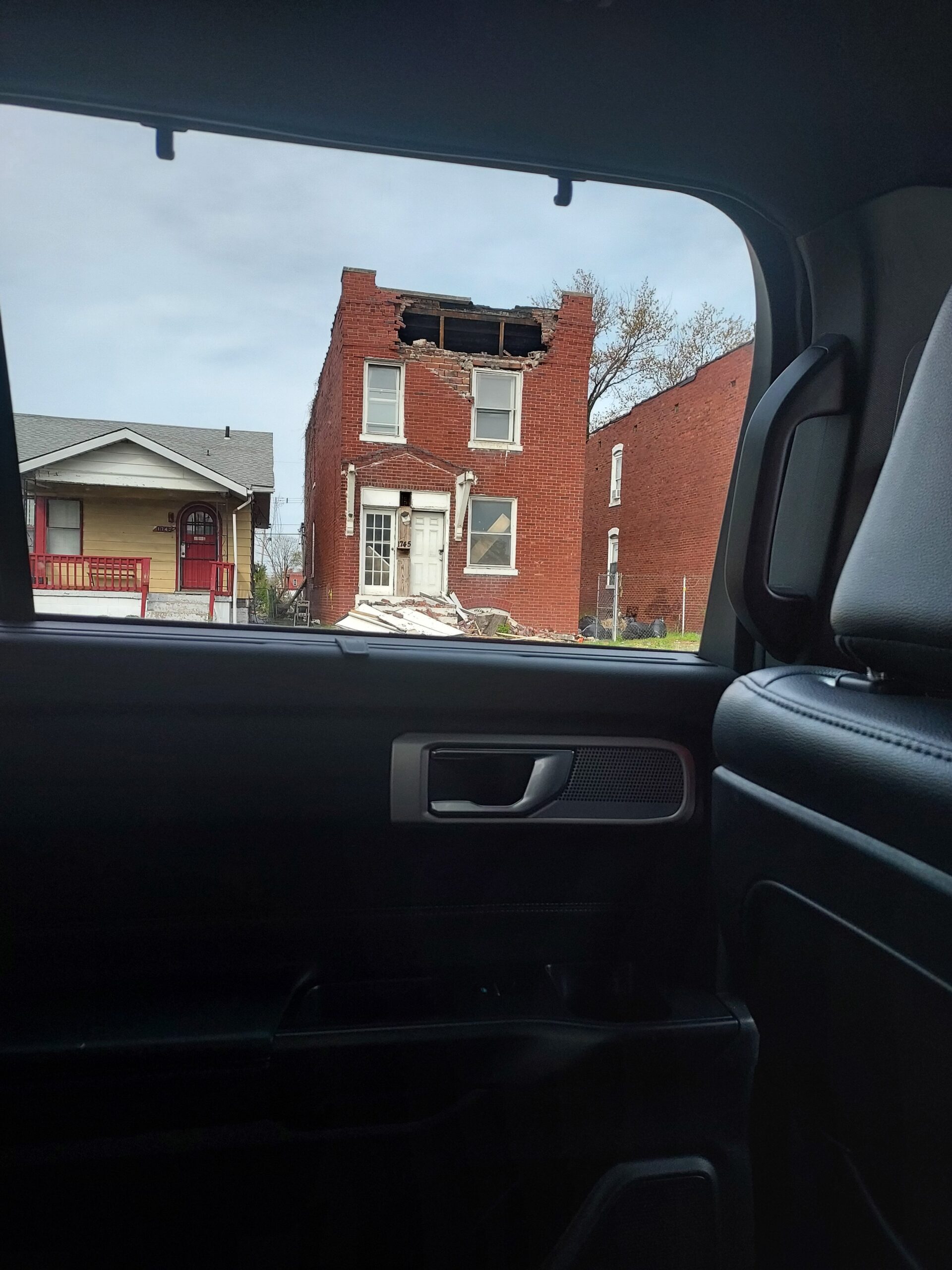
    Jazz musician ancestor Miles Davis grew up in the deep South…that is, southern Illinois. Nearby Davis’ boyhood home are stark images of ravaged homes such as this one I captured while riding in the back seat of a SUV.

    What are you capturing? Anywhere you are, I’m sure famous folk have walked those same streets. Research. Record. Reward your genealogy work.

    Somewhere in East St. Louis, IL. April 2022

  • FREEBIE FRIDAY!

    Join this listing, especially if you know the names of your families’ enslavers. Even if you are like us and have not confirmed those names, join the ones who have located this part of their legacies.

    https://beyondkin.org/enslaved-populations-research-directory/?s=09