Category: Library of Congress

  • Uncovering the Truth: The History of Indigenous Indians and the First Thanksgiving

    Uncovering the Truth: The History of Indigenous Indians and the First Thanksgiving

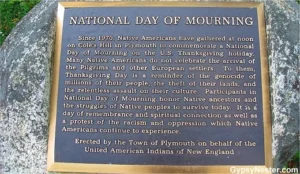
    While many of us are preparing “feasts” in honor of the U.S. Thanksgiving Day, many Native American communities will observe National Day of Mourning. On the same day as the U.S. Thanksgiving holiday, the protest is in recognition of the ongoing consequences of colonization, land dispossession, and cultural erasure.
    As we enter the holiday season, it’s important to look beyond the familiar Thanksgiving story many of us grew up with. The traditional tale of Pilgrims and Native people joyfully sharing a harvest feast leaves out the deeper, more complex history—especially the role of the Wampanoag Nation, the Indigenous people who lived in the region.

    National Day of Mourning
    Thanksgiving is National Day of Mourning among many Indigenous people

    When the Pilgrims arrived in 1620, they were unprepared for survival in a new environment. The Wampanoag, led by Ousamequin (Massasoit), taught them how to plant corn, fish, and live on the land—knowledge that likely saved the colonists’ lives (Plimoth Patuxet Museums). The 1621 harvest gathering that later became known as “The First Thanksgiving” was not a national holiday, but a brief diplomatic moment.

    However, the years that followed brought dramatic change. Colonists expanded onto Indigenous lands, trea

    Understanding this fuller history helps us challenge stereotypes, honor Indigenous resilience, and celebrate the holiday with greater truth and gratitude. For a deeper look at the real story, the National Museum of the American Indian offers an excellent overview.

    Wishing you a thoughtful and meaningful Thanksgiving.


  • Reclaiming Land, Reclaiming Legacy: Helping Descendants of Enslaved Families Build Historical Property Claims

    Reclaiming Land, Reclaiming Legacy: Helping Descendants of Enslaved Families Build Historical Property Claims

    Several years ago, I began my formal ancestral and genealogy journey with the intention that I would locate land and property that may have been lost by our family or worse, stolen during historical periods of social and economic upheaval. In other words, I wondered whether my family lost land and property before, during and post slavery. My question landed on whether anything lost could benefit my family today?

    The short answer is “yes.” I am not alone.

    Questions Answers Signage
    Lots of questions and few answers are                   connected to the property searches for                   descendants of formerly enslaved family               members.

    Reclaiming rights

    For generations, Black families have carried memories of land once farmed, homes once built, and dreams once held — even when the law, violence, and exclusion stripped them of the soil beneath their feet. Today, nationwide and in select global locations, descendants of enslaved people are reconnecting their threads of history with genealogical evidence of families’ rights. The big deal is the reclamation of land and the seeking of compensation for property lost through legal and social injustices.

    The renewed interest in this area is about dignity, legacy, and the restoration of generational wealth. This blog will begin a series around the topic of helping African Diasporan, Indigenous nations, and Free Blacks build historic property claims. For years, we’ve helped families locate their ancestors that includes matching geographical addresses, Census records, storytelling, and hundreds of other research avenues. Why? It not only is necessary to know one’s ancestors for mental, social, and informational purposes, the conformation of ancestral and genealogy records also is foundational for going to the next steps. That is, to seek historical property claims, pensions, and other potential financial linkages.

    Steps to Begin a Historical Property Claim Journey

    Good Genes Genealogy will lead families through the process to reclaim financial benefits. Here’s a sample of what we are seeking from families:

    ✅ 1. Interview Elders & Document Oral History

    • Names, locations, burial grounds

    • Nicknames, neighboring families, plantation links, freemen’s links

    • Stories of land loss or forced migration

    ✅ 2. Identify the Key Ancestors in Census & Vital Records

    • Start with the 1870 Census — the “gateway” document for formerly enslaved individuals

    ✅ 3. Research Land Ownership or Labor Placement

    • Search county courthouses, tax records, land deeds, and maps

    ✅ 4. Review Probate & Enslaver Records

    • Use varied government and personal records that linking enslaved ancestors to plantations and locations

    ✅ 5. Document Evidence of Loss or Displacement

    • Illegal takings or forced sale

    • Eminent domain cases

    • Racial violence or intimidation

    • Fraudulent legal proceedings

    • Loss of heirs’ property

    ✅ 6. Connect with Legal Advocates

    • Private attorney referrals, community legal services, land conservation groups, and reparations task forces can provide guidance

    ✅ 7. Build a Claim Packet*

    Organize:

    • Genealogy charts

    • Timeline of ownership & loss

    • Supporting documents

    • Maps and land descriptions

    • Witness testimonies/oral histories

    *Putting together this packet is the narrative foundation that allows for legal review or community restitution.

  • #29 The Great September U.S. Compromises (Part One)

    On September 18 and 20, 1850, history recorded two distinct “compromises” that impacted African American lives. Part One, we will look at what life became in the area now known as Washington, D.C., once Congress came together and compromised on legislation.

    The ‘give and take” of 1850

    The 20th of September marked the signing of a bill that affected an area now known as the District of Columbia: It abolished the slave trade. It was part of the U.S. package known as the Compromise of 1850. It was fashioned by Sen. Henry Clay, a 70+ legislator dubbed the “Great Pacificator” by his colleagues. His aim was to get Congressional members to ‘give and take’ in five different compromises, with one resulting in the freeing of slaves in the nation’s capital. Meanwhile, the fugitive slave law was strengthened nationwide.

    There were numerous congressional bills introduced in Congress in January 1850. By September, it was narrowed to five separate bills. Each bill was separately voted upon by Congress. Elimination of the slave trade in D.C. also included the welcoming of California as a free state in the U.S. and settling the border dispute between Mexico and Texas. It also gave the law enforcement authorities the right to capture slaves and suffer economic penalties if the slaves escaped while under the marshals and sheriffs’ jurisdictions. Eventually, this bill’s purpose would fall apart.

    The United States Congress abolished the slave trade in the District of Columbia on September 20, 1850, as part of the legislative package called the Compromise of 1850. Since the founding of the District of Columbia in 1800, enslaved people had lived and worked in the nation’s capital. By the mid-nineteenth century, laws regulating slavery in the district were considerably more lenient than slave codes in the South. Still, slavery continued to exist in Washington until April 16, 1862. President Lincoln signed legislation freeing the 3,000 African Americans bound by the District’s slave code on that day. (The Slavery Code of the District of Columbia… Washington: L. Towers, 1862. Slaves and the Courts, 1740 to 1860. Law Library)

    While Antebellum Washington was a thriving community for free Blacks, whereby 1860, they outnumbered the enslaved Blacks by four to one. The former slaves who could migrate to the District of Columbia did so. Meanwhile, former slaves who were granted their freedom by plantation owners were not given the flexibility to live their lives outside of the states approving the new status. It was home to a thriving community of free blacks.

    Certificate of Freedom of Harriet Bolling, Petersburg, Virginia, 1851. Free Blacks in the Antebellum Period. The African American Odyssey: A Quest for Full Citizenship. Carter G. Woodson Collection. Manuscript Division

    Harriet Bolling is an example of a Mulatto woman who was granted her freedom in Virginia by James Bolling. Yet, her freedom restricted her movements to the Commonwealth of Virginia, where she remained in Petersburg.

    “Free Southern blacks continued to live under the shadow of slavery, unable to travel or assemble as freely as those in the North. It was also more difficult for them to organize and sustain churches, schools, or fraternal orders such as the Masons,” according to the Library of Congress.

    Part Two: African American man is “first” to Compromise in the South

    The following blog will review another September “Compromise about noted educator Booker T. Washington’s classic address at an Atlanta convention in September 1895.

    In the next Good Genes Genealogy Services’ September 2021 e-book, read the combined Parts One and Two about the great “Compromises” impacting African Americans. Both occurred in September.

    Your assignment: The global community has been required to adhere to certain restrictions during the COVID-19 pandemic. How did you react when your everyday travel was restricted and asked to wear masks in public? How do you imagine the African American slaves responded to their lifetime restrictions?