Blog

  • My Memorial Day memories: Former slaves honoring the dead

    My Memorial Day memories: Former slaves honoring the dead

    I was among the few chosen ones.

    I don’t recall ‘sleeping in’ on Memorial Day as a child growing up in Omaha, Nebraska. I do not know how it happened that I was awakened early each Memorial Day Monday to accompany my maternal great-grandmother, Edna Robinson, and at least two other family members to the cemeteries. We arrived early to greet the morning dew upon the grassy knolls. Our task was to place fresh plants near the grave markers of our loved ones.

    I vividly recall Grandma Robinson’s words to me and others as she used her tender hands to dig out spaces to place each new plant in the ground. Even though my mother or cousin would bring along tools to help Grandma Robinson with her mini excavations, (the worms would always greet us and seek to find new, cool hiding spaces)she would turn them down.

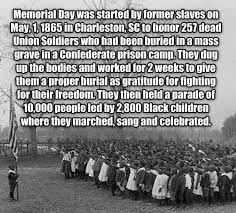
    Grandma Robinson believed in honoring our ancestors by using her hands or a nearby stick, if available, to tend to the soil. While busy in her planting, Grandma Robinson often recalled how former slaves started the tradition of Memorial Day as a way to pay tribute to the black soldiers returning home from the war.

    “They forgot about the colored soldiers,” Grandma Robinson always said without specifying the “who” in her recollections.

    But I figured out who she was speaking of as I read more and more about Memorial Day, yet did not see the historical references that I first heard from my grandmother.

    Grandma Robinson told me a lot more about the importance of remembering those who many forget upon their deaths. Through her example, Grandma Robinson taught me how to kneel upon the earth and dig into its richness. While in a kneeling position, we ALWAYS prayed in a quiet manner. She said prayers should be spoken in soft tones as we walk and work throughout the day. That was my first hint at how Grandma Robinson withstood the likely poor treatment while caring for other folks’ houses and children.

    Each year as we returned to the graves of our loved ones, I would look for the plants we plotted in the previous years. Some were completely wiped out by the winter’s snow or other seasonal heat. Some plants were either trampled on or somehow pushed into the dirt where only a tiny flower bud peeped from the ground. Once Grandma Robinson saw a glimmer of life in one of our previously planted vines, she would carefully dig around it and gird it up to continue its growth.

    We also did not leave a gravesite area without helping to pull back the grass overgrowth on graves with numbers engraved in cement to mark burial locations. That taught me to look out for my neighbors and honor them with the blessings that we had. Often, if we had a plant or two left over, Grandma Robinson would lead us to a burial site where someone she knew was placed beneath the earth. We always left the cemeteries with empty containers that once carried in the plants.

    Learning is loving and respecting and doing. I got it all in my annual visit to the Omaha cemeteries to honor our dead and the legacy of the holiday.

    Although I will not be in our maternal family’s home cemetery site in Springfield, Missouri to place a plant in the ground in honor of Grandma Robinson, I know that my family members will do so and thereby honor my grandmother and our ancestors.

    Photo: Dr. Rex-wordpress.com

    For more information about Memorial Day’s founding and its alternative observances by Confederate-loyal folk, see http://content.time.com/time/nation/article/0,8599,1900454,00.html
    And
    https://www.alternet.org/civil-liberties/untold-story-memorial-day-former-slaves-honoring-and-mourning-dead
    And more. Check out remembrances from your eldest family members.

    Ann L. Wead Kimbrough is an accomplished educator, award-winning financial journalist, author, special events leader, mentor and prolific contributor to select global and domestic non-profit causes. Her blog topics include travel, history, humor, education, career, family, journalism and ‘thought you should know’ subjects. https://www.linkedin.com/in/annlineve/

  • Pooling resources during Atlanta flight delays

    “Stuck” in Atlanta at busy Hartsfield-Jackson International Airport? Not to worry.

    My last lengthy flight delay occurred the Monday after Mother’s Day weekend. Thankfully, my airline notified me hours in advance of the postponement. I debated whether to extend my hotel reservation or swim my way through the delay. I chose the latter.

    Reduce the stress

    Jump in airport pools in Atlanta, Ga; Bangkok, Thailand; Detroit, Mich; Fort Worth. Texas; Munich, Germany; Orlando, Fla; Punta Cana, Dominican Republic; Qatar (western Asia); Singapore (southeast Asia); and Vancouver, Canada. Soon, JFK Airport will debut its rooftop pool in the TWA Flight Center.

    My tips:

    1. Always travel with your swimsuit or fork over $$$s for hotel-bought swimwear.

    2. Check whether hotel day rates are available at onsite or nearby airports if you rather nap instead of completing pool laps.

    3. Confirm the pool rules. My hotel at the Atlanta airport did not have a pool. Yet, my airport folio accompanied by a note by the front desk staff to the across-the-street hotel, yielded me a cool pool afternoon before boarding a flight that evening to chilly Chicago.

    Not a swimmer or want other entertainment or relaxation? Check with airports on your next destination just in case your flight is delayed. Up for shopping, videos, gyms and elaborate play areas? Get stuck in Chicago’s airports.

    Ann L. Wead Kimbrough is an accomplished educator, award-winning financial journalist, author, special events leader, mentor and prolific contributor to select global and domestic non-profit causes. Her blog topics include travel, history, humor, education, career, family, journalism and ‘thought you should know’ subjects. https://www.linkedin.com/in/annlineve/

  • Check out my other wordpress site

    https://wordpress.com/posts/annlineveweadkimbrough.blog


  • Riot Days of my Life: 3.4.1968 and 4.4.1968

    When I was 10 years old, my world as I knew it in Omaha, Nebraska, changed. Two riots and my ‘gentle giant’ Dad cruelly, physically battered by the police within a 30-day period that spring,  shook me wide awake.

    It was the year I decided that I would become a journalist. To get ready for my adult career choice, I reported and wrote stories that I believed presented the whole truth as I learned from listening to adults whom I admired.

    The first upheaval that touched my life began on March 4,  1968. Then American Party presidential candidate and segregationist George Wallace brought his racist campaign to Omaha. During and after his late night (started at 9 p.m.) speech at the Civic Auditorium, a race riot ensued. Majority market media reports focused more on the “unruly” protestors rather than Wallace’s baiting speech in Omaha.

    My Dad who made it a daily practice to eat dinner with his family, was not home for the meal that fateful evening.  My mother explained that he was peacefully protesting at the Wallace event. That was not unusual since both parents participated in many civil rights protests. Yet, this time, I felt something was wrong.

    My Dad arrived home early the next morning covered in his own dried blood. His left eye was bruised and sloped; his bloodied knuckles looked broken.  As I learned over the next several days, my Dad and a few other black men were forced into an empty room away from the rowdy Wallace speech site.  My Dad recalled how the white officers took off their badges and other IDs. They swung billy clubs that landed all over the men. If it were not for a well-known community activist arriving on the scene, my Dad believed he would have died that night.

    One month later, just after dinner, we learned that Dr. Martin Luther King, Jr. had been assassinated. A long period of rioting and looting and deadly clashes with the police dominated the newscasts and newspapers.  Noticeably, I did not see or hear news accounts that included or balanced the reporting. I learned of the different perspectives from the  mostly whispered conversations from the countless adults who visited our home.

    Yet, children can hear with their hearts and ears. While the adults would not share any details with my siblings and me, I heard enough to figure out that times in this Midwestern city would be perilous for an indefinite period. For those next days and weeks, I had the internal shivers. I was scared. I felt the police nor the media would protect us from hurt, harm and danger. For the first time in my young life, the racially divisive realities were real.

    In my youthful heart and mind, I had to do something to bring about change in this world in a non-violent and important way.  I started writing  about my confusion, anger, frustration and news stories in a journal. It is a practice I have kept up for 50 years.

    From a 10-year-old’s view, the world looked bleak and the only way for me to change it was to become a journalist. I kept my career choice a secret from my parents since journalists and the media were not in the favored category. My mother and father’s friends and family were critical of the news coverage.

    I often heard the phrase, “the pen is mightier than the sword.”  As a child who listened with a literal mind, I believed those words. I still do.

    I recalled the deeply impactful speeches of Dr. King and Malcolm X, who was born in Omaha with the surname “Little.”  Both leaders imposed a ton of ideas in my head and it allowed me to explore historical and contemporary documentation on activism.  It opened up my eyes and my world became clearer. My family stressed non-violent actions.

    Years later, I had the pleasure of meeting Martin Luther King III while we were college co-eds in the Atlanta University Center consortium of higher education institutions. I attended Clark College and he was a Morehouse College student. Remaining friends throughout the years since college, I appreciate Martin, his wife and his daughter (who spoke so eloquently during the March 24, 2018 youth march) for ‘walking the talk.’  The last time we talked, my son revealed to Martin that his son (and my grandson) Kingston was named in honor of Dr. Martin Luther King, Jr. “I wanted to name my son “King,” W. Earl Kimbrough said.

    earl and mlkiii fam

    At the end of the season of the tragic anniversary of Dr. King’s death, I salute the genius, courage and vision of Dr. King, his family and all in the ongoing civil rights movement.

    “Every man must decide whether he will walk in the light of creative altruism or in the darkness of destructive selfishness”  — Dr. Martin Luther King, Ph