Tag: Family Genealogy

  • Discovering Your Family’s Roots: Mastering the Art of Interviewing Relatives for Family Ancestry Stories

    Discovering Your Family’s Roots: Mastering the Art of Interviewing Relatives for Family Ancestry Stories

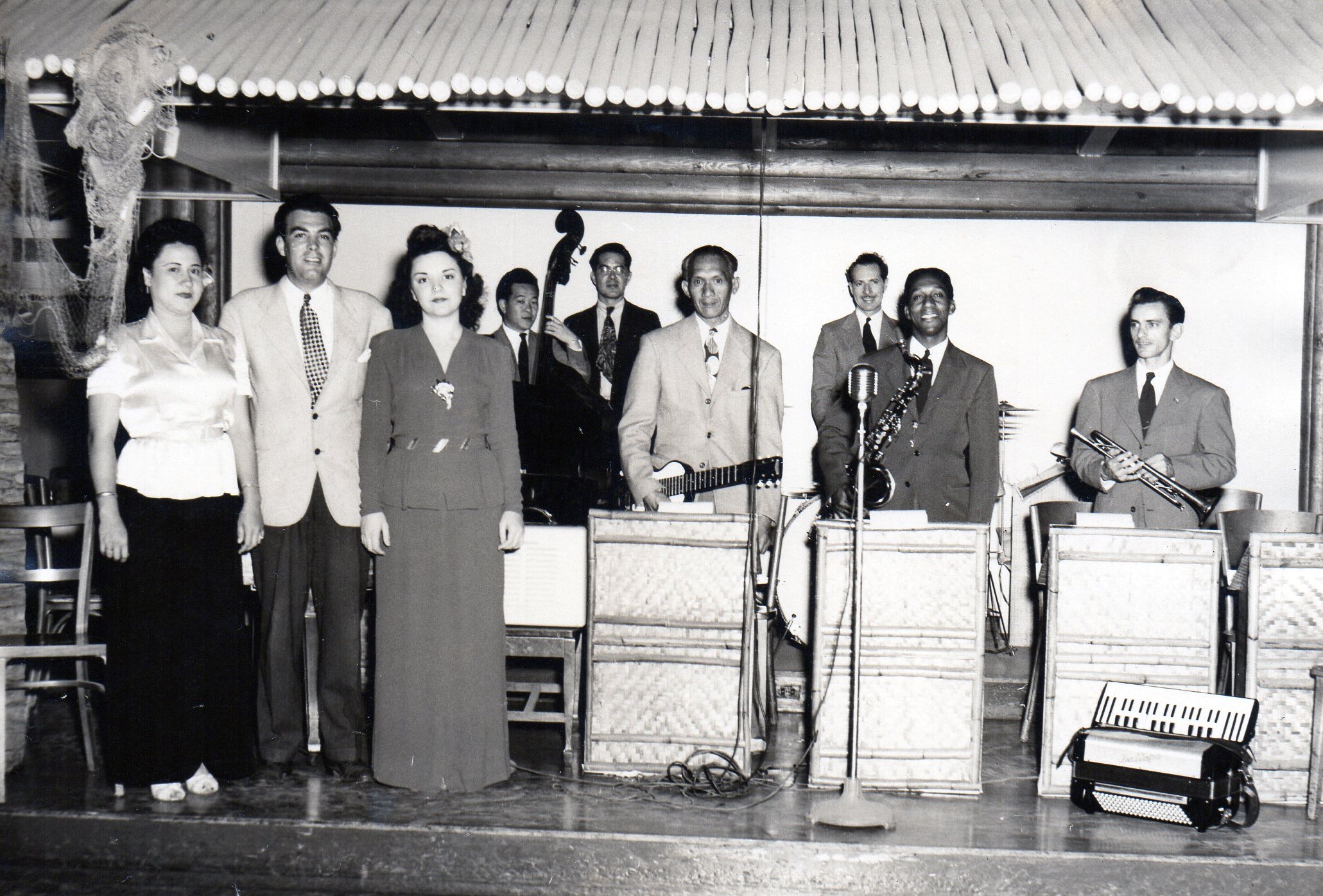
    Uncle Ernest Wilks
    Army Vet and Maternal Great Uncle Ernest Wilks (second right) and his band in Hawaii

    Gotta love the family stories!

    I’ve interviewed CEOs, community activists, a future U.S. Supreme Court justice, and lots of individuals who were skeptical of media members. It’s an art and a science to prepare for such sessions with individuals who are new acquaintances willing to share parts of their life stories to public audiences.

    Yet, no academic and OJT prepared me for asking personal questions of relatives to learn more about our family.

    “How did you and grandpa meet?” “What was it like to grow up in the Delta of Arkansas and witness the bloody riots in the early 1900s?” “Who are you named for?” “Did you really beat up a woman who knew your husband?” “Why didn’t you ever learn to drive?” “How did you celebrate Christmas when you were a child?”
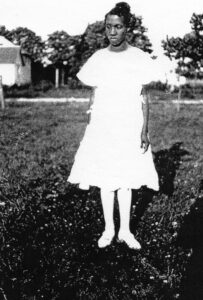
    Maternal great-grandmother Edna Wilks Robinson
    Maternal great-grandmother Edna Robinson

    Those are just a small sample of questions that I posed to my various family members. Their answers helped to connect the dots for me as I sought to uncover my family’s history. Like other African American families, our stories are mostly spotty and tough to easily put together. That’s why getting as much information from your relatives is imperative to completing your legacy findings.

    The art of the interviews

    The holidays and other special days are great times to listen to the conversations among family members. That’s the first tip: listen to what is being said and not said among your family member.

    Next, build upon the unanswered questions and ask questions. You may not get the answers you are seeking, yet you will get information, great stories, and usually surprises. Be as prepared as you able to be to receive unexpected surprise information. It helps if you can capture an audio recording. Some relatives, especially the older ones, are not as adverse to taped recordings as I once believed. They are actually the best ones to interview about family stories. Remember that great interviews are complimented by photographs. Take a lot of pictures that feature faces.

    Remember to be patient and expect to complete interviews over a span of time. It could be two days or even two years to gather the information you are seeking from family members.

    Pro tips

    • Prepare Thoughtful Questions
      Try to avoid the obvious awkward questions for starters.  Prepare open-ended questions to encourage storytelling. Ask about childhood memories, family traditions, and historical events they witnessed.
    • Find a Comfortable Setting
      Family stories often flow best in a relaxed environment.
    • You have to be a Great, Active Listener
      While you may have specific topics you want to cover, allow the conversation to naturally flow. Try to avoid interrupting unless necessary.
    • How to Handle Sensitive Topics
      Be mindful of how difficult, even painful that family experiences could be for your loved one. Acknowledge their feelings, respect their boundaries, and take a break.

    Preserving cultural and emotional history

    No matter what happens as you gather family stories, remember that you are recording precious history that perhaps no one will gather. You are preserving and documenting these stories, and thereby help your future generations.

    Contact me before or after you interview your relatives. Between my lived experiences and pro tips, I am here to help @weadwriteawayandgenealogy@gmail.com.
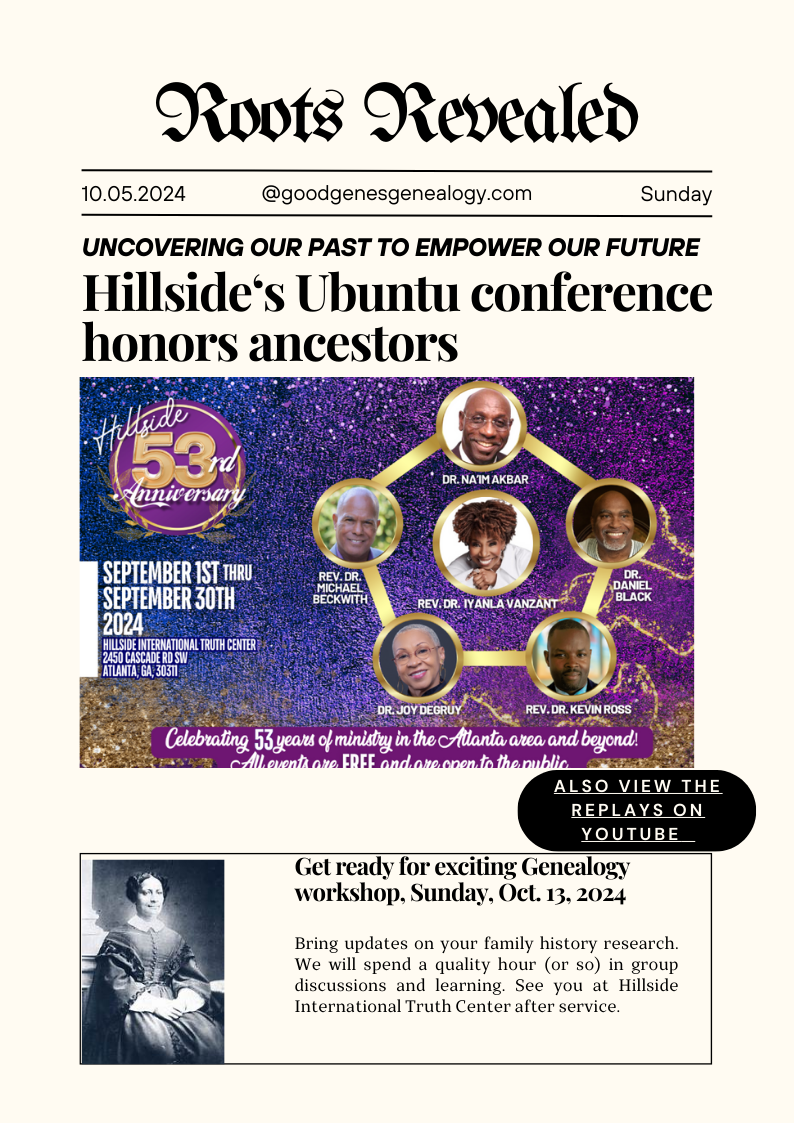
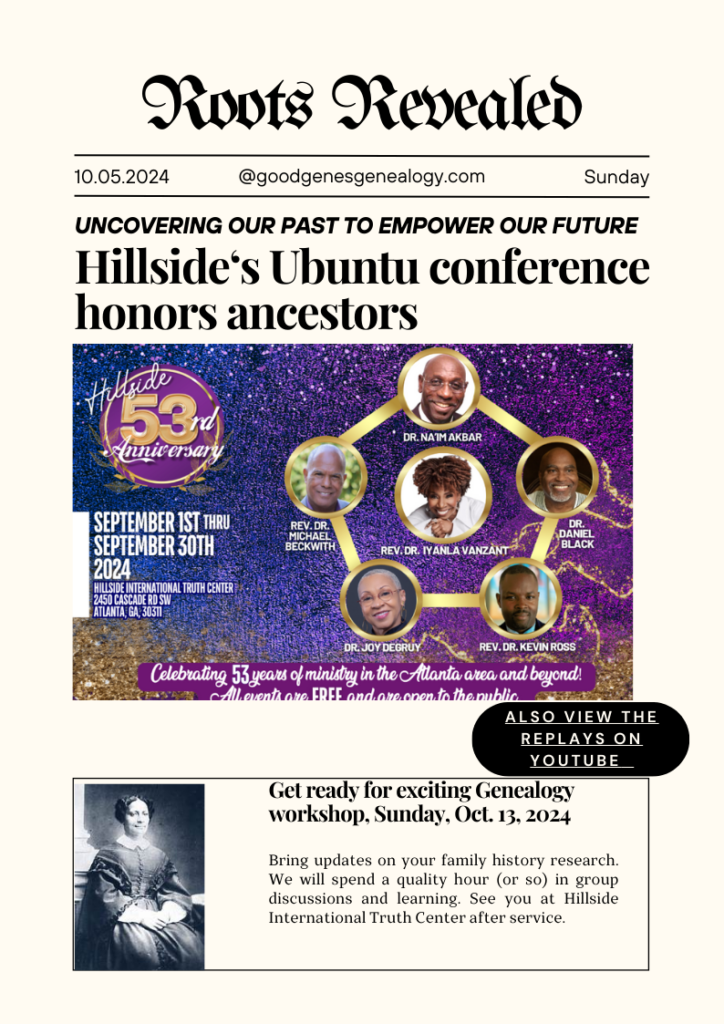


  • Getting ready for our in-person Genealogy Group workshop at Hillside International Truth Center, Atlanta, GA

    Getting ready for our in-person Genealogy Group workshop at Hillside International Truth Center, Atlanta, GA

    Prizes will be awarded to those who guess how many times the word “ancestor(s)” was spoken during the recent Ubuntu conference.

    Another free offering from Good Genes Genealogy Services via Dr. Ann Wead Kimbrough

  • How to begin your ancestry/family history research

    How to begin your ancestry/family history research

    My* mother, Angeline Cecil Owen, approximately one-year-old, with her parents, Helen Wilks Owen and Eugene Owen, Jr., in Springfield, Missouri (*Ann Wead Kimbrough)

    For many, the question of where to begin the hunt for their ancestors, is huge.

    Here are a few of the questions and comments the Good Genes Genealogy Services (GGGS) team receives from our prospective and new clients:

    I am adopted and I don’t know anything about my birth family.

    I don’t know my mother’s maiden name.

    I don’t know my Dad or his family.

    Since the U.S. Census doesn’t have any official records about Black people until 1870 and even that is incomplete, how am I supposed to trace my family back to their arrival in the United States?

    I started my family research but then I hit that “brick wall” and cannot move forward. I am ready to give up.

    I don’t know anything about my family past my maternal grandmother and my great grandfather on my father’s side.

    I heard that my entire family is buried in cemeteries in South Carolina and that’s where I’m from but I don’t know my family’s history.

    Photo by Bruno Scramgnon on Pexels.com

    For African Diasporan-connected family members, the quest to begin the ancestry search may appear to be even more daunting than our counterparts. Yet, we all had to begin somewhere. That’s our first tip:

    1. Begin where you are (see our March 20, 2023 post). Some begin with a picture like the one above. Just one photograph, in this case taken in 1938, is the start of the family tree building.
    2. Interview living relatives. Someone knows a nugget of a story that can lead to greater discovery. For instance, asking a family elder what s/he remembers about their childhood home, will likely lead to extended dialogue based on responses such as “uncle Jim used to bring home melons every Saturday after he cashed his check from working as a “soda jerk” in a hotel kitchen in Omaha.”
    3. Follow any lead and visit a federal government website for expansion of your findings. Using the hint provided in #2, you may be able to gain the once “lost” uncle’s name — even if it’s just the first name — and begin there. Use his first name and the family name in the online research tree search. If it doesn’t work, it is likely an online hint will arrive to give you more clarity. Also, knowing that the uncle worked as a “soda jerk” during your elder’s childhood, can lead you to the U.S. Department of Labor’s website. From there, you can research the number of soda jerks working in the 1940s, for instance. Also, you may be able to locate the exact hotel in Omaha with a lead from the federal site to the local, Omaha newspapers and historical societies.
    4. Sign up on social media sites, websites, and engage with other virtual or in-person groups to learn more about how others are conquering their ancestry research.
    5. Remember to write and record your results. This is the start of building your family tree and hopefully, other family members are doing the same. Be sure to link with those family members to make your family tree even more robust.
    Photo by cottonbro studio on Pexels.com

    Those are just a few tips offered to help anyone get started or re-energized to keep up the research for one’s family heritage.

    Everyone’s journey is different. Yet, there are similarities in our collective ancestry research efforts based on our listening skills, questioning of relatives, learning new techniques, and jumping in the swim of family research.

  • Floridians and nearby genealogy researchers: Meet up in Lake County

    This wonderful event is from the Wilson Griot Legacy site:

    WILSON GRIOT LEGACY

    The Wilson Griot Legacy is a modern enterprise to create new sacred storytelling to unravel information inherent in our genealogical past.

    RESEARCHING BLACK FAMILY HISTORY

    Posted byWILSON GRIOT LEGACYSeptember 9, 2023Posted inUncategorized

    I will be joining with the Kinseekers Genealogical Society of Lake County, Florida in conjunction with the Leesburg Public Library in a special event on Saturday, September 23, 2023.

    Both in-person and virtual event:

    Saturday, 23 September 2023

    9:45am – 3:30pm EST

    Informal meet ‘n greet at 9:30am EST.

    Event is free & open to all!!

    Advertisement

    Presented by Kinseekers Genealogical Society and the Leesburg Public Library.

    To attend virtually, register here. 

    To attend in-person, contact the Leesburg Public Library at 352.728.9790

    MORNING SESSION (9:45am – 12:15pm EST)

    –Welcome & Announcements

    – Researching Black Family History, 1900-1950: Essential Foundations: presented by Taneya Koonce

    –Context Matters: Researching World War Two Black Ancestors:presented by KB Barcomb

    LUNCH BREAK (12:15pm – 1:00pm EST)

    AFTERNOON SESSION (1:00pm – 3:00pm) 

    –  Colleges, Clubs, & Cotton Fields: Researching Black Women, 1900-1950:presented by Adrienne G. Whaley

    –  Open Round Table Discussion

  • Sad, yet necessary sources for African American ancestry researchers

    Sad, yet necessary sources for African American ancestry researchers

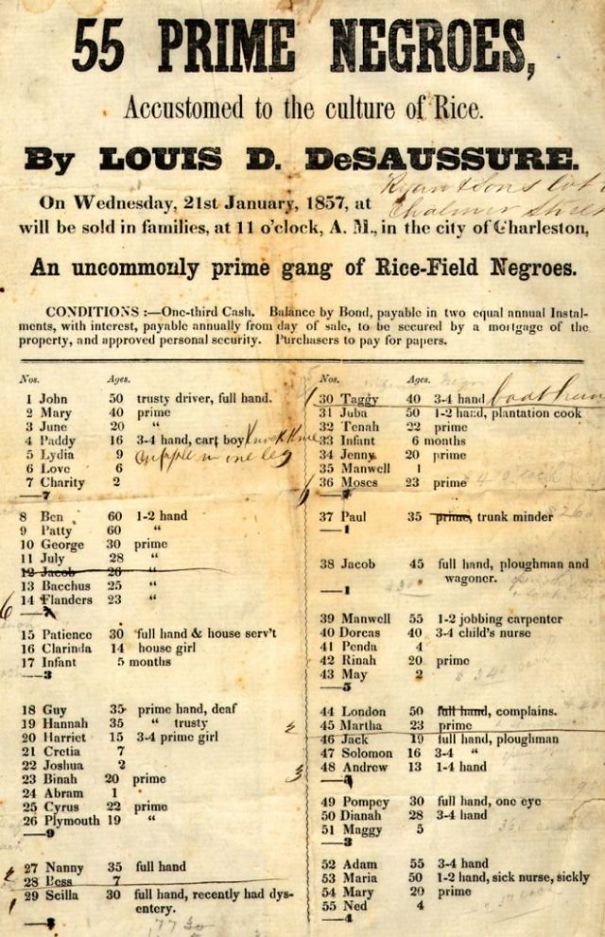
    The last place many African Diaspora ancestors want to research is through the study of slave sales. The writing and imagery are sadly powerful in the historical accounts of financial transactions and public spectacles involving slaves.

    Yet, the mostly oddly written newspaper advertisements and posters, often offer great clues to African American, Caribbean American, Native American and European Blacks’ genealogy and ancestry links.

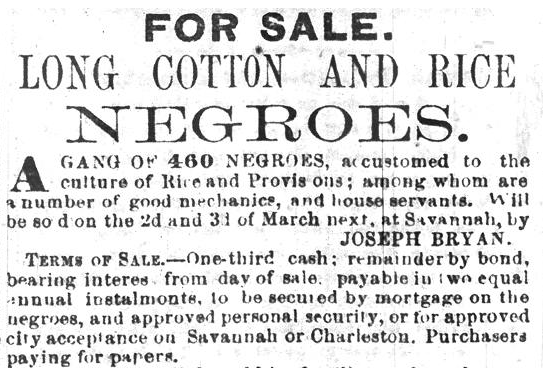
    The best clues to tear down the “brick wall” research are found in the names on the ads by the slave owners. Their imprints are often with first and surnames and identities of their family members who would benefit from the sale. The ad below that was posted in the Savannah, Georgia newspaper in 1859, brought more than $300,000 in revenue for Joseph Bryan, whose name appears in the ad. That’s equal to more than $9 million in today’s dollars.

    Also, the location of the sale helps to confirm the researchers are on the right track in identifying African Diaspora family members.

    An advertisement published in The Savannah Republican on Feb. 8, 1859, by the slave dealer Joseph Bryan for a two-day auction that became the largest in history. Four hundred thirty-six men, women and children were sold for $303,850, equivalent to about $9.4 million today.(https://www.nytimes.com/interactive/2020/02/12/magazine/1619-project-slave-auction-sites.html)

    The advertisements also include information that is helpful when comparing tax and estate records of enslavers and their sales agents. The ad below also includes a signature that is also important when ensuring the slave owners’ records including African Americans in bondage are accurately connected to genealogy documents.

    The ad was published in 1851. In today’s economic terms, the $1,200 to $1,250 is equivalent to approximately $50,000 in today’s monetary terms.


    In some instances — albeit rare — slave owners listed the first names and primary trade or unpaid work purposes of the African Americans they owned. This helps African American genealogy, history and ancestral researchers identify legacy relatives. In our genealogy research, typically the slaves’ surnames were those of their owners.

    This sale also indicates that the slaves would be sold in families. Sadly and happily, this was considered a huge benefit to the African American enslaved population.

  • We were asked to share this great news

    We were asked to share this great news

    ‘Reconstructing the Black Archive’ Aims to Create a More Complete Picture of History in South Carolina

    29 Jun 2023 9:22 AMAnonymous

    Twenty-four scholars from across the country will spend three weeks in South Carolina, learning how to teach and tell a more complete picture of American history, thanks to a grant from the National Endowment for the Humanities.

    “Reconstructing the Black Archive,” a summer institute run by Furman University and Clemson University, will send the scholars, most of whom teach undergraduate students, into churches, historical associations, museums and other sources to learn to recover missing, often intentionally buried, histories.

    “These are vibrant sources that tell a history lost to many earlier generations. It’s exciting and thrilling to behold,” said Gregg Hecimovich, Furman professor English, who directs the institute with Furman’s Kaniqua Robinson, assistant professor of anthropology, and Clemson’s Susanna Ashton and Rhondda Robinson Thomas, both professors in the Department of English.

    The scholars’ itinerary takes them to sources at Clemson University and the city itself, Columbia and Charleston where they’ll learn from a cast of expertsincluding archivists, literary critics, prize-winning authors, poets and historians, people who have forged the tools for reassembling the scattered shards of information that give a fuller picture of the past.

    You can read more in an article by Tina Underwood  published in the Furman web site at: https://tinyurl.com/hbxpt2ey.

  • In honor of our ancestral Mother’s Days

    In honor of our ancestral Mother’s Days


    In the words of our family’s maternal matriarch, the late Lou Edna Wilks Robinson, “every day is Mother’s Day.”

    Born in 1892 as the oldest daughter born in Springfield, Greene County, Missouri, to Melissa Catherine Gray and Robert Wilkes, our “Grandma Robinson” was the glue that kept our family together.

    We’ve often wondered how our ancestral mothers were able to accomplish so much in their lives. Except for Grandma Robinson’s birth to two children, including our maternal grandmother, Mary Helen Wilks Owen Douthy, most mothers ‘in her day’ bore several children. Midwives brought babies, especially those of African American heritage, into this world. Indoor plumbing was nonexistent for our ancestral mothers. They grew food, drew well from waters, cooked, cleaned and managed the households. They raised other people’s children, they were our teachers, loyal church members and builders of great legacies admist the harsh societal conditions that often pushed our ancestral mothers to the least known positions.

    Yet, our ancestral mothers rarely complained about their fates. Instead, they often rejoiced about the present and future that always included the achievements — known and unknown — of their children and lineage.

    We honor you, ancestral mothers.

    Official start of Mother’s Day in the USA

    In 1914, a few years before the birth of our maternal Grandmother Mary Helen, the nation received an official declaration from U.S. President Woodrow Wilson, to honor mothers on the second Sunday in May. The recognition began simple enough: To honor mothers in celebration of peace.

    The origins of Mother’s Day as celebrated in the United States date back to the 19th century. In the years before the Civil War, Ann Reeves Jarvis of West Virginia helped start “Mothers’ Day Work Clubs” to teach local women how to properly care for their children.

    These clubs later became a unifying force in a region of the country still divided over the Civil War. In 1868 Jarvis organized “Mothers’ Friendship Day,” at which mothers gathered with former Union and Confederate soldiers to promote reconciliation.

    Another precursor to Mother’s Day came from the abolitionist and suffragette Julia Ward Howe. In 1870 Howe wrote the “Mother’s Day Proclamation,” a call to action that asked mothers to unite in promoting world peace. In 1873 Howe campaigned for a “Mother’s Peace Day” to be celebrated every June 2.

    Other early Mother’s Day pioneers include Juliet Calhoun Blakely, a temperance activist who inspired a local Mother’s Day in Albion, Michigan, in the 1870s. The duo of Mary Towles Sasseen and Frank Hering, meanwhile, both worked to organize a Mothers’ Day in the late 19th and early 20th centuries. Some have even called Hering “the father of Mothers’ Day.”

    https://www.history.com/topics/holidays/mothers-day

    A few current-day Mother’s Day facts

    • The honoring of mothers has reached a feverish commercial pitch with an estimated $36 billion being allocated in U.S. receipts in 2023.
    • There are approximately 43.5 million women who are considered mothers in the United States.
    • More than 100 global countries celebrate their mothers on various days on the calendar.
    • The white carnation is the official flower of Mother’s Day.
    • Mother’s Day is the busiest day for restaurants in the U.S.

    Happy Mother’s Day.


  • It’s global DNA Day! April 25, 2023

    Free workshops, webinars and other sources of information are offered. We’ve listed several activities.


    It’s official name is Deoxyribonucleic acid and that is why it is shortened to DNA to describe “a self-replicating material that is present in nearly all living organisms as the main constituent of chromosomes. It is the carrier of genetic information.”

    Genealogists often refer to DNA as putting the “gene” back in genealogy. The Good Genes Genealogy team (Maternal first cousins Mark Owen and Ann Wead Kimbrough) is DNA tested. We are not scientists who can provide you with the details on how the genetic makeup is key to breaking through brick walls and other delays in tracking our family histories. Yet, we’ve utilized DNA in our processes that have helped to build about family members.

    Today and this week, we invite you to learn about DNA and its applications to genealogy searches. There are countless free workshops and other sources of information. As you get inside of the virtual and in-person sessions, remember a few key things about the DNA journey:

  • Genealogy Find: Original Beat Box(es)

    Check out the oriiginal human beat box group. Their vocal moves are amazing.

    One of the benefits of researching our ancestors is the “find.” In this case, find is pure gold through the super talented siblings who set the human “beat box” standards. They are the Mills Brothers.

    While combing through the online ancestry files of the Good Genes Genealogy Services’ grandfather, Eugene Owen, Jr., this remembrance was round. Our grandfather left Omaha, Nebraska for Los Angeles, Calif. to pursue his dream of becoming a Mills Brother-like entertainer. It was the 1940s and he left a family behind in Omaha, including little girls who would grow up and become our mothers of Good Genes Genealogy Services team members.

    Our grandfather’s goal was to form a singing group become as popular as the Mills Brothers, a musical team of siblings whose 40+ years of success began in the 1930s. Our grandfather never achieved the same fame. He likely broke the hearts of our grandmother, “Mama” Helen Wilkes Owen Douthy, and her children and other family members. There are joys and pains in researching our families’ histories and this is an example of wading through all of the materials to get to the truth.

    Yet, each time we hear the Mills Brothers’ recordings and watch the more than 20 movies that they appeared in during their stellar career, we think of Grandpa Owen.

  • “Colored” farmer finds gold worth $604,000+ today

    Colored farmer find $16,000 buried in land in 1897 

    Today, its valued at $604,429.88. 


    Always keep searching for your ancestors and their stories. Here’s one about someone’s “colored” ancestor, D.H. Johnson, who was farming in February 1897. He hit hard ground while plowing a field near Hogansville, GA. He kept removing the layers of stone until he located what was estimated to be $16,000 in coins, including some from foreign soil.

    Today, that would amount to approximately $600,000 according to government calculations. (See above for new estimate). According to this newspaper clipping, Johnson placed the money in the bank. “…the theory is that whoever owned the money hid it out until some secure time, when they would look for it again” the article reported

    Updated takeaways for African American genealogy and ancestry researchers

    1. Don’t ignore your instincts, family talk over the years, and other signs that may lead you to a patch of land on the family farm. You may find ‘gold in dem hills.’
    2. Check out other governmental and non-governmental sites to search and hopefully find links to your ancestors’ financial assets. Check the Freedmen’s Bank, wills, probates, land records, employment records (look for pension information), taxes and church records. 
    3. Go for it. See #1 in this listing and trust your gut on where to begin your search for financial tracks to your ancestors. If that doesn’t work, contact us at @goodgenesgenealogyservices.com to get you going in the right direction.