

What if one tiny detail on a faded World War II draft card could unravel an entire story about your ancestor’s daily life, workplace, community, and economic reality?
That’s exactly what happened when I discovered one unexpected line on my cousin Herley Bedell Jr.’s registration card.
How many times have family researchers of African Diasporan and Indigenous descent wondered what our ancestors truly experienced? I often find myself imagining their daily lives and asking questions such as:
-
How did they survive the brutal Midwestern winters without central heating or the comforts we take for granted today?
-
What was it like to participate in a church service in 1918, in the midst of a world war and a pandemic?
-
Where did they work beyond farms, domestic labor, or the physical jobs typically assigned to African Americans and Indigenous people of the era?
The good news is that many of these questions can be answered—or at least illuminated—by learning to “read between the lines” of the documents, photographs, and artifacts our ancestors left behind. One such example comes from that small but powerful clue found on Herley Bedell Jr.’s draft card.
A Draft Card Opens a Doorway Into 1940s Life
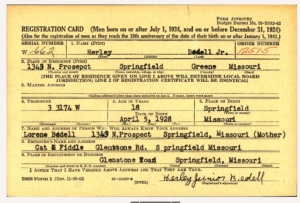
Herley Bedell, Jr. ‘s draft card____
Cousin Herley’s card revealed that he worked at The Cat & Fiddle Restaurant in Springfield, Missouri. His mother, Lorene Wilks, was the sister of my great-grandmother, Edna Wilks Robinson, making Herley my great-aunt’s son.
With that one detail—his workplace—an entire exploration began.
I first used Google to look up the Cat & Fiddle in Springfield around 1942, an approximate year when Herley may have worked as a busboy or possibly a waiter. I then searched social media for a possible Cat & Fiddle affinity group. Although none existed, I stumbled upon something unexpected: a modern entrepreneur selling t-shirts with logos of former Springfield landmarks—including The Cat & Fiddle.
Full disclosure: I proudly purchased a Cat & Fiddle t-shirt in honor of Herley.
Following Digital Footprints to Local History
My search led me to the Facebook group “Springfield, Missouri History, Landmarks & Vintage Photography,” moderated by historian Richard Crabtree. In one detailed post, the group featured the Cat & Fiddle, including:
-
A photograph of the restaurant
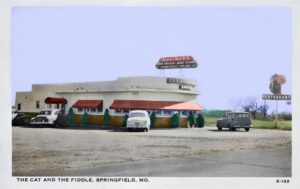
Springfield, Missouri’s Cat & Fiddle Restaurant and Bar
-
An advertisement
-
The whimsical logo of a cat playing the fiddle
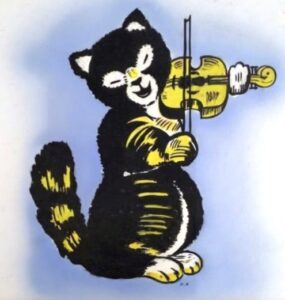
Springfield, Missouri Cat & Fiddle Restaurant Logo
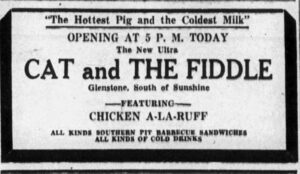
Newspaper ad for Cat and the Fiddle in Springfield, Missouri
Beyond the images, the comments from Springfield residents—current and former—offered lived memories that help reconstruct what the community felt like during Herley’s time.
Reconstructing Wages and Daily Reality
Although not mentioned directly in the post, my additional research revealed that Black workers in Missouri during the 1940s often earned about 50 cents per hour—sometimes less, depending on discriminatory practices. According to the University of Missouri Library’s labor research archives, fifty cents in 1940 is equivalent to roughly $5.51 in early-2000s dollars.
This small detail helps us understand not only Herley’s work environment but also the economic conditions shaping his daily life.
Expanding the Search: Historical Societies & Artifact Sites
One fact—the name of an employer—can open many doors. In Springfield alone, several resources help piece together family histories:
For artifacts, postcards, and memorabilia, I consulted:
-
WorthPoint, an online database of antiques and collectibles
-
A royalty-free image site offering a vintage Cat & Fiddle postcard for $12
These items, once tucked away in someone’s attic, now help fill in historical gaps.
Building Your Ancestor’s Story With Curiosity
This journey is a testament to what one small detail can reveal. A single draft card led me to a restaurant logo, wage estimates, community recollections, historical societies, and vintage artifacts—all of which help paint a fuller picture of Herley Bedell Jr.’s world.
As family researchers, our task is to use curiosity and creativity to pull these threads together. Documents may give facts, but it is our interpretation, imagination, and follow-up research that transform those facts into ancestral stories worth telling.
