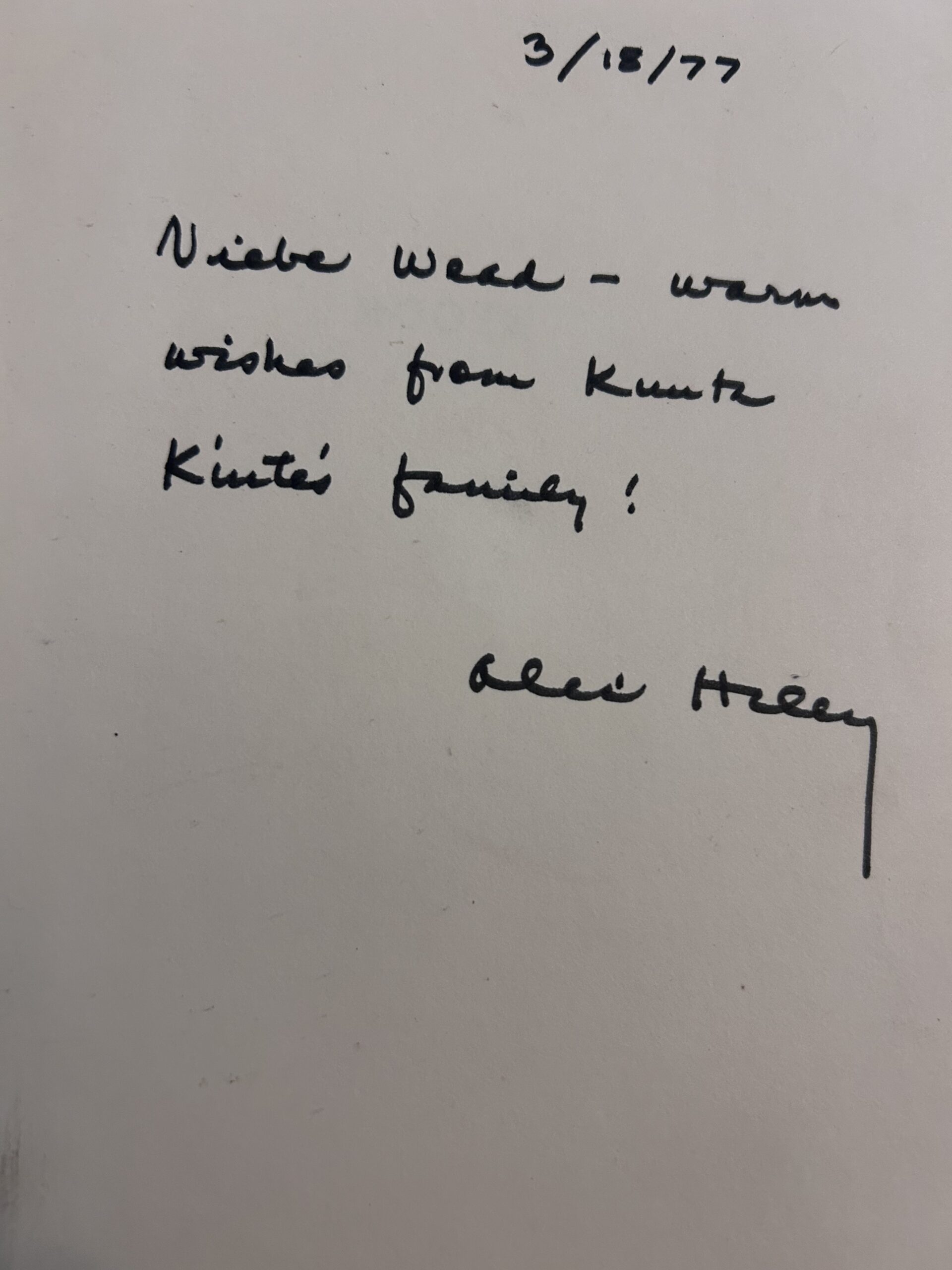
It was pure serendipity. In 1977, while I was a sophomore at Clark College (now Clark Atlanta University) in Atlanta, I obtained a cherished autograph from a U.S. Coast Guard veteran turned legendary journalist and author: Alex Haley, the man who penned Roots: The Saga of an American Family.
Handwritten note from Alex Haley to Nieve Wead
My middle name, Lineve, was shortened into the nickname “Nieve,” which is how Haley addressed me in his note. Just a month after our encounter, he received a Pulitzer Prize, earning a special citation for Roots as “the story of a Black family from its origins in Africa through seven generations to the present day in America.”


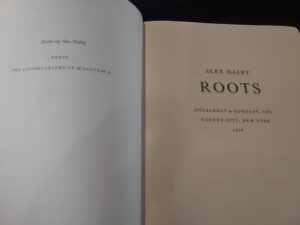
The Phenomenon of Roots
Today, there are few people who haven’t heard of, read, or watched Haley’s deeply moving masterpiece. Released in 1976, Roots spent a staggering 46 weeks on the New York Times Bestseller list.
The novel chronicled the life of Kunta Kinte, an 18th-century Mandinka man captured in his West African homeland and trafficked to North America. From there, it took readers through the painful, violent, yet remarkably resilient lives of Kunta Kinte’s descendants in the United States. What made the book so revolutionary at the time was the revelation that these descendants included Haley himself.
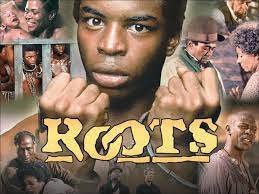
Haley was a prolific researcher and writer. His massive literary success didn’t stop with the original book and its groundbreaking initial television adaptation with the Roots Miniseries that aired in January 1977. For eight consecutive nights in my dormitory, Merner Hall, on Clark College’s campus, we were tuned into the impactful video story of our new champion family. I recall how I vowed to follow Alex Haley’s path in locating my long-lost family in Africa and other places around the world. The final chapters of his story were later adapted into the 1979 TV miniseries, Roots: The Next Generations.
Inspiration Amid Controversy
Like thousands of people around the world, I was instantly inspired to research my own African American genealogy. However, the book’s massive success also brought intense scrutiny. A highly regarded historian challenged Haley’s findings, claiming he could not have located the exact village where Kunta Kinte was born. In response to the widespread criticism, Haley gracefully defended his work by reminding the public that he had written a “factional” or “historical novel”—a blend of deep historical research and narrative storytelling.
Looking back, the lessons I learned from that moment as a college student were numerous:
- Respect the Grind: Always respect and give credence to the grueling, lengthy work of genealogical researchers, writers, and producers.
- Trust, but Verify: This is always the order of the day for genealogists, especially those of us engaged in African Diaspora research.
- Context Matters: The timing of Roots was incredibly noteworthy, arriving just as Jimmy Carter was inaugurated as U.S. President in January 1977, a time of profound national reflection.
- Endless Stories: There are millions of stories waiting to be uncovered that allow us to accurately piece together our African Diaspora ancestry.
My 30-Year Nudge
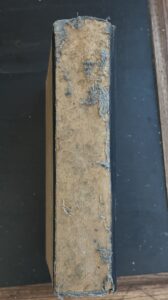
Pictured below is my original copy of Roots. As you can see, I simply wore it out from reading and re-reading it so many times.
While Alex Haley gave me the inspiration to vigorously research my family’s roots back in 1976, it ultimately took me 30 years to act on that great nudge. Today, I can proudly boast several hundred newly discovered family members on our family tree. My family tree now stretches back 13 generations across both my maternal and paternal sides, tracing our lines through Switzerland, Africa, Ireland, Germany, Missouri, Mississippi, Georgia, Virginia, North Carolina, and beyond.
The journey takes time—but the reward is looking history right in the face.