
One of my favorite places to search for African Diaspora ancestry is the U.S., African American Newspapers, 1829 – 1947 collection. It is one of the few research sources where I willingly become distracted.
I often begin with a specific objective—a person, a family, or another subject that needs solving. Yet often I find myself reading entire newspaper pages. The articles, advertisements, editorials, and community announcements provide a rich understanding of the times in which our ancestors lived.
Sometimes the most valuable discoveries have nothing to do with the individual I originally set out to find.
A Unique “Census” for Black Folk
The African American newspaper collection serves as a critical research center for locating information about African Diaspora relatives who can otherwise be difficult to trace through traditional records. More importantly, these newspapers reveal how Black individuals and communities lived, worked, worshipped, celebrated, and persevered during some of the most challenging periods in American history.
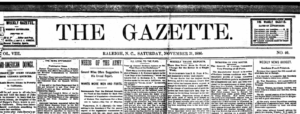
While researching the life of Rev. LeGrand Lee “L.L.” Thomas (born September 1865 in Bishopville, South Carolina, and died April 13, 1917, in Manning, South Carolina), I encountered several fascinating articles in The Gazette on Nov. 21, 1896.
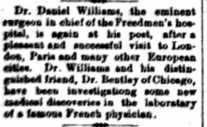
One brief article reported that pioneering physician Dr. Daniel Hale Williams was traveling to Europe with another Black physician to study medical advancements.
In just a few lines, I learned two important facts. First, Dr. Williams was serving as chief of Freedmen’s Hospital (now Howard University Hospital) . Second, he was traveling internationally in pursuit of medical knowledge and professional development. Those details transformed him from a historical name into a living; ambitious professional engaged with the wider world.
Other articles in the same issue contained a complete listing of Black attendees at a “Colored State Fair” near Raleigh, North Carolina. To a genealogist, such a list can function almost like a community census, documenting individuals who may not appear elsewhere in records of the era.
Then another article captured my attention.
“Col. A.B. Andrews Thinks Well of the Colored Race”
The headline alone was enough to stop me.
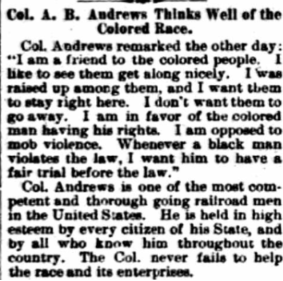
The article was not an advertisement. Instead, it appeared among reports about the Colored State Fair and other community news. Naturally, I wondered why a former Confederate colonel would feel compelled to publicly express such sentiments in a Black newspaper.
Researching Col. A.B. Andrews did not fully answer my question, but I did learn that he:
- Served as a Confederate cavalry officer;
- Worked as a railroad executive;
- Was trained as an engineer before the Civil War;
- Saw active battlefield service; and
- Contributed significantly to North Carolina’s transportation network after the war.
Although his motivations remain unclear, the article offered a fascinating glimpse into the complex racial and social dynamics of the late nineteenth century.
Why the Black Press Matters
Beginning with the founding of Freedom’s Journal in 1827, hundreds of Black newspapers chronicled the lives, aspirations, achievements, migrations, and struggles of African Americans.
| Period | Approximate Number |
|---|---|
| Before the Civil War (1827–1861) | About 30 Black newspapers were established. (OUPblog) |
| By 1880 | About 30 Black newspapers were operating nationally. (The New Yorker) |
| By the start of World War I (1914–1917) | Around 300 Black newspapers were being published. (The New Yorker) |
| Entire history of the Black press | More than 3,000 African American newspapers, magazines, and presses have existed since 1827. (Encyclopedia) |
For family historians and professional genealogists, these newspapers preserve stories and personal details that often cannot be found elsewhere. I grew up in Omaha, Nebraska and Chicago, Illinois. I was fortunate that the weekly Omaha Star newspaper was my anchor as a young person who longed to read news about Black people in my community and around the world. The same was true of the Chicago Defender newspaper, an iconic brand in the African American newspaper sector. I am fortunate to brag that I have published articles in both of these historic, dynamic papers that well-serve and served our communities.
By the beginning of World War I, approximately 300 Black newspapers were being published throughout the United States. Over the course of U.S. history, more than 3,000 Black newspapers, magazines, and presses have existed.
These sacred publications documented:
- Births and deaths;
- Athletic feats;
- Marriages and anniversaries;
- Church activities;
- School achievements;
- Business ventures;
- Military service;
- Social events;
- Community leadership; and
- Migration patterns.
For many African American families, Black newspapers preserve the only surviving evidence that an ancestor lived, worked, worshipped, or contributed to a community.
A Funny Thing Happened on the Way to the Search
I eventually located the information I sought regarding Rev. Thomas’s wife. However, the search produced much more than I expected.
Because Rev. Thomas was a well-known minister in the Raleigh community, the newspaper references extended far beyond him. The searches revealed family members, church activities, community events, and social networks connected to his life.
Once again, the lesson was clear. Sometimes we search for one person and discover an entire community.
That is the beauty of African Diaspora genealogy research. The records do not simply tell us where our ancestors lived. They tell us how they lived. Occasionally, we are introduced to people and stories we never expected to find.
zza
