
Guilty for ‘walking while Black’
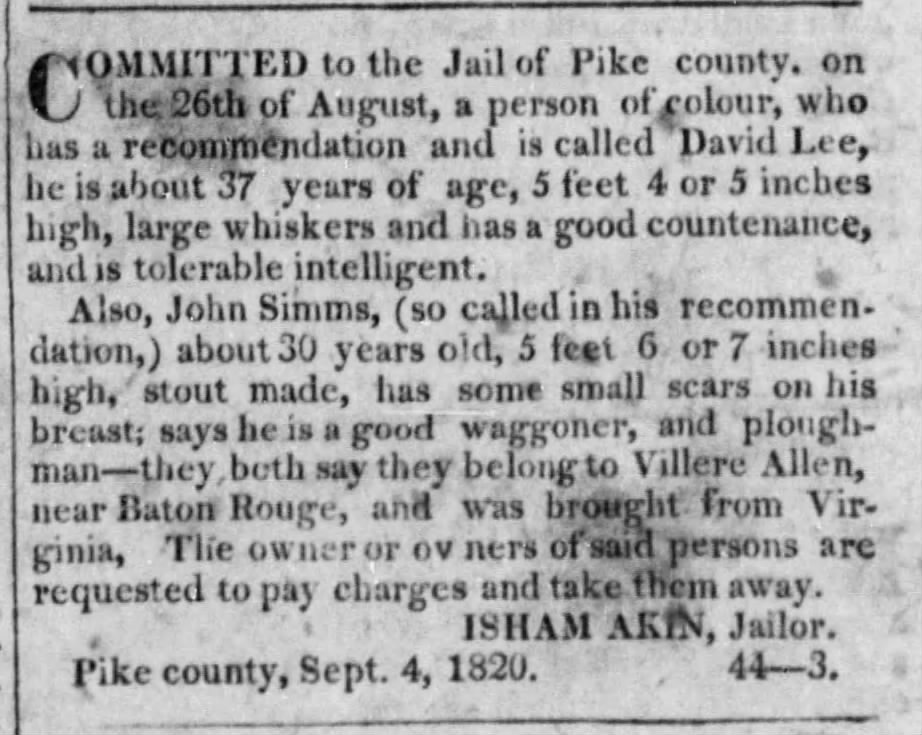
That’s what happened to my paternal ancestor, David Lee, in 1820. He could have lost his life. He could have been severely hurt. Instead, he was jailed despite having all of his “papers” in order.
It was published in the Mississippi Free Trader newspaper on September 19, 1820.
David Lee had sufficient documentation to prove he was allowed to walk along the Mississippi pathway. The wording in the newspaper ad gave me the clue that the authorities questioned his paperwork: “…has a recommendation and is called David Lee…” In the early 1800s, the written pass, travel permit, or some type of certificate had to be shown to identify the enslaved.
I discovered this newspaper article while researching my paternal family’s history. Such notices were often placed in Southern newspapers. The hard-to-read print summarizes the plight of my paternal third great-grandfather, David Lee. Here’s the summary of the translation:
- David Lee was born about 1783, which made him 37 years old at the time of his detainment.
- He was 5’4″ to 5’5″ with large facial whiskers and his overall appearance was described as “good countenance.” Translated: He looked respectable in their terms, and not criminal-looking.
- He was in Pike County, Mississippi during August–September 1820.
- He was traveling with John Simms.
- He/they were associated with an enslaver identified as Villere Allen near Baton Rouge.
- Lee was brought from Virginia, suggesting an interstate sale or forced migration.
- He was described physically in unusual detail, which helps to distinguish him from other men named David Lee in records.
How Family Researchers and Genealogists Connect the Dots
It is very challenging to locate and link African Diaspora ancestors to our family trees. For our research, this single advertisement provides confirmation on my ancestor’s connection in our family as I compared his information and timeline to his marriage of another relative.
There were other valuable leads:
- “They say they belong to Villere Allen…” who lived near Baton Rouge.
-
- The jailer believed the two men were traveling together.
- “… was brought from Virginia.”
This last clue is huge because it places my ancestor, David Lee, within the massive forced migration known as the Second Middle Passage. That is when hundreds of enslaved people were sold from the Upper South (especially Maryland and Virginia) to the Deep South after the invention of the cotton gin.
