
Ninety-degree heat. Forty-eight-degree cold.
That was the reality of my journey from Accra, Ghana, to Amsterdam, the Netherlands.
What Do You Pack for Research Across Two Continents?
One day, I was standing under the warm West African sun in temperatures reaching 32°C (90°F). Just six hours later, I stepped off a plane into Amsterdam’s chilly spring air of 9°C (48°F), arriving at the start of the country’s largest national celebration—King’s Day.
As I prepared for this international journey from the United States, packing became more than deciding what clothes to wear. I thought of the two continents, multiple climates, different cultural norms, and my optimistic research agenda centered on the African Diaspora and the history of the Trans-Atlantic Slave Trade.
My international travel goals were straightforward:
- Actively participate in mission work with my church colleagues that focused on delivery of our donated goods and service at an orphanage, school, and village in Ghana.
- Conduct historical and genealogical research related to the African Diaspora and the Trans-Atlantic Slave Trade.
- Experience the people, culture, and history of each destination with a focus on safety and being respectful of local customs.
My so-called challenge was to fit everything needed for ministry, research, tourism, and everyday life into a manageable number of two checked and two carry on bags.
What follows are the lessons I learned—and the items I am glad I packed.
Pack Like a Researcher
Since 2010 when I first visited Rwanda, Africa as part of my doctoral studies, I learned that research travel requires a different mindset than vacation travel. Whether visiting archives, museums, cemeteries, historical sites, or cultural sites like the botanical gardens in Ghana, researchers need tools that allow us to capture information quickly and accurately.
My research essentials:
- Smartphone with extra storage and internet access
- Energy converters for plugs and other gadgets
- Portable chargers
- Large and small/thin notebooks and pens
- Small cross-body bag
- Digital copies of my passport and travel documents
- Archive contact information and copies of permission documents to conduct research (know the protocols)
- Cloud storage access for photos and notes
- Activate the Whatsapp feature for telephonic and texting communication
- Monies budgeted for copying, scanning, and other document preservation
My two days of research in Ghana at Public Records and Archives Administration Department (PRAAD) generated hundreds of photographs, documents, and observations. I reserved some and had many scanned by the PRAAD team and delivered to me via my Whatsapp because the documents were not deliverable through my email. In Amsterdam, the celebration of King’s Day precluded me from conducting research at its libraries that stored the historical records I was seeking. However, I was able to gather sufficient visual content related to the Trans-Atlantic Slave Trade. A future writing will delve into this with more detail.
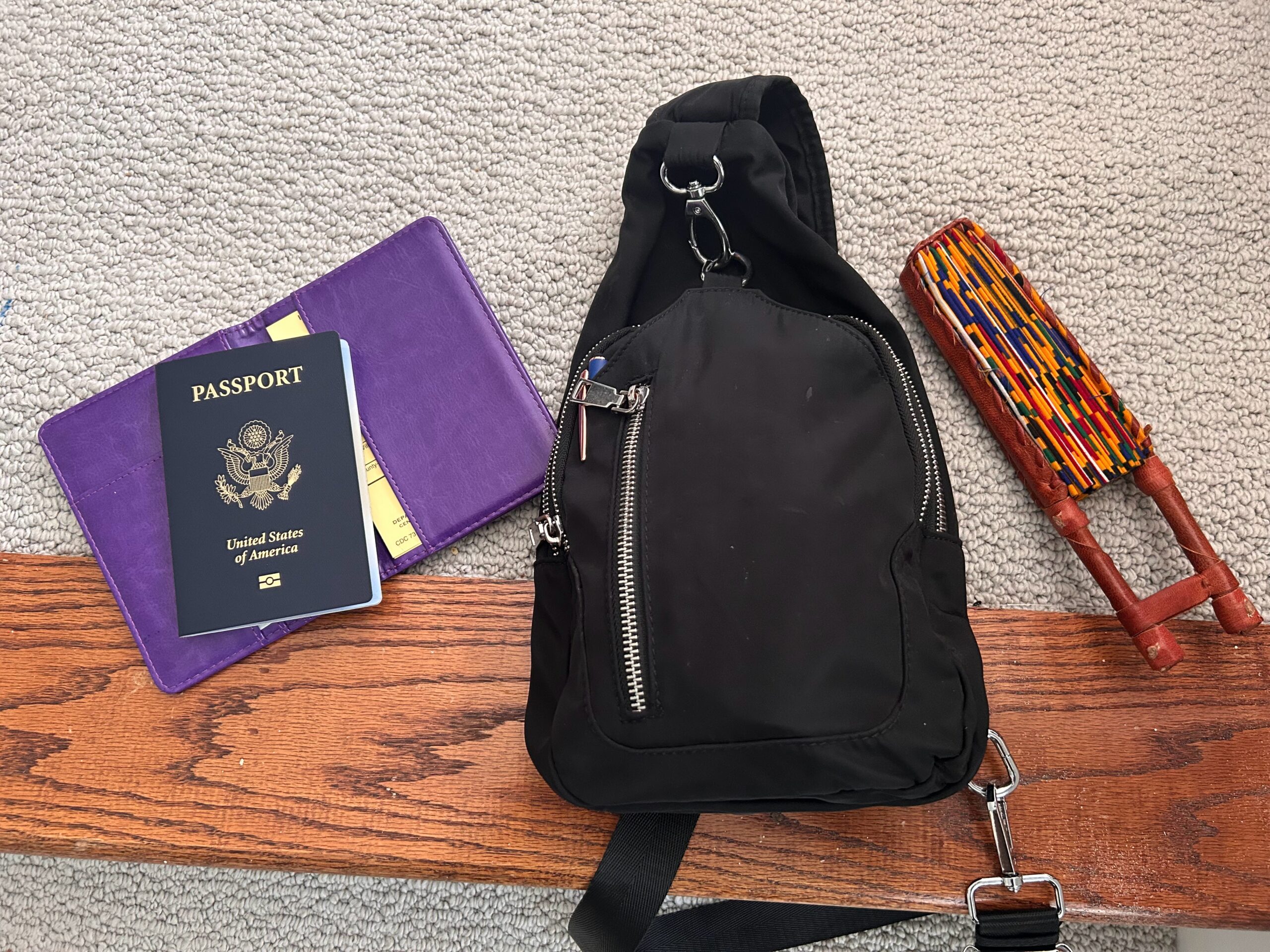
Besides your passport, researchers should be well-armed with the essential travel items including the cross-body and a Ghanian made hand fan.
In all, being organized matters.
Essentials:
- Medical vaccinations and travel medicine (if needed), forms
- Lightweight shirts and blouses
- Compression socks
- Convertible travel pants — preferably blue, black, white, tan
- Light sweater or fleece — preferably fleece
- Rain-resistant jacket
- Comfortable walking shoes — my preference are Crocs
- One outfit suitable for dressy formal occasions
Pack for the unexpected
I learned this lesson many years ago while on a mission trip in Costa Rica: Never pack your suitcase completely full. As a research traveler, I inevitably return with books, documents, maps, gifts and souvenirs that help me remember the story. The extra space I left in my luggage proved invaluable. Once I brought a foldable suitcase. Another time, while in Japan, I purchased a suitcase. It was much cheaper to buy it there than in the United States.
Great lessons
I packed far more than clothing, my United States passport, and other travel gear. I packed my high curiosity about the once heavily traveled ship route between the Gold Coast on West Africa and the Netherlands. Those dealings resulted in the most lucrative aspect of the Trans-Atlantic Slave Trade. I packed patience and profound faith to follow history wherever it led. My luggage helped me move between continents. Those internal qualities helped me move between centuries.
