
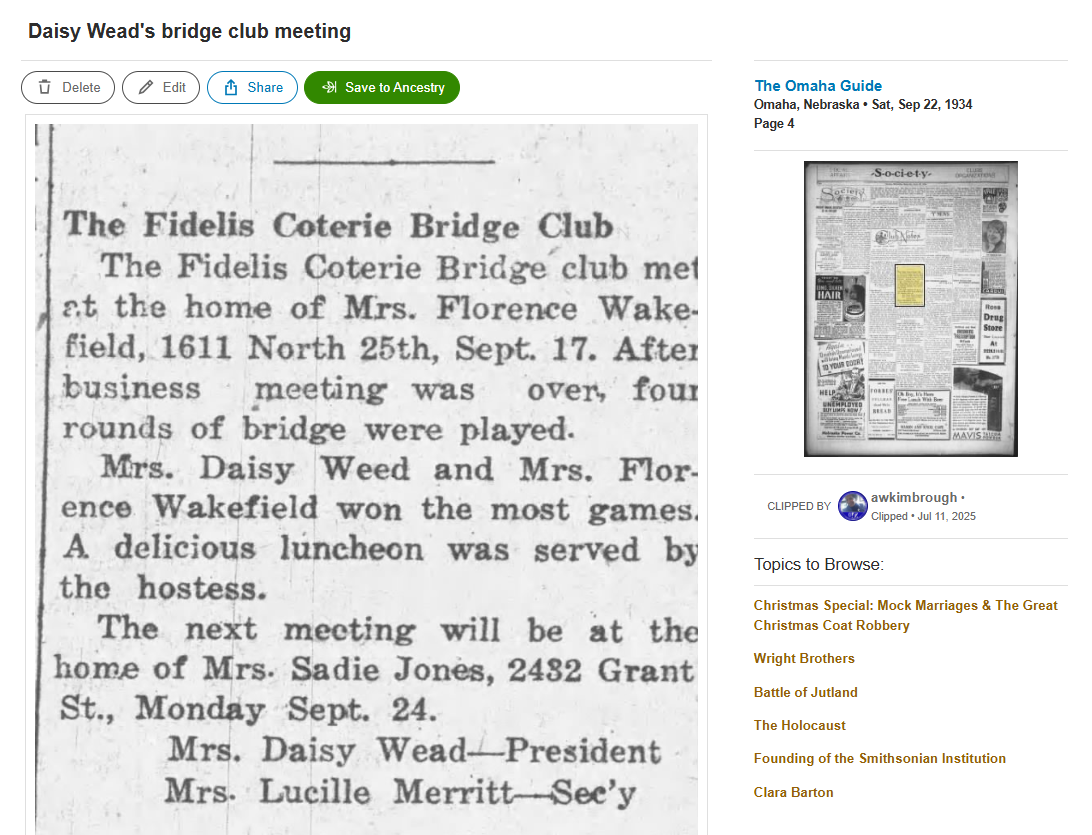
Paternal grandmother Daisy Shanks Wead was the president of the bridge club in 1934
Historical newspapers remain one of my favorite starting points when I am curious about what life was like for my ancestors. While perusing the newspapers.com, I found a series of articles about my paternal grandmother and grandfather. My grandmother was a co-organizer of a bridge club in Omaha, Nebraska, in the early 1930s. Who knew? Surely, not my Dad, Rodney Wead, who is the oldest son to Daisy and Samuel Luster Wead. My Dad is also a bridge player as was his father who also started a bridge group in Omaha.
I did not know that both grandparents were ardent bridge players. It helps to further add texture and shape their lives within our memories of them during the Jim Crow era of racial discrimination in the United States, even in the Midwestern areas.
Yet, I remain appreciative of newspapers for serving a vital role in preserving the scattered facts of our collective family’s histories. For African Diasporan and Indigenous Americans, newspapers were essential in extending facts that often were jumbled or omitted.
‘Read all about it’
Let’s take a closer look at some of the unique features of historical newspapers.
- The authenticity of the content: These are not just random pictures or generic stories. These are real, untampered artifacts from my family history. This adds a personal touch and a deeper level of connection with the readers.
- A slice of life: Through these photographs and even letters that I discovered, I got a slice of life from the 1930s – a time when the world was on the brink of a major change. The post captures the simplicity and the small joys of everyday life in a way that is both mesmerizing and eye-opening.
- Lessons and values: Beyond the nostalgia and the historical value, the short articles featuring my grandmother, grandfather and their friends, delves into the lessons and values that my grandparents passed down to me. From generosity to resilience to gratitude to love for family, these are timeless principles that still hold relevance in our lives today.
Grandma and Grandpa’s hands
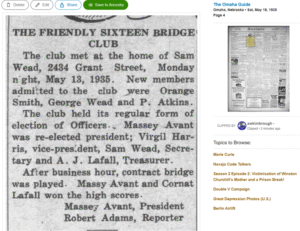
The articles featured in this post and other similar reports on the ladies’ and gentlemen’s bridge games are more than the short articles reveal. It’s about the journeys of two African Americans gaining their form of notoriety received from having their names in the newspapers. Those were the days when newspapers were the “gospel” and rarely were there good features in the mainstream media about the pleasant lives of African Americans. These articles, however, were in a time limited African American owned newspaper, the Omaha Guide.
I paused and imagined being in my grandparents’ space and watching them win their respective bridge game. I was fortunate to see my grandfather play bridge and I can still hear the laughter and slapping of cards on the table as they enjoyed snacks and drinks. I transported to a different time and place in thinking about their fun times. I could feel the emotions, the joy in their hosting duties with their respective bridge club.
I urge you to reconnect with your own family history and discover the untold stories and memories that lie dormant. It’s an opportunity to honor our roots and the people who came before us, who have contributed to making us who we are today. So join me on this journey to 1934, and let’s uncover the “Precious Finds” together. My Dad was born in 1935 and the newspaper clippings about my grandmother’s bridge games came to a screeching halt to make room for the article listing the birth of a son to his parents.