
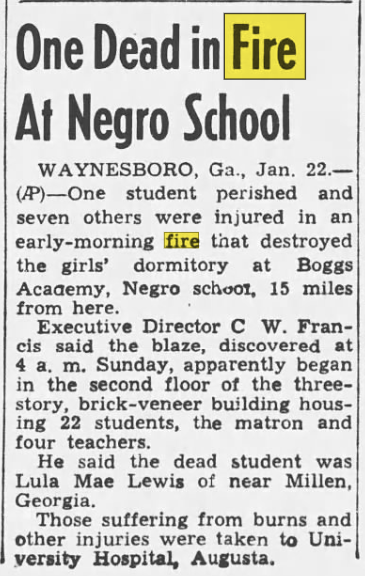

The Fire, the Cemetery, and the Family Connection
While seeking to confirm the identity of a pro bono client’s father, I unexpectedly discovered another way to verify whether a family lineage was accurate. The confirmation came through the grave records of the client’s 15-year-old aunt, who tragically perished in an early morning dormitory fire in south Georgia in 1940.
What followed was another reminder of the twists, turns, and emotional complexity that often accompany African Diaspora genealogy research.
The client and his brother shared the same name as their biological father, who was not married to their mother. The client knew his father’s name, the year of his death, and the alleged location of his burial site. As with most African Diaspora genealogy projects, I began with the traditional route — reviewing the race/ethnic references, names, approximate birth records, death records, and family connections tied to the client’s parents.
Initially, the research moved forward steadily. However, after adding several generations to the family tree, the records suddenly stopped. I had reached a familiar genealogical roadblock.
To work my way out of the blockage, I stepped back and carefully reviewed the foundational details again: The race/ethnic references, names of the client’s parents, their birth dates, death dates, locations, and associated relatives. Yet the challenge remained. The father’s name was common enough that thousands of similarly named men appeared throughout records across the United States. I needed another method to determine whether the individual I was tracing truly belonged to this family line.
The Curiosity Detour That Changed the Entire Family Search
I began reviewing every Ancestry.com hint connected to the father’s extended family — parents, siblings, grandparents, collateral relatives, locations, etc. During what I now call a “curiosity detour,” I opened the death certificate of the client’s young aunt.
At first glance, the document confirmed the expected information: Race, parents’ names, approximate ages, and location. But experienced genealogists know that some of the most important clues often hide in the less-obvious details. I mentally noted the funeral home operator and, more importantly, the cemetery listed as her place of burial.
That detail stayed with me.
Follow your intuition
Next, I searched Newspapers.com for reports of fires involving young women in Georgia during 1940. Initially, I believed she may have been connected to a substantial dormitory fire involving a male residence hall in what is now considered the metro Atlanta area. Yet nothing in those reports clearly linked the young girl to the tragedy described on her death certificate.
So I kept searching.
After hours of research, I paused — one of those quiet moments genealogists understand well — and simply reflected on the question: What really happened here to link this ancestor to my family research?
Then I found it.
An article describing the tragic circumstances surrounding her death confirmed the details listed on the death certificate. My curiosity detour had suddenly become a breakthrough.
But the real discovery came afterward.
The Cemetery Clue That Confirmed a Family Lineage
Because I remembered the cemetery listed on the death certificate, I began searching for that same burial location among other possible family members. There it was again — the identical cemetery name appearing across generations of relatives. Thankfully, many members of the family had lived and died in a small Georgia town, making the burial connections easier to trace.
The cemetery itself was attached to a small rural church.
That single repeated detail gave me a new level of confidence. The cemetery became the anchor point connecting multiple generations of the family together. Suddenly, the puzzle pieces aligned with greater clarity, allowing me to move more confidently through the family structure and verify that the individuals I was tracing were indeed connected to my client’s lineage.
Almost there
Only one major question remained: Locating the final burial place of the client’s father in order to construct a fuller timeline of his life. Family accounts suggested he may have been buried nearly a thousand miles away, while other evidence pointed back to the small church cemetery tied to generations of relatives.
But such unresolved questions are familiar territory in African Diaspora genealogy research.
There is almost always another mystery waiting behind the next document, another contradiction buried within oral history, another unexpected clue hiding in plain sight. That is both the challenge and the beauty of this work.
Sometimes the answers we seek are not found in the records we intended to search — but in the records we almost overlooked. Keep searching African Diaspora researchers.
