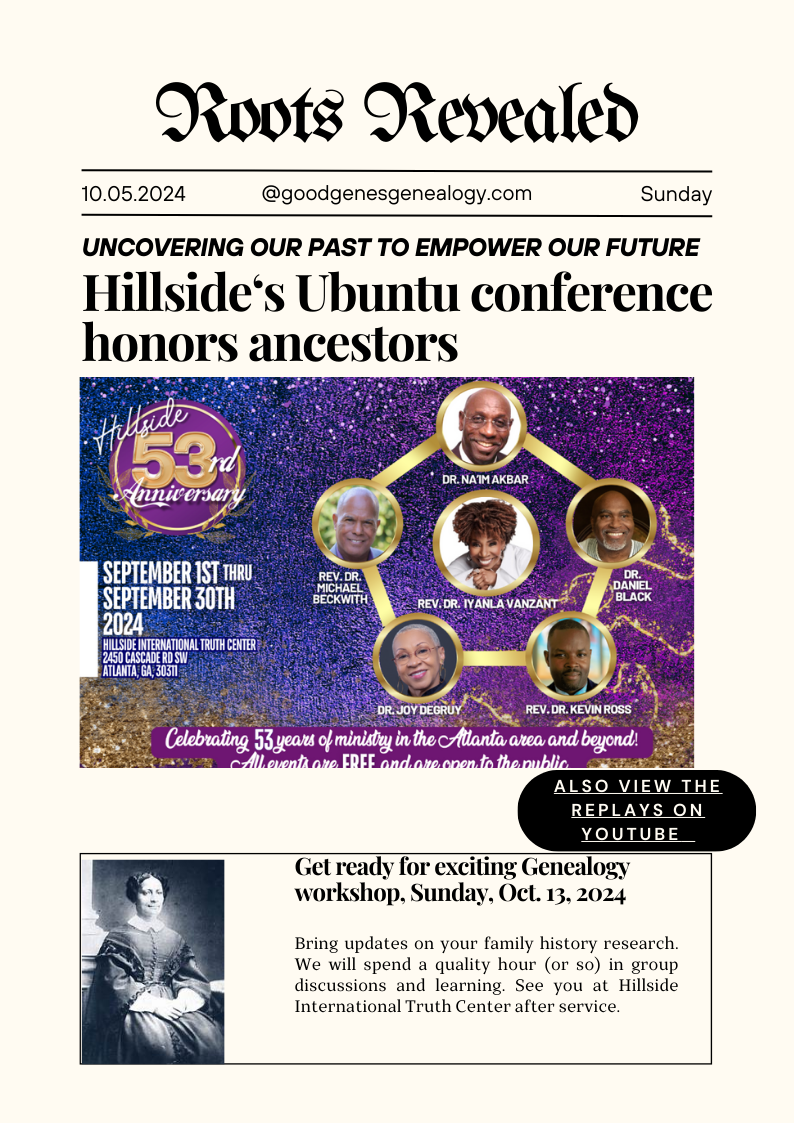
Category: Genealogy Group forms at Hillside International Truth Center

Hillside International Truth Center kicks off its Ancestral and Genealogical Research ministry. It is hosted by Good Genes Genealogy Services’ co-founder, Dr. Ann Lineve Wead Kimbrough

  • Black Geneaology

    Black genealogy begins where many family stories do, with a name, a place, and a question. Yet the trail for people of African descent often bends ⁢through records‌ created by others, across borders and oceans, and into archives where identity can be ⁣obscured by time, language, or law. The past is present in fragments: a baptism entry that replaces a surname, a ship’s ⁣list without a⁢ homeland, a census that marks presence but withholds origins. Tracing ‌lineage here is less a straight line⁤ than a map made of overlapping routes.

    This article explores that landscape. It looks at how enslavement,emancipation,migration,and colonial governance shaped what was written down-and what was not. It surveys the sources researchers ‍turn to, from plantation books and probate files to church registers, newspapers, military rolls, the Freedmen’s Bureau, Caribbean manumission records, and community archives. It considers the tools that connect the⁣ dots today, including DNA testing, digitized‍ collections, and methodologies that follow not just individuals but their friends, associates, and neighbors.

    The aim is orientation ⁤rather than destination. Along the way, we’ll‌ note regional⁤ variations across the United States,‌ the Caribbean, Latin America,⁤ Europe, and⁤ Africa; common hurdles like name changes and shifting boundaries; and practical questions about⁢ ethics, privacy, and interpretation. Black genealogy ⁤is both⁤ meticulous and imaginative work-assembling a lineage from scattered evidence, reading silence as carefully as ink.⁢ What follows is a guide to navigating that work with clarity, context, and care, wherever your ⁢question begins.

    Breaking ⁤brick walls ⁢in black genealogy⁣ during the slavery era: Bills of sale, probate inventories, plantation journals, and the Bureau of Refugees and Freedmen records

    Transactional paper trails can pry open closed ⁣doors when traditional family records are missing. A single line in a bill⁤ of sale ⁤ or a note in a probate⁣ inventory may reveal ages,skills,kinship clusters,or movement between⁤ counties.Read for‌ patterns, not ⁤just names: repeated buyers, witnesses who reappear, and groupings of‍ people appraised ⁢together often signal family ties. Pair these⁢ details with plantation journals-work ‌lists, birth entries, rations, and patient‌ logs-to reconstruct everyday context⁣ and identify seasonal rhythms that align with later-life records. Use the FAN method (Friends,⁢ Associates,⁣ neighbors) to follow enslavers, attorneys, overseers, and adjacent households; their paper ‌footprints can led straight to your ancestor’s.

    • Extract every descriptor (age, height, complexion, skills, relationships) and ‌track name variants and nicknames.
    • Map ⁢people​ to places by chaining deed books,⁣ tax rolls, and court minutes; note migrations‍ tied⁤ to heirs or debt.
    • Cluster witnesses and buyers-their estates and lawsuits frequently enough preserve parallel copies of the‍ same people.
    • Cross-date events from journals with crop cycles, holidays, or epidemics to synchronize identities across records.

    After emancipation, the Bureau of ⁤Refugees and Freedmen ⁢ becomes the bridge between ⁣bondage and freedom. Labor​ contracts can ⁢tie​ newly chosen surnames to former enslavers; hospital, ration, and complaints registers place people in specific neighborhoods;⁣ marriages solemnized by the Bureau often list prior cohabitation and ⁤children.Pair these with local newspapers, church⁣ registers,⁣ and school reports to capture witnesses and employers-those names frequently enough echo the last enslaving households. When surnames shift,follow⁢ the ‌employer in⁤ the contract,the godparent in a‌ baptism,or the neighbor in a complaint; those anchors frequently pull the prewar record set⁢ into focus.

    Record Where to Look Key Clues Swift Tip
    Bills of Sale County deed books; private papers Seller/buyer, price, age/skills, ⁣groupings Index under enslaver; scan adjacent deeds
    Probate Inventories Wills, estate files, ‍court packets Household clusters,​ valuations, allotments Track divisions‍ to heirs across counties
    Plantation journals University archives; historical societies Births,‌ work lists, rations, ⁤movements Align entries with later marriages/births
    Freedmen’s Bureau NARA; FamilySearch; Ancestry Labor contracts, marriages, aid, schools Search by employer/plantation and locality

    Smart searches and must use‍ databases for Black family history: AfriGeneas, FamilySearch, National Archives ‍Catalog,​ Chronicling America, and ⁤Digital Library ⁤on American Slavery with wildcard and cluster ⁤research tactics

    cast a ⁢wide net, then close in: begin with flexible queries that anticipate⁢ variant spellings, nicknames, and transliterations across AfriGeneas, FamilySearch, the National Archives Catalog, Chronicling America, and the Digital Library on American Slavery. Try surname ⁤stems (Jacks* to net Jackson/jaxon), ​swap vowels (J?hn for John/Jahn),⁣ and search by place first when names are unstable. On FamilySearch, layer filters‌ (race, residence, record type) after a broad wildcard pass;⁢ in the National Archives Catalog, pair keywords with record groups like RG 105 (Freedmen’s Bureau), RG 15 (pensions), or⁣ RG 94 (military service). ⁤In Chronicling America,⁢ leverage phrase and proximity logic for OCR-challenged newsprint; in DLAS, query by enslaver, buyer/seller, county to surface bonds between ⁣people otherwise listed without surnames. AfriGeneas is your conversation engine-post a concise query with year, county, and variant spellings to invite community memory and leads.

    • Wildcard savvy: truncate roots (Freedm*), swap⁣ characters (Smi?h), and test phonetics (Mack/Mc).
    • Cluster strategy: follow the​ FAN circle-friends,‌ associates, neighbors, and enslavers, ‌witnesses,​ sureties,⁣ and employers.
    • Time bridges: anchor in 1870, reach back with Freedmen’s Bureau and DLAS, and corroborate forward with newspapers and pensions.
    • Context cues: map church affiliations, regimental designations (USCT), and postwar migration paths.
    Database Best Use Try This Clues You’ll‌ Find
    AfriGeneas Community expertise “Goochland VA Jacks*“ Surname variants, local leads
    FamilySearch Indexed + images “Eliz*“‍ + residence filter 1870 links,‍ Freedmen’s records
    NARA Catalog Record​ groups “RG 105 Bureau Goochland” Contracts, ⁣rations, disputes
    Chronicling America Historical press “colored school“⁣ AND county Names in notices, events
    DLAS Slavery-era links Seller + county + “*son“ Bills ​of sale, cohabitation ties

    Work the web of relationships: build a grid ‍of witnesses, neighbors, enslavers, and church officers, then​ chase each name through⁤ the five platforms with the same wildcard trunk-your‌ “one-to-many” approach turns faint traces into a pattern. Iteratively log sources, note spelling drift, and tag each hit by place and decade; when the same cluster reappears-say, ⁢a USCT sergeant in a pension file, the same surname root in ​a DLAS deed, ​and a church fundraiser in a newspaper clip-you’ve triangulated identity with autonomous proofs fit for a‌ sturdy, citation-ready lineage.

    DNA‍ done responsibly in African diaspora research: Autosomal, Y, and ​mitochondrial testing with triangulation, match grouping,⁤ and strict privacy settings

    Pairing autosomal DNA with ‌targeted Y-DNA and mitochondrial ‌DNA can clarify kinship across the Atlantic, but the‍ power comes from method, not volume.⁣ Use triangulation ⁣to confirm that three or more relatives share the same DNA segment⁤ and an ancestor, and⁣ practice match grouping by clustering cousins around known places,⁣ surnames, or enslavers’ records. Where endogamy or​ community overlap is highly ‌likely, prioritize cross-branch corroboration, phased matches from older⁣ relatives, and ⁤documented timelines. The guide below can ‌help you choose what to test first ⁤and how to read results in context.

    Test Inheritance Best for Notes
    Autosomal All lines Recent kin, segments Enable‌ triangulation
    Y-DNA Direct paternal Surname,⁤ patriline Haplogroup, STR/SNP
    mtDNA Direct maternal Maternal origin Deep lineage, caution

    Guard dignity and data with strict ‍privacy settings ⁣and consent-first sharing. Lock down match visibility,hide your full name,and only reveal tree details necessary for a specific query. Use neutral, trauma-aware language when messaging potential relatives, and store notes off-platform when sensitive. For ⁣uploads and third-party tools, obtain explicit consent, and remove kits on request. These practices protect living family while still advancing discovery through careful collaboration.

    • Privacy-first: disable auto-searchable trees; mask living people; ⁣use aliases.
    • Consent: Written permission for kit uploads, transfers, and public posts.
    • Evidence: Combine segments + records; avoid overreliance⁣ on ethnicity estimates.
    • Grouping: Label matches by⁣ ancestor,location,migration event,or enslaver.
    • Documentation: Timestamped notes, sources cited, and reversible conclusions.

    Mapping⁢ movement and identity shifts in african American lineages: Great Migration​ routes,US Colored Troops service files,surname changes,and timeline building across counties and states

    Trace movement ⁤as a storyline by plotting each appearance of an ancestor across counties and states,then ‌overlaying those points with Great Migration corridors,rail lines,and labor routes. City directories, draft cards, and passenger lists‌ can reveal the pivot from rural farms to industrial neighborhoods, while Freedmen’s Bureau records and local tax lists capture earlier post-emancipation pivots. As ‌you ​assemble waypoints, note the chain migrants-siblings, in-laws,‌ and neighbors-who often took the ​same path, building clusters that explain sudden jumps on a map. Add dates, employers, and‍ church affiliations to transform a static tree into a living route map.

    Identity shifts are⁣ the breadcrumbs: US colored Troops service files and ⁤pension applications frequently enough ​preserve pre-war names, birthplaces, and witnesses who later reappear under ⁣new surnames. Track variant​ spellings, double surnames, and aliases alongside changes in jurisdictions as county lines and wards are redrawn. Cross-check baptisms with ​muster rolls, ​obituaries with school rosters, and land deeds with WWI/WWII draft cards to ‍confirm continuity of the same person across ⁤records. A⁣ disciplined timeline-documented⁣ entry by entry-keeps the thread intact when⁢ names bend,move,or merge.

    • Plot corridors: Align residence dates with ​known rail lines and factory booms to explain‍ leaps.
    • Read the pension: USCT files can link pre-war kin, migration stops, and later surnames.
    • Trace the surname: ⁤ Compare enslaver‍ surnames, marriages, and church rolls for adoption ‌patterns.
    • Date-stamp ⁢every appearance: Build a county-by-county chronology to avoid conflating identities.
    • Mind the map: Note boundary changes that shift ​an ancestor without them ever moving.
    ancestor from → To Years Clues
    Isaac Green(e) Pike co., MS → chicago, IL 1917-1923 Rail pass; steel mill payroll; South Side directory
    Mary “Polly” → Mary ⁢Carter Edgefield, SC → Augusta, GA 1870-1875 Freedmen’s marriage; 1870 census; domestic service ad
    Private louis Jackson‌ (USCT) Halifax, NC → Washington, DC 1864-1867 Pension alias; hospital muster; witness affidavit
    Ella Brooks → Brooks-Williams Jefferson⁢ Co., AL ⁢→ Detroit, MI 1941-1943 Defense ID; church transfer; ⁢wartime boarding list

    The Way Forward

    Black genealogy is⁢ less ⁤a straight line than a careful braid-threads ⁤gathered ⁣from courthouse ledgers and‍ church registers, ⁢from Freedmen’s Bureau pages, ship manifests, and the remembered edges ‌of family stories.‌ The tools at hand are varied-archives and oral histories, DNA tests‍ and digital databases-and each ⁤offers clarity in one moment and caution in the next.Names shift, borders move, and silence occupies entire ⁣generations; even so, the seams themselves become data, showing where‍ lives met⁢ laws, where communities adapted, and ‌where memory chose to keep watch.

    What emerges ‌is not a single narrative,but a mosaic that can be read at multiple distances: intimate enough to catch ​the inflection of a great-grandparent’s nickname,wide enough to map migrations across counties,oceans,and⁤ eras. As researchers proceed,‌ context ‍matters as much as discovery-dates mean little without ⁣the social weather⁤ around ⁣them, and ​documents are best approached ‌with respect⁣ for the living people they still touch. The ⁣work rarely concludes; it pauses, ⁤it revises, ‍it waits for another record to surface or another elder to speak. Perhaps that is the most reliable guide: an openness to complexity. In ​this⁣ field, the last entry on ⁢the⁤ page is not a ‌period but a fold-turn it, ​and the story continues.

  • The Health Care Life Savers: Black Midwives during Jim Crow

    The Health Care Life Savers: Black Midwives during Jim Crow

    Black midwife in Greene County, Ga (Library of Congress)

    Look around and ask your African American adult family members if they were birthed by midwives. It is likely that if they were born in the segregated South, the answer is yes!

    Maternal health care to Black women in the Jim Crow era

    In 1941, this priceless photograph was captured by photographer Jack Delano during a time when the federal government was documenting daily life in the South, especially among African American communities, tenant farmers, and sharecroppers. It was the Farm Security Administration/Office of War Information’s vast project. While it seems like the project was a huge invasion of privacy upon the lives of wonderful people, it is a blessing to genealogists and African Diasporan families researching our ancestors.

    This unnamed African American midwife in Greene County, Georgia, carefully prepares her birthing kit before going out on call. Midwives were the “sheroes” of their communities, providing amazing care to African American women during pregnancy and childbirth. Most  hospitals were segregated and therefore, not available to the women. That is why the skill and devotion by Black midwives was so important. Their service has sustained generations, blending traditional knowledge with formal training to ensure safe deliveries and continuity of life.

    Thank you, unsung “sheroes” aka the African American midwives. Let’s honor the ongoing organization that supports Black women’s health, the National Black Midwives Alliance. 


  • Kicked Out but Not Silenced: The African American Pastor Who Roared Back at the Georgia General Assembly

    Kicked Out but Not Silenced: The African American Pastor Who Roared Back at the Georgia General Assembly

    African Methodist Episcopal Bishop Henry McNeil Turner
    Ardent defender of African American rights, Bishop Henry McNeil Turner

    I often find myself imagining what life was like for the ancestors I research. Whether I’m tracing the African Diasporan roots of a client’s lineage or tending to my own family tree, I have a persistent yearning to understand and feel more than names and dates. I want to get a sense of their resilience, to know the determination that carried them through trials, and even to picture their everyday and ordinary activities.

    To get me into the time and place, I recommend that novice to expert ancestral and genealogy researchers spend the quality time to go beyond the online family tree services. It is absolutely necessary to utilize government data, community news, and any oral history. For instance, pair census and street directories with employment and civic engagement. In the case of my fifth great-grandfather, Issac H. Anderson (1835 – 1906), his amazing life is highlighted by overcoming slavery to become a prominent businessman, religious and educational leader. It was his significant election to the Georgia Senate in 1867 that opened the door for me to learn about the unprecedented and perilous times for him and 32 other Black male pioneers. They were named the “Original 33, ” Black men who were among the first elected legislators in the United States.

    “Original 33” marker to honor the Black men elected to the Georgia General Assembly in 1867

    Following ancestor Anderson’s life led me to his fellow Georgia Senator, African Methodist Episcopal Church Bishiop Henry McNeil Turner (1834 – 1915).

    Faith and Fire

    One hundred and fifty-seven years ago this month (Sept. 3, 1868), a newly elected Georgia State Senator, delivered a “fiery” speech to his Republican Party colleagues who unanimously voted to expel the 33 Black members based on the color of their skin. Upon the start of the 1868 Georgia legislative session, the white lawmakers immediately expelled the delegation of Black men based on the color of their skin and their slave lineage. Bishop Turner officially addressed his remarks to the Speaker of the House.


    Rev. Henry McNeal Turner’s famous speech to the Georgia General Assembly 1868

    Excerpts of Bishop Turner’s remarks

    “Mr. Speaker: Before proceeding to argue this question upon its intrinsic merits, I wish the members                                                                                                                      of this House to understand the position that I take. I hold that I am a member of this body. Therefore,                                                                                                                sir, I shall neither fawn nor cringe before any party, nor stoop to beg them for my rights. Some of my                                                                                                                    colored fellow members, in the course of their remarks, took occasion to appeal to the sympathies of                                                                                                                      members on the opposite side, and to eulogize their character for magnanimity. It reminds me very                                                                                                                      much, sir, of slaves begging under the lash. I am here to demand my rights and to hurl thunderbolts                                                                                                                      at the men who would dare to cross the threshold of my manhood. There is an old aphorism which                                                                                                                        says, “”fight the devil with fire,” and if I should observe the rule in this instance, I wish gentlemen to                                                                                                                        understand that it is but fighting them with their own weapon.”

    And

    “Whose legislature is this? Is it a white man’s legislature, or is it a black man’s legislature? Who voted for                                                                                                              a constitutional convention, in obedience to the mandate of the Congress of the United States? Who first                                                                                                              rallied around the standard of Reconstruction? Who set the ball of loyalty rolling in the state of Georgia?                                                                                                              And whose voice was heard on the hills and in the valleys of this state? It was the voice of the brawny armed                                                                                                        Negro, with the few humanitarian hearted white men who came to our assistance. I claim the honor, sir, of                                                                                                          having been the instrument of convincing hundreds yea, thousands of white men, that to reconstruct under                                                                                                        the measures of the United States Congress was the safest and the best course for the interest of the state.”

    ‘Am I not a man?’

    Bishop Turner continued with, “The great question, sir, is this: Am I a man? If I am such, I claim the rights of a man. Am I not a man because I happen to be of a darker hue than honorable gentlemen around me? ”

    He ended his lengthy manuscript and spoken word in a summary commitment to receive justice from another source for what the expulsion from the Georgia House and Senate. “You may expel us, gentlemen, by your votes, today; but, while you do it, remember that there is a just God in Heaven, whose All-Seeing Eye beholds alike the acts of the oppressor and the oppressed, and who, despite the machinations of the wicked, never fails to vindicate the cause of Justice, and the sanctity of His own handiwork.”

    Justice restored

    The men took their cases to the federal and state high courts. In June 1869, the Georgia Supreme Court rules that the Black men were allowed to hold a public office. Although my ancestor Anderson was not restored to his seat due to a technicality involving a perceived conflict, 27 of the 33 men were placed in their seats by U.S. General Alfred Terry. The newly installed Black men made a huge difference in enacting Georgia laws, including establishing the public school system.

    Original 33 Decision of the Georgia Supreme Court in 1869

    Needed info for ancestry researchers

    The actions of Bishop Turner deeply shaped the human rights path of my ancestor, Anderson. Though Anderson achieved prominence as a businessman, co-founder of Lane College in Jackson, Tennessee, and a founding leader of the Christian Methodist Episcopal Church, he never wavered in his activism. He supported  college students in their peaceful protests and helped countless Black Georgians find safe passage to new lives in Tennessee, Arkansas, and Mississippi.

    Discovering Turner as Anderson’s close colleague highlighted not only my ancestor’s choices after the turbulent Reconstruction years of 1868–1870 but also the broader struggle they remained committed to wage together. For today’s ancestry researchers, the lesson is clear: Just as neighbors listed in census records can reveal hidden family ties, the colleagues and allies of our ancestors—whether in business, politics, civic life, or education—can unlock powerful insights into their purpose and movements. By tracing these networks, we move closer to understanding the full story of those who came before us.

    Remember what our ancestor left us

    In the end, our African Diasporan ancestors’ stories are rarely one-sided. The stories born from the lives of our ancestor are woven with the lives of neighbors, friends, and business, church, civic colleagues. By following those tracks, we honor our ancestors’ journeys and importantly, uncover the deeper legacy they left us.

  • Hillside Sankofa Virtual Genealogy Workshop December 2024 v

    Namaskar!

    We are mindful of the many activities that are taking place this glorious month. As such, please check out my in-person replacement: A short video to wrap up our year in ancestral research.

    Note that there is an approximate 2-minute pause in the video (8:55 – 11:15″) and that is your opportunity to plan your next genealogy goals for 2025.

    Expect a regular stream of Zoom and other virtual educational workshops.

    Thank you for support Good Genes Genealogy Services!

  • Discover Your Roots: Genealogy Workshop Postponed – Stay Tuned for New Date!

    Questions Answers Signage
    The December 8, 2024 in-person meeting postponed

    📅 IMPORTANT ANNOUNCEMENT: Genealogy Workshop Postponed to TBA!

    Due to exciting in-person programming at Hillside International Truth Center on Sunday, Dec. 8, 2024, we are postponing our highly anticipated genealogy workshop.  We assure you that a Zoom link will be provided for a virtual meeting that will bring you an even more enriching and valuable experience.

    African Diasporan ancestry research is a beautiful pursuit that allows us to uncover our roots, connect with our ancestors, and gain a better understanding of our identity and heritage. It is a journey of discovery and self-discovery, made even more meaningful when shared with others. That is why we are thrilled to invite you to our upcoming genealogy workshop, where we will delve into the fascinating world of tracing your family history.

    We anticipate an exciting 2025 where virtual workshops and other gatherings will equip you with the necessary skills and tools to research your family history. We will cover everything from basic research techniques to advanced strategies for locating and analyzing records. Whether you are a beginner or have been on the genealogy journey for some time, our workshops will cater to all levels of experience and knowledge. 🔍

    Here’s what you can expect:  Hands-on activities and exercises to help put your newfound knowledge into practice; Practical tips for conducting effective and fast genealogical research; In-depth genealogy basics; Q&A sessions with our Hillside family members and other expert speakers on the subject of our genealogy and ancestry topics; and more.

    Be sure to follow up on Facebook and YouTube.

    Thank you for a marvelous year of ancestral research and realized journeys!

  • Getting ready for our in-person Genealogy Group workshop at Hillside International Truth Center, Atlanta, GA

    Getting ready for our in-person Genealogy Group workshop at Hillside International Truth Center, Atlanta, GA

    Prizes will be awarded to those who guess how many times the word “ancestor(s)” was spoken during the recent Ubuntu conference.

    Another free offering from Good Genes Genealogy Services via Dr. Ann Wead Kimbrough

  • Unlock Your Family’s Past: A Guide to Seeing Ancestors in Old Photographs

    Enjoy this animated, easy-to-follow way to dig deeper in public photos to find your ancestors.

    Eatonton, GA

  • “Unlocking Your Roots: Mastering Ancestry and Genealogy Searches for a Strong Sense of Belonging”

    I belong to several ancestry and genealogy research groups, chats, organizations, and regularly participate in training sessions. This aids in my development as a genealogist specializing in African Diasporan family searches.

    One of my favorite organizations is the Afro-American Historical and Genealogical Society, Inc., especially the metro Atlanta chapter. Here’s a sample of the great connections you are provided by AAHGS when you join the organization:


    21 JUL 2024(pictorial generated by AI)


    These events are provided as a courtesy to our AAHGS Metro Atlanta members but are not the responsibility of our chapter.


    Timelines for Genealogy, Dottie Baugh

    Mon Jul 22nd

    Presented by Charlotte County Genealogical Society
    10:30am ET

    All classes are free and open to the public. For a Zoom link, send an email to President@ccgsi.org

    For details see www.ccgsi.org


    The Homestead Act, with Ranger, Amber Kirkendall, Homestead National Historic Park

    Mon Jul 22nd

    Presented by Heritage Seekers Genealogy Club
    7:30pm ET

    Ranger, Amber Kirkendall, Homestead National Historic Park

    This is a Zoom virtual meeting. To get a link to attend, you must:
    – be a paid member, or
    – subscribe to our email list at https://heritageseekersar.com/subscribe/ or
    – follow us on Facebook at https://www.facebook.com/heritageseekersar.club

    Zoom link available closer to the event – See the website!

    For details see heritageseekersar.com/


    Pins & Needles: Adding Social Media to Your Genealogy Repertoire

    Mon Jul 22nd

    Presented by Plainfield Area Public Library
    8:00pm ET

    Many of us have used Facebook to find distant cousins and former high school friends. Join us for a fun session on using sites like Pinterest, Flickr, Instagram and more to locate, identify and share ancestors.

    This is a virtual program. Login information will be sent when you register for the program

    For details see plainfieldpubliclibrary.librarymarket.com/event/virtual-pins-needles-adding-social-media-your-genealogy-repertoire-65597


    Researching LGBTQ Genealogy, with Stewart Traiman

    Mon Jul 22nd

    Presented by Denver Public Library
    8:00pm ET

    Lesbian, Gay, Bisexual, Trans, and Queer folk have always been a part of our history and family stories. Our trees’ confirmed bachelor or spinster aunt may not have been single. Perhaps they did have partners but there is no legal documentation or family acknowledgment. This class will explore census, newspapers, obituaries, military records, photographs, phone books, and archives for clues on our ancestor’s sexuality. We will also explore LGBTQ History and many individual stories giving context to the available records. Discovering our LGBTQ ancestors’ stories and inviting them back into our trees will enrich our entire family history.

    For details see www.denverlibrary.org/event/researching-lgbtq-genealogy


    Beginning Ancestry by Scott Jones

    Tue Jul 23rd

    Presented by Los Angeles FamilySearch Center
    2:00pm ET

    What and where?

    For details see churchofjesuschrist.zoom.us/j/95462341725?pwd=dmxZaWNGR1hpWVlCM1lYaHBENERLdz09#successlBSaWtyS0pwSDJxdz09%23success


    Using the FamilySearch Catalog by Clark Jenkins

    Tue Jul 23rd

    Presented by Los Angeles FamilySearch Center
    5:00pm ET

    Learn how to search the entire FamilySearch database using the Catalog. This will include searching indexed and unindexed records, book titles and authors, and keyword searches. Learn how to navigate through unindexed record collections to find digitized original records.

    For details see churchofjesuschrist.zoom.us/j/95462341725?pwd=dmxZaWNGR1hpWVlCM1lYaHBENERLdz09#successlBSaWtyS0pwSDJxdz09%23success


    What’s the Tea in Your Family Tree?

    Tue Jul 23rd

    Presented by Charlotte Mecklenburg Library / West Boulevard Library
    6:00pm ET

    Unearth secrets, reveal truths, and explore the colorful stories hidden within your ancestral lineage.

    This is a HYBRID program, so you can attend in-person at West Boulevard Library or online via Zoom.

    *Registration Required* Registration begins the first day of the month.

    For details see cmlibrary.bibliocommons.com/events/664e02e3e3e1ee30003fe2c7


    Genealogy for Beginners: Census records and obituaries

    Tue Jul 23rd

    Presented by Cincinnati Public Library / Pleasant Ridge
    6:30pm ET

    Census records and obituaries are the most popular and easiest to find genealogical records. Learn how to search for and use these records when digging into your family history.

    This event will be in person at the Pleasant Ridge Branch and also live streamed over Zoom. The Zoom link will be shared a few hours before the program starts.

    Registration is required to receive the Zoom link.

    For details see cincinnatilibrary.bibliocommons.com/events/65d74df01e57af280037c162


    Finding and Using City Directories for Genealogy – Fourth Tuesday Genealogy Series

    Tue Jul 23rd

    Presented by The Erie Society for Genealogical Research
    7:00pm ET

    Fourth Tuesday Genealogy Series: Session is repeated via Zoom at 7 p.m. For handouts and to register for the session go to: events.erielibrary.org/ and search for genealogy.

    23 Jul 2024: Finding and Using City Directories for Genealogy: Information which might be found in city and county directories. What you might be missing in these resources. Locating city directories. Hints for using city directories. Abbreviations. Other historical directories.

    For details see www.genealogyerie.org/p/Calendar/event/Finding-and-Using-City-Directories-for-Genealogy-387


    The Genealogist’s Google Search Methodology

    Tue Jul 23rd

    Presented by Louisville Genealogical Society
    1:00pm ET

    Presented by Lisa Louise Cooke

    It’s a new decade, so if you think you know how to Google, think again! Technology changes rapidly and keeping our search skills updated and sharp is key to search success. Come learn the latest Google Search Methodology for Genealogy. You’ll hear about the latest and best search innovations and learn the process that will dramatically improve your genealogical search results. These skills can be used with all associated Google tools.

    Free but REGISTRATION REQUIRED at www.kylgs.org


    Genealogy Quick Start TV – LIVE with Andre Kearns

    Tue Jul 23rd

    Presented by Genealogy Quick Start TV
    8:00pm ET

    Fact or Fiction: Which assumptions are you making about your family history? In “Getting Past Your Assumptions” provide a method for understanding the truth of family-lore. Then our special guest Andre Kearns will dive deeply into the assumptions we make with 1870 census in “Emancipating the Stories of Blended Families in the 1870 Census”

    JOIN Live from our YouTube Channel or Facebook Page, LIVE every other Tuesday @ 8:00 PM ET
    www.youtube.com/@GenealogyQuickStart/streams

    This is an interactive genealogy TV show, not a genealogy webinar. We invite you to chat, comment, and ask questions.

    For details see www.facebook.com/events/1011977810605274/


    Introduction to Genealogy

    Tue Jul 23rd

    Presented by Plano Public Library / Haggard Library
    8:00pm ET

    Learn the basics of common genealogical research tools and techniques.

    For details see plano-cep.bc.sirsidynix.net/event/introduction-to-genealogy-2/


    Latest Updates to the MyHeritage Mobile App, with Gilad Katz

    Tue Jul 23rd

    Presented by Legacy Family Tree Webinars
    2:00pm ET

    More and more, people are preferring to use their mobile devices to access their favorite software and services — and genealogists shouldn’t be left behind. MyHeritage continues to improve the genealogy-on-the-go experience from the MyHeritage mobile app, making it easier than ever to manage your family tree and conduct research from the palm of your hand. In this session, Gilad Katz, Senior Product Manager at MyHeritage, will show you the latest developments in the mobile app.

    For details see familytreewebinars.com/webinar/latest-updates-to-the-myheritage-mobile-app/


    Stories Behind the Stars – World War II Heroes

    Tue Jul 23rd

    Presented by the Cobb County Genealogical Society
    7:00pm ET

    CCGS Board member Loren Plisco volunteers with Stories Behind the Stars, a nonprofit organization dedicated to researching and writing the stories of over 421,000 Americans who sacrificed their lives in World War II. The stories will reside in memorials on Fold3 and will be linked to memorials on FindAGrave. This project is supported by Ancestry, Newspapers.com, Fold3, Together We Served, and other organizations. To date, hundreds of volunteers have written approximately 40,000 stories, with the ambitious goal to complete all of the stories by the end of 2025, which marks the anniversary of the end of World War II.

    Register online here: us06web.zoom.us/meeting/register/tZ0sduygrTMtE9a-Tw82s-BdPUeWY60wWyiO#/registration

    For details see cobbgagensoc.org/


    TOTS – Tech on Tuesdays You Can Never Have Too Many Backups — Backups, Data Preservation and Back Blaze

    Tue Jul 23rd

    Presented by The Colorado Genealogy Society
    9:00pm ET

    For details see us02web.zoom.us/meeting/register/tZwsf–urjotH9Hp3pmcJZvhz6Vh5Yvs2rKt


    Working with DNA Matches: Beginning to Sort Your Matches

    Tue Jul 23rd

    Presented by The Genealogy Center at Allen County Public Library
    2:30pm ET

    In this introductory session, we will learn to work with your genetic cousin matches from an autosomal DNA test. We will learn how to determine your familial relationship to your DNA matches (beginning with known relatives) and begin to sort your matches into groups based on the connecting ancestors that you share. Presented by Sara Allen.

    For details see acpl.libnet.info/event/11055953


    Imaging by Clark Jenkins

    Wed Jul 24th

    Presented by Los Angeles FamilySearch Center
    5:00pm ET

    How to look up images in FamilySearch?

    For details see churchofjesuschrist.zoom.us/j/95462341725?pwd=dmxZaWNGR1hpWVlCM1lYaHBENERLdz09#successlBSaWtyS0pwSDJxdz09%23success


    Writing Family Stories Within FamilySearch by Holly Jones

    Wed Jul 24th

    Presented by Los Angeles FamilySearch Center
    2:00pm ET

    Writing your personal and family stories.

    For details see churchofjesuschrist.zoom.us/j/95462341725?pwd=dmxZaWNGR1hpWVlCM1lYaHBENERLdz09#successlBSaWtyS0pwSDJxdz09%23success


    Getting Around the Missing 1890 Census, Part 1, with Sara Cochran

    Wed Jul 24th

    Presented by Fountaindale Public Library
    12:00pm ET

    Sara Cochran, the Skeleton Whisperer, will help you strategize and gather tips for success in locating your family in other records between the 1880 and 1900 Federal censuses.

    The loss of the 1890 Federal census is a source of great frustration for American Genealogists, but all hope is not lost! Sara Cochran, the Skeleton Whisperer, will help you strategize and gather tips for success in locating your family in other records between the 1880 and 1900 Federal censuses. This is part one of a two-session series.

    This program is available in a Zoom webinar format. A link and handout will be sent a day before the event. A reminder will be sent an hour before the event.

    For details see communico.fountaindale.org/event/9545900


    Periodicals for Genealogy

    Wed Jul 24th

    Presented by Midwest Genealogy Center at Mid-Continent Public Library
    7:30pm ET

    Learn how to search for and use periodicals at the Midwest Genealogy Center and other libraries, as another resource in your genealogy research. This is a beginner-level class. This class will be held in person as well as virtually via Zoom simultaneously. Registration is required and closes one hour before the start of the program. Please indicate whether you will be attending in person or virtually when registering. An email address is required when registering to attend on Zoom. All start times are Central Standard Time.

    For details see www.mymcpl.org/events/98202/periodicals-genealogy-hybrid


    From the Grassroots Roundtable: Preserving Places and Stories in the East Tennessee Black Community

    Presented by East Tennessee History Center
    12:00pm ET

    Please join our esteemed panelists as they consider their contributions to the preservation of spaces and stories in their home communities, whether through ensuring the Black community’s history and family connections are shared and/or buildings themselves are saved and reused. They will also share their dreams of next steps and share insights on conducting community projects.

    Pre-registration is required, both for in-person or for Zoom.

    For details see www.easttnhistory.org/event/advanced-genealogy/


    Preserving Family Memories: Audio Recordings

    Wed Jul 24th

    Presented by Dallas Public Library
    3:00pm ET

    The sound of a loved one’s voice = irreplaceable family memories. Learn how to digitize and preserve your audio recordings stored on cassette tapes, microcassette tapes and LPs. Hear from one of Dallas Public Library’s A/V librarians on how to edit your audio, and share your precious family memories using the Heritage Lab located on the 8th floor of the J. Erik Jonsson Central Library.

    This Genealogy & History program is available both in-person at the J. Erik Jonsson Central Library, 8th floor AND online via Zoom.

    Please register in advance.

    For details see dallaslibrary.librarymarket.com/event/preserving-family-memories-audio-recordings-366192


    African American Research Workshop

    Wed Jul 24th

    Presented by Oakland Family History Library
    9:00 PM Eastern

    This is an ongoing, free, hands-on research workshop comprised of African Americans, also referred to as Black or Afro-American, or those who harmonize with Sub-Saharan Africa, with ancestry, citizenship, or residency in the United States. The workshop is an interactive exchange of research tools, methods and systems, and discussions necessary for progress at individual levels of family histories and genealogies impacted by the 16th Century removal of Africans to America as slaves.
    For a Zoom link to the virtual workshop, churchofjesuschrist.zoom.us/j/98525123399?pwd=WFptb0RWSDk5UjdHVGhtNXl3NkZadz09#success

    For additional information E-Mail: pat4gene@gmail.com
    or go to
    www.familysearch.org/en/wiki/Oakland_California_FamilySearch_Library/Learning_Center_Descriptions#African_American_Research_Workshop


    Preserving Family History

    Thu Jul 25th

    Presented by Lake County Public Library
    2:30pm ET

    Have you ever wondered how to take care of those old photographs, scrapbooks, and stories passed down from generation to generation? This session has got you covered. Join Jeremy Pekarek, Archivist at Indiana University Northwest, to learn more about best practices involving proper housing techniques, documentation, and digital materials.

    For details see www.lcplin.org/event/9176704


    25+ Free Genealogy Sites

    Thu Jul 25th

    Presented by St. Louis County Library
    7:30pm ET

    Explore how to access and use several free websites for your family history research.

    Registration opens June1, 2024. Registration required. Participants will receive Zoom information immediately after registering.

    For details see slcl.events.mylibrary.digital/event?id=96470


    Ancestry.com, a Premier Website, Online Class: Great tips for finding your families, and editing photos, and using Storymaker Studio

    Thu Jul 25th

    Presented by Riverton Utah FamilySearch Center
    9:00pm ET

    Presented by R. Ray

    Ancestry.com, the Premier Family History Website. Ancestry.com has partnered with FamilySearch to easily share family tree records and information. Over 60 billion records (~6 times as many as FamilySearch has) makes it easier to find your families. Over 10 billion of those records come from FamilySearch so, you will see those records too.

    To attend the online classes, you will need to register. It is recommended that you review the class handouts before attending the class by viewing them online or by printing them. Handouts available at www.familysearch.org/en/wiki/Riverton_Utah_FamilySearch_Center/Online_Classes

    Register at churchofjesuschrist.zoom.us/meeting/register/tJAkd-muqDgpHdbGtkUcRX5VLxKL2IzeMAJK

    For details see www.familysearch.org/en/wiki/Riverton_Utah_FamilySearch_Center/Online_Classes


    Facebook Workshop for Genealogists

    Thu Jul 25th

    Presented by Mount Vernon Genealogical Society
    1:00pm ET

    Instructor: Jo Pearson

    Unlock the power of Facebook for your genealogy research! Learn how to create and manage a genealogy-focused Facebook page or group, best practices for posting and sharing, and how to use Facebook events to organize virtual meetups or collaborative research sessions.

    TO REGISTER: Please send an email with your name and phone number, the class date and title, to Amy Breedlove at albreedlove@comcast.net
    Thank you.

    Once you’ve registered, a reminder email will be sent to you a few days ahead of the class with the zoom link and any handouts, etc.

    For details see www.mvgenealogy.org/


    How to Use Newspapers for Genealogy

    Thu Jul 25th

    Presented by Cuyahoga County Public Library
    7:00pm ET

    Tips and tricks on using newspapers in your genealogy research.

    A meeting link will be emailed to registered participants approximately one hour prior to the start of the program. Staff will be available for help with connecting to Zoom and technical issues beginning 15 minutes prior to the program. You will need a device with audio and/or video and an internet connection to join.

    For details see attend.cuyahogalibrary.org/event/10366070


    The Why, Where, When, What and How of Lineage and Hereditary Societies, with Christine Cohen

    Thu Jul 25th

    Presented by Marin County Genealogical Society
    10:00pm ET

    Why should you join a lineage society? How do you join a lineage society? What activities do they perform? What member benefits are available? Are DNA test results a membership option?

    The Genealogical Society General meetings are open to the public, with no admission fee. Feel free to drop in! Bring your friends as everyone is welcome. Come early and ask your burning genealogical questions of other members before the meeting.

    The public is welcome to attend all of our virtual meetings. Contact info@maringensoc.org for more information.

    Please register in advance.

    For details see www.maringensoc.org/event-5756426


    Genealogy in Teaching

    Fri Jul 26th

    Presented by CALS Central Arkansas Library System
    1:00pm ET

    Learn how to use genealogy databases and other resources to teach language arts, science, and math as well as social studies.

    This is a hybrid event; the in-person class will take place in Meeting Room B at the Fletcher Library. Virtual attendees will access the class via Zoom.

    If you wish to attend virtually, you must register to receive the Zoom link to join the class.

    Please email at digital@cals.org or call 1.501.320.5724 if you have any questions.

    For details see events.cals.org/event/10666775


     Military Records at TSLAC

    Fri Jul 26th

    Presented by Texas State Library and Archives Commission
    9:00am ET Find out how to locate Texas military service records at TSLAC.

    The Archives and Information Services Division offers a suite of research webinar recordings on-demand throughout the year. The start date listed here is the date the webinar will be first available.

    For details see www.tsl.texas.gov/arc/workshops


    8 Tips for Using AI as Your Genealogy Assistant

    Fri Jul 26th

    Presented by Bay Area Genealogical Society
    8:00pm ET

    Speaker: Dana Leeds. AI can help you complete many tasks faster than you can on your own. This makes it an incredible time-saver. It can also help you get more out of the records you find. But where do you start? And what can it help you with?

    This presentation will highlight eight areas where AI can be a patient and knowledgeable assistant, supporting you in both your genealogy research and daily tasks. In your genealogy work, AI can help you summarize information, extract and visualize data, write engaging family history narratives, convert handwritten documents into searchable text, and illustrate your family story. Additionally, AI can assist you with daily tasks such as tech troubleshooting, saving you valuable time. Join us and discover the various ways AI can help you be more efficient and effective in your pursuits!

    For details see www.txbayareagen.org/?page_id=5


    Genealogical Research & Writing: Are You a Saint, Sinner, or Bumfuzzled Soul?, with Elizabeth Shown Mills, CG, CGL (members only)

    Fri Jul 26th

    Presented by Legacy Family Tree Webinars
    (members only) (VIRTUAL)
    2:00pm ET

    As researchers, family historians, compilers, bloggers, or writers of other ilk, genealogists face legal and ethical perils they often do not anticipate. This crash course offers practical guidance to enhance your skills and keep you safe as you explore history, reconstruct lives, and “write up” your findings. While the issues are serious—from the legal issue of copyright to the ethical issue of plagiarism—the lessons are taught with a light heart and humor.

    For details see familytreewebinars.com/webinar/genealogical-research-writing-are-you-a-saint-sinner-or-bumfuzzled-soul/


    Reeling ‘Em in with Cousin Bait: 10 Ways to Connect with Family, with Cheri Hudson Passey

    Sat Jul 27th

    Presented by Polk County Genealogy Speaker Series
    10:00am ET

    Want to connect with those who may have information about your family? Learn 10 strategies to help you connect and collaborate with family members, including creating “Cousin Bait.”

    This is a hybrid virtual program. The presenter will appear virtually, but guests are invited to join us at the History Center to participate in the Zoom. For Zoom details, contact the Polk County History Center at (863) 534-4386 or ShannonGraham@polk-county.net.

    For details see www.polk-county.net/events/reeling-em-in-with-cousin-bait-10-ways-to-connect-with-family-genealogy-speaker-series/


    Discovering Your Ancestors – Series 1 with Janet Camarata

    Sat Jul 27th

    Presented by Puget Sound Genealogical Society
    1:30pm ET

    Genealogy is an enriching and rewarding way to discover our own families through their written records, photographs and artifacts. Tracing our ancestral roots expands our understanding of history and how they lived in earlier generations. The individual pieces of the family jigsaw puzzle consists of vital records, censuses, land records, immigration, naturalization, military records, church histories, taxes, court and courthouse records, DNA and much more. The tools and techniques used by genealogists today are extensive and include the Internet, specific genealogy programs and websites, i.e. Ancestry and FamilySearch. Learn in a computer environment the resources available online and off-line to investigate the various jigsaw puzzle pieces that document your ancestors’ lives.
    This class will focus on Strategic Searching, Sources & Citations, Cemetery Research.
    This will be a hybrid class with in person at the Sylvan Way Library and on Zoom. The Zoom link will be posted on our website an our Facebook page on July 26.

    For details see www.psgsociety.org


    How to Read Old Handwriting, with Lisa Lisson

    Sat Jul 27th

    Presented by Capital District Genealogical Society
    1:00pm ET

    Struggling to read those old historical documents? Gain invaluable insights and practical strategies for deciphering your ancestors’ records, allowing you to uncover hidden stories and connect with your heritage in ways you never thought possible. From understanding the evolution of handwriting styles to employing innovative techniques for enhancing legibility, this talk promises to equip you with the skills and confidence needed to navigate the rich tapestry of your family’s history. Don’t miss this opportunity to sharpen your genealogical prowess and forge deeper connections with your roots!

    Non-members may register starting on the 16th of the month (space permitting). Non-Members must create a free CDGS account before they can register. You only need to create an account once, as you can login to that account to register for future presentations.

    For details see www.capitaldistrictgenealogicalsociety.org/


    FamilySearch Overview – Everything You Don’t Know But Should

    Sat Jul 27th

    Presented by San Mateo County Genealogical Society
    1:30pm ET

    FamilySearch has done a lot of improvements and changes over the past few years. Did you know you can get free consultations from them now? Do you know where to look for the latest catalog information? Have checked out the maps of what cemeteries your relatives are in? Come listen to an overview of what FamilySearch has changed lately and how you can use it to make sure you get the most out of FamilySearch. You can learn about the community groups and guided research all now available on FamilySearch. Join Pamela Brigham for this presentation on FamilySearch.

    Please register in advance

    For details see www.smcgs.org/


    Join the International Genealogical Community with Year-Round RootsTech, with James Tanner

    Sun Jul 28th

    Presented by BYU Library / Family History Sunday Classes
    5:30pm ET

    The BYU Family History Library presents virtual Sunday classes for anyone interested in family history! Classes are free and everyone is welcome.

    No registration required. Click the link “Join Live Class” at the URL below, where you’ll also find the upcoming class calendar, as well as their library of previously recorded virtual classes. All free!

    The Zoom link for Sunday Classes at the scheduled time is
    https://byu.zoom.us/j/97185943513?pwd=IgbedZiLURYMxnPxlkWolxQNK6iEGd.1

    For details see https://familyhistory.lib.byu.edu/learning/webinars


    —

    “Discovering Our Ancestors, Our History and Ourselves-TOGETHER”


    Afro-American Historical and Genealogical Society, Inc.
    Metro- Atlanta Chapter

    www.aahgsatl.org

  • Unlock Hidden Family History Gems with these Free Genealogy Resources in Libraries

    Unlock Hidden Family History Gems with these Free Genealogy Resources in Libraries

    Welcome all genealogy enthusiasts in search of African American family histories.

    Whether you are a newbie to the African Diaspora trail searching or a veteran who can quickly guide through genealogy online searches.

    Let’s get started:

    My all-time favorite source: Public Libraries

    For those who know, it’s your county library system.

    Since I am based in the Atlanta area, I regularly utilize the Fulton County Library System that serves Atlanta and 12 other cities. It includes the historic Auburn Avenue Research Library on African American Culture and History. The collection was a trailblazer among library systems in the United States when became the first public library in the Southeast to provide archival and reference materials that focused on the historical aspects of African American culture. In 2016, it re-opened after a $20 million renovation.

    I am also a member of the DeKalb County Library System,  which is located in the metro Atlanta area.  My unique setting is that I have an Atlanta address while being situated in DeKalb County. Why are libraries my all-time favorite genealogy sources? It’s simple. Libraries are as close as down the street from your home and are long-time collectors and organizers of information that are useful to the general community. Holding residence in a community allows most persons to receive a “free” library card and that leads to access to other free online sites such as Ancestry.com, HeritageHub, Census.gov and thousands of more.

    Libraries offer free and fee-based genealogy researchers, lectures, linkages with genealogical societies, affinity groups that include ancestry researchers and myriads of other free and special offerings. Other notable library sources for African American ancestry researchers include:

    Allen County Public Library, Fort Wayne, Indiana. Its Fred J. Reynolds Historical Genealogy Department is a centerpiece of the library with special collections of African American and Native American genealogies.   Wikipedia describes this historic collection of genealogy materials best. The Allen County Public Library houses  “the largest public genealogy department in North America, home to more than 350,000 printed volumes and 513,000 items of microfilm and microfiche.[4][5] Only the Family History Library in Salt Lake City, a private institution, is larger.[6] Allen County Public Library is also a partner of WeRelate, a collaborative online genealogy database currently providing access to over one million records and two million person pages.”

    One of my favorite quasi private/public libraries to visit is the National Museum of African American History & Culture Library. Spoiler alert: It takes 2 – 3 days to fully tour and experience the museum and library. It is focused on African Diaspora and African American culture, history, and lots of displays. I especially appreciate its collaboration with an ancestry research service and the U.S. Census to offer genealogy and family history assistance.

    The National Archives Black History collections are my epic winners for original, unusual, and special research in areas that include photographs, military, culture, and state, regional mega libraries and archives. Its online resources offer federal and non-federal associations, groups, agencies.

    The U.S. Library of Congress, Washington, DC. This free public library is a collection of libraries within libraries. Its African American History Online resources are phenomenal in that many of the documents are originals, or primary, as it is notated in the library collections. Its extensive pictorial, other artifacts, books, audio and video recordings, and so many more rare resources are widely available through the LOC.

    Denver Public Library, Denver, CO’s Blair-Caldwell African American Research Library  is the creation of the city’s first African American Mayor, Wellington Webb and his wife, Wilma Webb. They wanted to highlight the history of African Americans in the American West. From the couple’s 1999 conception of it, the library collection opened in 2003 and serves as a research library. It states as its mission, to “collect and preserve the history and culture of African Americans in Colorado and throughout the Rocky Mountain West.”

    The Schomberg Center for Research in Black Culture is the New York Public Library’s research library. Named for Afro-Puerto Rican Scholar, Arturo Alfonso Schomburg, the library is situated in the Harlem neighborhood of Manhattan, New York City. The massive library and archive collections has five separate divisions that provide superior data, visuals, and other resources for African Diaspora descendants who are interested in global historical facts. The library is also known for hostings celebrity and local creative artists, art exhibitions, theatrical events, and notable discussions.


    Other Public Libraries featuring African Diaspora Research, Archives

    The point of this blog is to heighten your interest in utilizing research libraries to gain free resources. Please search for great research opportunities in special collections in both public and private libraries.

    Bonus freebie

    The National Genealogical Society offers a free membership for senior citizens 65 years and older. The membership value is up to $100. Check out how to take advantage of this offering:


    Happy researching!


  • Unlocking Your Family’s Past: A Beginner’s Guide to Ancestry Research

    Begin your online ancestry research with joy
    The ancestry research journey often begins online

    Congratulations!

    You are joining millions of individuals around the globe who are beginning their exciting discoveries of families’ histories.

    You are in good company whether you are just getting started or dabbled a bit in genealogy. Ancestry research is a popular and engaging hobby for many genealogy seekers, gaining even more momentum over the last decade as accessible online resources.  Today, one of the largest ancestry research sites reports some 3 million subscribers searching for 15 million ancestors. Another genealogical network claims another 27 million ancestors in its organization.

    Ancestry tracing of your family’s lineage will satisfy more than your curiosity. It is proven to offer comfort, relief, joy, pride, and many positive attributes in the uncovering of the histories of family members often never known. The discoveries also offer many somber and sober moments as our loved ones often had colorful lives. You will see mirrors of yourself and other family members. The rewards of researching family histories bring great rewards.

    Let’s get started. This post will show you the way.

    First: Set a goal of the essential research you wish to achieve. When I got started with my family’s research, my goal was to learn more about the maternal grandfather that I did not grow up with. I was born in Omaha, Nebraska and my grandfather, Eugene Owen, Sr., lived approximately 1,533 miles away in Los Angeles, California.   I also wanted to learn everything about my paternal grandfather who fled Helena, Arkansas after the race killings in 1919. After many years — prior to the ample offerings of online ancestry research — I achieved my initial goals. Keep in mind that your research should be essential to your intended results. You may be interested in building a family tree, learning about your ethnic heritage, or perhaps delving into a specific ancestor’s life story?

    Next: Invest in research time both online and offline. This website, goodgenesgenealogyservices.com, and many others offer you access to records. Your county library system, historical societies, archives, family, friends, city tours, and so many resources are available to help fill in the blanks for your ancestry research. Your online records search should yield information to confirm birth, marriage and death certificates. Consult the U.S. Census data for your initial search.

    Next: On this site, you can build your family tree. Start with the basics that include your name, date of birth, and other any other relatives’ basic information. Your tree will begin to build itself. Your next steps will be to check in your tree to learn of any updates.

    Finally: The exciting part begins with the family puzzle pieces coming together.  On your family tree, remember to be flexible and open to unexpected discoveries.

    It’s a long and winding journey, yet the results are how you will honor and preserve your family’s legacy.