Category: Genealogy Group forms at Hillside International Truth Center
Hillside International Truth Center kicks off its Ancestral and Genealogical Research ministry. It is hosted by Good Genes Genealogy Services’ co-founder, Dr. Ann Lineve Wead Kimbrough
In our family, we are aware of at least two relatives — one is an ancestor — who were and are visually impaired. In our lineage, Great Aunt Ada Chitwood Wilkes, became blind during our Grandmother Helen Wilkes Owen Douthy’s youth. The other visually impaired — fully blind — relative is John Charles Kimbrough, 36, son of Ann Wead Kimbrough of Good Genes Genealogy.
On Oct. 15, 2022, we honor White Cane Safety Day by sharing what we know of our Great Aunt Ada. She and Great Uncle Cecil Wilkes, were co-principal caregivers for Grandmother Helen along with her mother, Edna Wilkes Robinson, the Good Genes Genealogy team, Mark Owen and Kimbrough.
“I remember ‘Mom’ was blind and yet, she could really cook and sew,” said Angeline Cecil Owen Wead, eldest daughter of Grandmother Helen, also the mother and aunt of the Good Genes Genealogy team.
Ancestry.com research confirmed the abilities of Great Aunt Ada and Great Uncle Cecil inhabited a home in 1934 that confirmed her occupation. We suggest that all readers of this blog research ancestors who were differently abled by asking questions of your living relatives. That is how we learned about the life of Great Aunt Ada. She transitioned on Nov. 19, 1955 in Omaha, Nebraska, several years following the death of her husband, Great Uncle Cecil.
Capture from ancestry.com by Ann Wead Kimbrough
White Cane Day Safety Day is one way to pause and observe the challenges our ancestors faced while navigating the sighted U.S. prior to the enactment of the Americans with Disabilities Act in 1990. The signing of the U.S. law followed years of discrimination lawsuits and awareness campaigns by advocates and individuals who knew well the hurdles faced by those with mental, emotional and physical ailments.
The United States does not have the lock on providing legislation to protect and support those with visual and other disabilities. While in Hong Kong, Good Genes Genealogy’s Ann Wead Kimbrough, learned firsthand of the societal accommodations for its elderly and disabled residents. For instance, streetlights, public signage and private facilities showcased its welcoming adjustments for “specially abled” individuals.
Kowloon, Hong Kong Home for the Aged Blind (Photo by Ann Wead Kimbrough)
Here are some ideas on how to honor our ancestors on White Cane Safety Day:
Ask questions of relatives to learn about ancestors who were partially or wholly blind or otherwise visually impaired.
Research those lives of ancestors and conduct additional searches of how their lifestyles intersected with public accommodations, private settings and more.
Write about what you have discovered. Keep our ancestors stories in front of our families and friends.
Chapter Four Labor Day and Black Codes, Black Laws
From “Labor Day in Brooklyn …” brownstoner.com
Most of us regard the Labor Day weekend each September as the official end of summer. Yet, Labor Day had different meanings for the once enslaved African Americans who worked for no wages on lucrative agricultural plantations. Even after the Union defeated the Confederate states in the Civil War, those freed by the federal statute continued to endure harsh conditions during the Reconstruction period. Those conditions were imposed upon African Americans by the Southern states’ Black Codes (read in the next section of this blog) while U.S. labor unions were waging efforts for the federal government to enact a national holiday in honor of other laborers.
The federal law creating Labor Day was born to recognize the employed men, women, and children. During the Industrial Revolution in late 1800, several atrocities were reported about the working conditions for the impoverished and new migrants whose average workdays were 12 hours and children as young as five were included. (Labor Day 2021: Facts, Meaning & Founding – HISTORY). On Sept. 5, 1882, the first Labor Day parade took place in New York City. See below.
U.S. Labor Department photo
Black Codes, Black Laws
history.com
Meanwhile, African Americans were suffering as laborers during the same late 19th century period. African Americans’ treatment in the Industrial Revolution era was deemed as carryover treatment from the days of mass enslavement. Post-slavery and during the Reconstruction, every Southern state’s legislature enacted Black Codes to “protect their investments” (Project MUSE – Blue Laws and Black Codes (jhu.edu) and to build infrastructure. In Virginia, prison labor on the chain gang was primarily comprised mainly of African Americans who were deemed vagrants and guilty of other crimes under the state’s Black Codes. The chain gang members were not compensated, and their purpose was to build roads “to bring Virginia into the automobile age.” (Project MUSE – Blue Laws and Black Codes (jhu.edu) Black codes required freed African Americans to sign yearly labor contracts. If they refused to sign the agreements, the laborer risked being arrested, fined, and forced to join the chain gang and not receive any wages for their toils. ( https://www.history.com/topics/black-history/black-codes) https://nomoreslaveryyay.weebly.com/rights-and-vagrancylaws.html According to numerous historical documents, Congress passed legislation to repeal all Black Codes, yet the Southern States continued with its practices. (https://nomoreslaveryyay.weebly.com/rights-and-vagrancylaws.html) There was an overlap of Black Codes in non-Southern states. Known as the Black Laws, the restrictions were enacted in conditions that included Ohio in 1803. Author Stephen Middleton, (The Black Laws: Race and the Legal Process in Early Ohio · Ohio University Press / Swallow Press (ohioswallow.com) explains Black slaves and free African Americans found refuge in Ohio. Yet, new laws prohibited many movements and imposed restrictions that were eventually overturned in 1886.
Real Labor Days The real labor days began in the 17th century in the United States. Enslaved ancestors from the Trans-Atlantic Slave Trade were often sold and repurchased again at marketplaces like this one on Whitehall Street in Atlanta, Georgia. Civil war photographs, 1861-1865, Library of Congress, Prints and Photographs Division The involuntary work performed by slaves has been documented in multiple media formats. However, leading scholars on the topic of African Americans’ slave history, “Clearly, dominant narratives at historic plantation sites have long been maintained by a white elite class at the expense of the enslaved and African American history in general. There is evidence of inclusion of the enslaved at the plantation museums; however, this movement is slow and evolutionary—not revolutionary.” (SEGEOGLOGO.eps (d1wqtxts1xzle7.cloudfront.net) The enslaved life was anything but glamorous. Southern plantations were booming in commerce. Due to demands for cotton, tobacco, rice, and all agricultural products, the wealth of its owners increased the intensity to grow the slave population. Dark-skinned people, including Spence Johnson, the once free member of the Choctaw Nation, were placed in involuntary servitude. He and his family lived in the Indian Territory in 1850 when his mother and Johnson were sold at a Louisiana slave auction. They were not brought to the United States during the Trans-Atlantic Slave Trade, yet were stolen and sold to perform free labor on giant plantations: As if laborious tasks were not enough to complete, slaves were the victims of horrific crimes against their bodies. Sometimes the chopping off of legs and arms and even women’s breasts were designed to keep slaves from fleeing their plantations. In the case of the phenomenal inventor and scholar George Washington Carver, he was castrated as a child by his master. His enslaver wanted to ensure the African American slave would not be intimate with the White man’s daughter.
(George Washington Carver Was Not Gay, But Castrated (Updated 2021) – MICHEAUX PUBLISHING (wordpress.com
One of the best ways to attract the attention of the genealogy “police” is to utilize materials that are either copyright protected or belong to private collections. Instead, find the copyright owners and utilize government archives and subscription services — including those that require fees — to remain free and clear in your postings. For instance, my subscription with WordPress entitles me to pull photos from its files.
Remember to first check the copyright status of any document or visual element when preparing to post the material in the so-called public domain. Social media is considered public domain. Social media is not considered the public domain. It may seem as if I was double-speaking. I am and I am not. Here’s why:
Just because something has been posted to Instagram, Twitter, or other social media platforms does not mean that content is now in the public domain and free for anyone to use. Social media is no different than other forms of online content — the content creator retains the copyrights to any images, text, or video he or she created. When reusing content found on the internet it’s vitally important to make sure you have obtained the right to do so from the content owner.
2. I usually post content and pictures that are derived from my personal files, including photographs taken by me or someone who have given the “rights” for me to do so.
Source: Ancestry, family files.
3. I usually seek photos to reuse that are from public sources such as the National Archives, Georgia Archives, newspapers and other media where the ownership is clearly stated. Please add the citations that are conveniently provided by the public site. For instance, the Digital Library of Georgia via GALILEO, offers five tabs on its site that include “cite.” Click on that tab and you will find the following for the photo that I am posting:
Citations Photograph of the parent teacher association booth at the fair, Manchester, Georgia, 1953 MLA Not Available. “Photograph of the parent teacher association booth at the fair, Manchester, Georgia, 1953.” Pine Mountain Regional Library. 1953, http://dlg.galileo.usg.edu/pinemountain/do:bhtc53312. APA Not Available (1953). Photograph of the parent teacher association booth at the fair, Manchester, Georgia, 1953. Retrieved from http://dlg.galileo.usg.edu/pinemountain/do:bhtc53312 Chicago Not Available. “Photograph of the parent teacher association booth at the fair, Manchester, Georgia, 1953.” 1953. May 4, 2022. http://dlg.galileo.usg.edu/pinemountain/do:bhtc53312.
https://dlg.usg.edu/record/gbp_bhtc_bhtc53312
https://dlg.usg.edu/record/gbp_bhtc_bhtc53312
4. Below is the content that accompanies the above photograph. I post it with a sigh of relief that all copyright and/or free use content is acceptable.
5. Be careful with the use of music as copyright infringement cases are plentiful in this category. Yet, there are many ways to work around using music in your genealogy spaces with safety and care. My advice:
Keep your ancestry genealogy research fun and worthwhile. The best way is to avoid collisions with those who troll with the intent to make innocent mistakes a big deal.
“Decide what you want, decide what you are willing to exchange for it, establish your priorities and go to work.” Anonymous
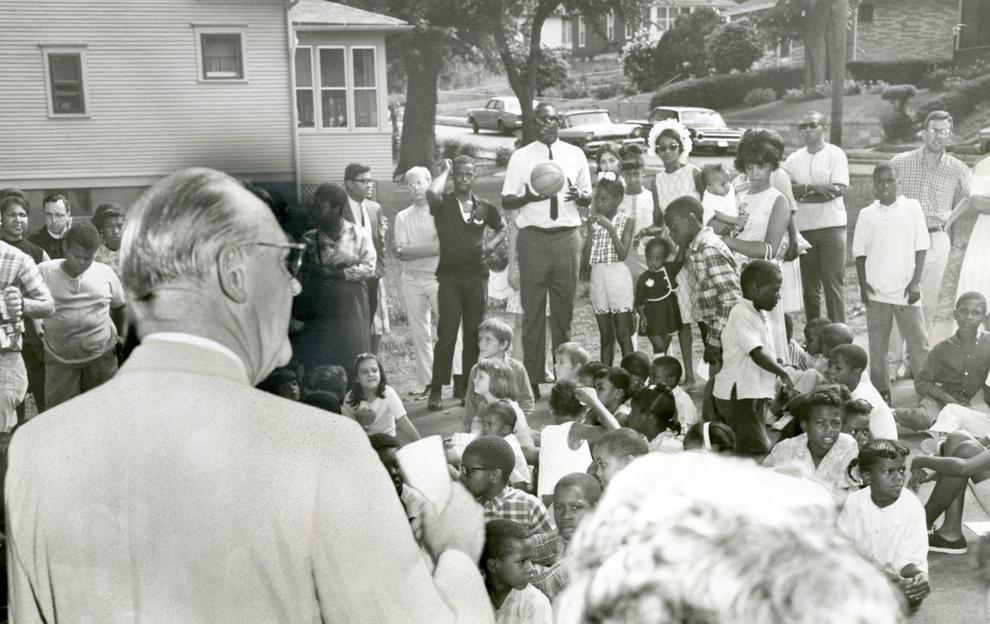
Omaha, Nebraska in 1966 with my family and me at the opening of the “pocket playground.” Mayor A.V. Sorensen (foreground) addresses the group that includes my Dad (with basketball) and me on the right side of him.
The next time you look at a public photo, take a second and third look. Look at little closer.
I did just that and discovered a few gems that otherwise would remain barely etched into my childhood memories. At the picture in this blog feed, you will notice a Black man with a basketball. That’s my Dad, Dr. Rodney S. Wead. I am right next to his right, left from our view. I also noticed my maternal grandmother, Helen Douthy (the sunglasses and bonnet-like hat) holding the hand of my cousin, Lori. Lori’s mother, Aunt Greta, is holding my other cousin, Debbie.
Franklin Elementary School playground time in 1969.
I was 11 years old when this photo was take at Franklin Elementary School. Always the tallest girl in each grade, it helps now that my height helps to identify me in a crowd such as this one.
My paternal grandfather, Sampson Wead, is pictured in what was a rare sighting. He was a member of the DePorres Club and they were protesting Reed Ice Cream not hiring Black workers. That took a lot to do in the 1950s for Black folk no matter the location.
Sampson Wead, foreground left, is identified by me in this 1953 photo.
PRESENTED BY VALERIE TOLIVER IN THE FORM OF A COLLAGE
The great family legacy of Valerie Toliver
During the month of February 2022, Good Genes Genealogy Services presented three Saturday virtual classes involving family ancestry and genealogy.
Theme: “Walk With Our Ancestors
Participants: Adults.
Assignment: Express families’ histories in varied formats. Others showcased their various projects. All shared with classmates to spark deeper ancestral questions, comments.
Here’s Valerie Toliver’s compelling story about her journey:
Genealogy project
February 19, 2022
My History, A journey Through Time
This collage encompasses my journey from my homeland, Africa! In doing the African Ancestry DNA test, it was determined that my matriclan test (my mother’s maternal roots) results were for the Yoruba Tribe in Nigeria. A female cousin on my father’s side did the matriclan test as well. Her results determined the maternal roots for my father’s family. The results were the Yoruba and Hausa tribes also of Nigeria. Thus, I have included the flag of Nigeria as well as the symbols for both Yoruba and Hausa on my collage.
In my genealogy research over the years, I have been able to uncover 5 enslavers of my maternal and paternal ancestors. I have this list of surnames included in my collage. At this time, I have verified only one of the enslavers as being a DNA connection. My maternal great-great grandfather was enslaved and fathered by a member of the Shields family who originated in Scotland/Ireland. I don’t have a picture of the enslaver, but I have included pictures of one of his son’s and grandson’s. I also have included a picture of the DNA match that I have with one of his descendants, my 4-6th cousin. Their family shield, along with the copy of the will showing the sale of my ancestor to a 2nd enslaver is on the collage as well. I’m continuing to research the other 3 enslavers for my family. I have included a copy of the slave list for one enslaver and a reimbursement for funds owed to one of the enslavers for allowing my ancestor to serve in the United Stated Colored Troops. The signage used to lure more of the Black people, both enslaved and free, to serve in the Civil War is depicted in my project as well.
The culmination of items included are: pictures of my maternal and paternal ancestors, churches they attended, cities and states they lived in, articles from the “colored news “, the gravestones of my enslaved great-great grandfather and great-great grandmother, my grandfather’s barn and the stone memorial erected at my mother’s childhood church listing the members that have transitioned since 1870. My mother cut the ribbon for this historic wall only a few years prior to her transition in 2020. At the time, she was the oldest member in age and years of attendance that still attended the church.
This project started out just as a small collage to acknowledge Black History Month. It became much more as I stood in my truth about who I am and how I came to be.
I am my ancestors’ wildest dreams. I am God’s child.
I am taking a different narrative to receiving tips on where to find freebies to aid in genealogy research: Let’s freely give back a gratitude of thanks to a man who quietly helped a cherished civil rights favorite.
Rosa Parks would have been a 109 years old this month. Mike Ilitch transitioned two years ago.
Rosa Parks in her arrest photo on left; entrepreneur and philanthropist Mike Ilitch, right photo.
Rosa Parks
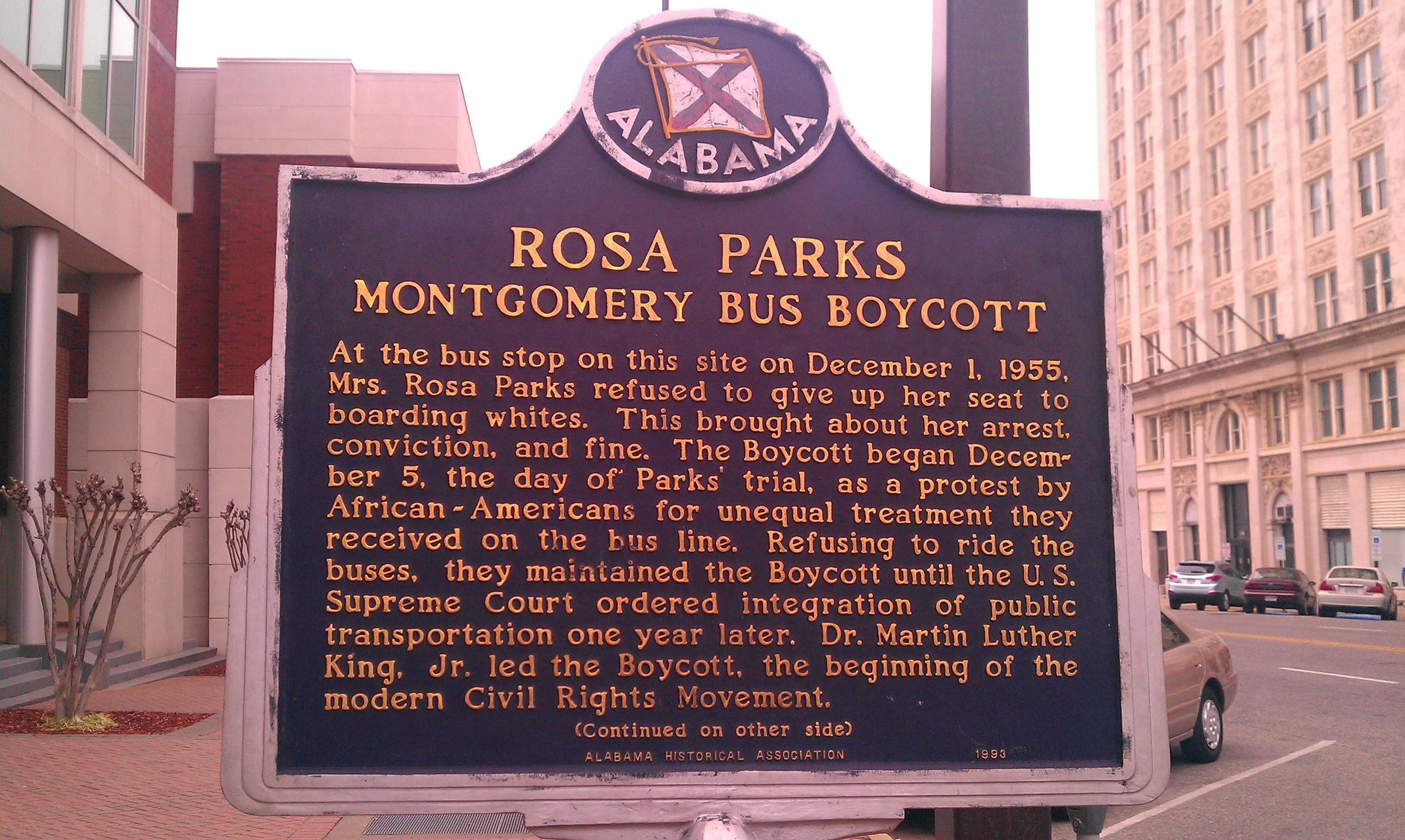
This marker in Alabama summarizes the brave act by Mrs. Parks.
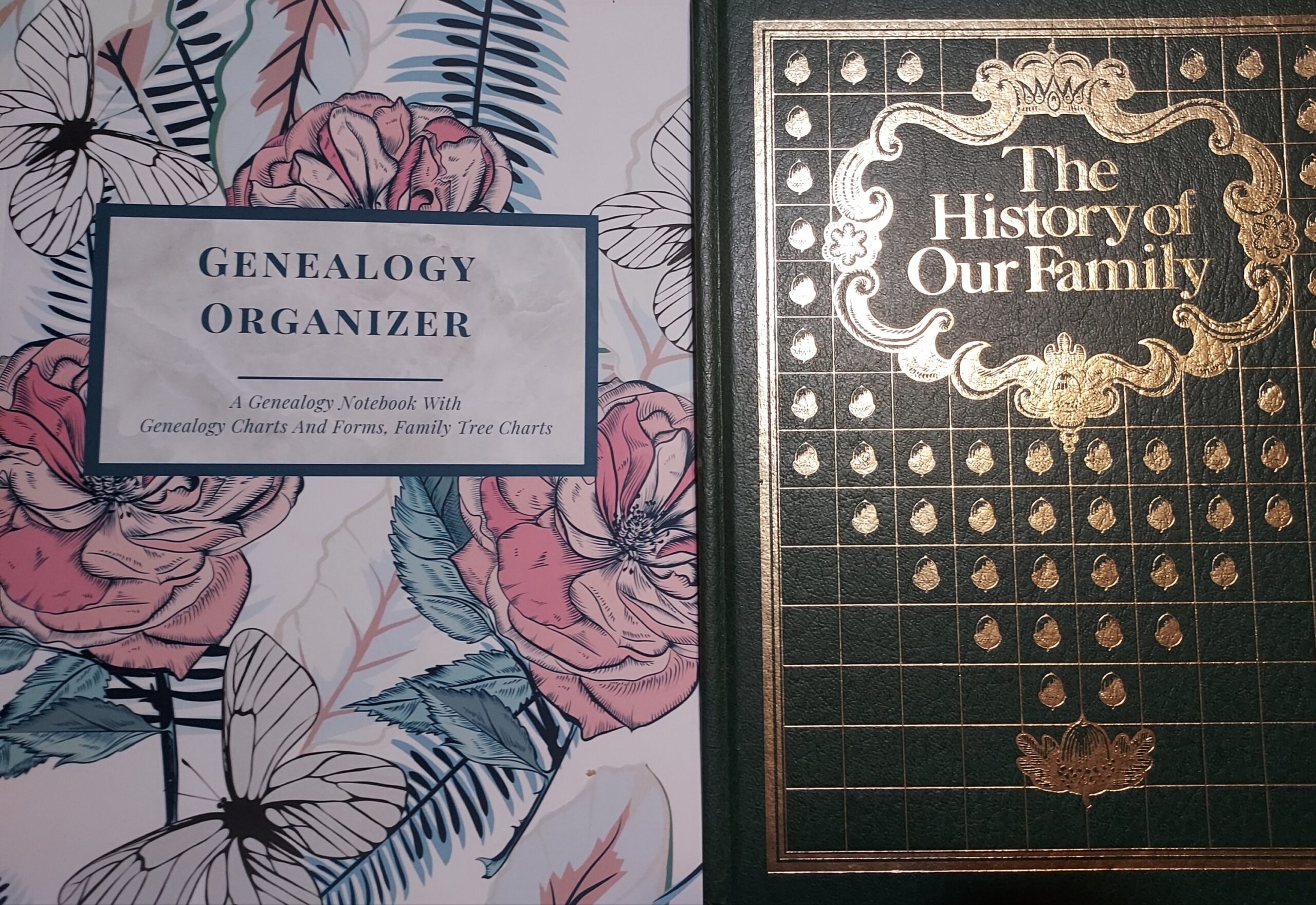
Two of my many hardcover books for family ancestry and genealogy
There are many electronic helpers to keep us organized and efficient in our generational family tree building.
I utilize about 6 different electronic research sites to initiate and maintain records about loved ones who have transitioned a those of us still on earth.
I also love the preservation of records and my handwriting in books creates a special record for future generations to hopefully cherish, evaluate and aid in the ease of family research.
Keeping handwritten records is also a great defense against others invading your family trees with inaccurate information. The family tree invasion is more commonplace today and new restrictions are being established to maintain privacy and integrity of the research.
Researching genealogy and family histories are exciting activities. Equally thrilling are the research results coming to life in the form of podcasts, blogs, puzzles, articles, affirmations, proclamations, presentations, stage plays, films, clothing and other expressions of our ancestors’ rich legacies.
Here’s a partial listing of the Black History Month programs, activities and other recognitions throughout the United States:
President Thomas Jefferson and Sally Hemings Descendant Gayle Jessup White – African-American Burial Ground, Monticello
Good Genes Genealogy Services offers a hands-on, virtual series of workshops with the proceeds benefiting Hillside International Truth Center. Learn how to move your research into multi-media productions, products and services. The bonus is the honoring of our ancestors with an in-person circle of release and love. See below to register.
How to attend and be present for the future
Remember to bring along a notepad, whether electronic or paper. My youngest son brings his Braille notetaker.
Listen to the genealogy and ancestry points of information that relate to your current and future research.
Ask questions and make comments about what matters to you. At one of my recent online seminars, a participant asked that I return to former slides to review the listing of great resources for genealogy research.
Provide feedback to the event host. The feedback and especially the recommendations for topics of future topics, remain important to event hosts.
Relax and release so that you may enjoy and learn from every activity and program.
About 12 years ago, I received important advice from an Arkansas special collections librarian. She asked me to share my paternal family’s history as I discovered it — bit by bit.
I recall telling her that I did not have much to report on my grandfather, Samuel Luster Weed (now Wead), and his family who lived in Helena, Arkansas during the bloody summer of 1919 in the Delta region. She said, “even if you have one page to share, share it.” This librarian was responsible for my brick wall breakthrough as she found Big PaPa Wead. I am forever grateful.
A rare photo of my grandfather, Sampson Luster Wead in the 1950s at a civil rights protest.
Start where you are. That is the straight-forward message I received from Rhonda. It applies to new and seasoned genealogy and family ancestry researchers.
Thank you, Rhonda.
I have been repeating that refrain since then. I will repeat it again soon during the annual Sankofa Genealogy monthlong celebrations hosted by Atlanta, Ga.’s Hillside International Truth Center. During our Saturday Sankofa Genealogy workshops, our emphasis is to encourage participants to show their work. Do as Rhonda wisely advised me, share their stories. As the Ghanian Sankofa bird teaches us, reach back to retrieve what is lost while moving forward as its body shows.
www.shokopress.com
Start where you are … again.
Start where you are.
I recently received an email prompt from the TV network, NBC. It showcased a story about a lady who “struck” black family genealogy gold by linking her family’s past to that of Abolitionist Harriet Tubman. Another NBC story that aired a year ago was also a great bright light. It featured a boy dressed up like his favorite news anchor who became an ancestor. It is an example of starting where you are. I am sure that Rhonda is proud. I am.
Tips for starting where you are in family research
Begin with your research question or purpose. It could be you are looking to find at least one family member from your mother’s or father’s ancestors.
Ask questions among family members, even if you are repeating yourself. You may be surprised with their new responses to you.
Seek the help from a librarian, a historian, a genealogist and newspaper by utilizing surnames that you are familiar with. Make sure you spell the surname at least seven different ways.
If you are seeking a female ancestor, know that her married name may cause many brick walls. Seek her maiden name, albeit it is usually a tough search.
Publish, write, speak or produce a video. Create a one-page document as I did to break the ice of publishing my research, thanks to Rhonda.