Join us at 10 a.m., Saturday, Feb. 11, 2023, for a valuable workshop via Zoom designed to prompt participants to find their “lost” loved ones and gain joy, satisfaction, identity and spiritual uplift on the journey. The workshop focuses on Black Genealogy and Ancestry family research and more.
Part two and final 2023 Sankofa Genealogy workshop will be held at the same time, Saturday, Feb. 18, 2023. Details will be provided next week.
Partners sponsoring this workshop.
Ann Wead Kimbrough and Mark Owen, first cousins and genealogists of GGGS, will facilitate the workshops for the third year. Workshop partner leadership: Presiding Bishop Jack L. Bomar, Rev. Sharon Hodnett (Zoom ologist) and Dr. Marian Gamble (Assisting Zoom ologist)
Genealogy and ancestry “hunters” come in all ages.
‘Back in the day,’ our ancestors’ version of social media was human contact. Stories were shared by village griots about our roots. Physical signs such as smoke were used to communicate. Entries were manually entered into family Bibles. Long visits with food-in-hands were made to families whose loved ones transitioned. Telephone calls were made on rotary dial devices. Telephone company operators connected calls between lines.
Storytelling among family via original stories and those read from informative books, are valuable to pass along family history.
Today, there are hundreds, perhaps thousands of daily opportunities for the novice to serious genealogy and ancestry “hunters” to find details about their loved ones. One of the obvious, natural sources of data gathering is apparent in our daily doses of media. Whether current TV newscasts or historical clippings from newspapers, there are photos and stories waiting for us to find and connect them to our ancestors.
“… forms of electronic communication (such as websites for social networking and microblogging) through which users create online communities to share information, ideas, personal messages, and other content (such as videos)…”
Meriam-Webster Dictionary
There are so many sites that apply to this definition and that is where the Good Genes Genealogy Team invites you to begin or resume your ancestry research. According to Datareportal, nearly 5 billion social media users are regular users on thousands of different sites. On average, 7.2 sites are visited each month by users. The top reason why we utilize social media is to remain in contact with living and deceased friends and families. Often, we receive news about the passing of a loved one from social media sources.
To help jog your brain, here are a few of the platforms that are part of our social media community:
Church websites
Sorority and fraternal websites
Community blogs and vlogs
Every app on cellular phones
Government resources
Newspapers
TV and Radio
Event, show bookings
Tradeshows
Quiz sites
Dissertation sites
Publications, ranging from scholarly to trade
Lots more sites are revealed on Datareportal:
Here’s an important tip on locating historical points on the QuizDaily website. It opened clues to one of our client’s family members.
“In 1832, the Georgia Infirmary became the first hospital for African Americans when it opened on Christmas Eve. Established by the Georgia General Assembly and a $10,000 grant from the estate of a merchant and minister named Thomas F. Williams, the Georgia Infirmary was built 10 miles south of Savannah, Georgia. In 1974, the infirmary was renamed the Adult Day Center; it is still an operating facility.”
In the worldwide Census data collection and distribution, there are straightforward and confusing results within the same reports. In the U.K. (England and Wales), the percentage of whites, for example, increased in the latest Census due to:
The ethnic groups used in the 2021 Census were slightly different from the 2011 Census ethnic groups.
There were 2 changes in 2021 – the ‘Roma’ group was added under the ‘white’ ethnic group, and people could write their own response under the ‘black African’ ethnic group.
As a result, figures for the white other and black African and black other ethnic groups may not be directly comparable for 2011 and 2021, although the groups concerned account for very low percentages of the overall population.
The Romani, or Roma as they are known, were once the EU’s largest minority group and now the addition of their population has increased the “white” column in the 2022 U.K. Census data. Romas are counted in the 2022 U.K. Census — actually in two categories. Why? That’s the straight forward-yet confusing data that is found in the U.K. Census.
As a result, the change in how whites and African-connected heritages are reported resulted in the latest data released about the ethnic, Caribbean, African and white populations in England and Wales. The latest results are not comparable to other years.
Over time, here’s what shows up as percentages of the entire population. Note that what I derived from the overall data will not equal 100 percent. See the full table of data:
According to the 2021 Census, the total population of England and Wales was 59.6 million and 81.7% of the population was white.
People from Asian ethnic groups made up the second largest percentage of the population (9.3%), followed by black (4.0%), mixed (2.9%) and other (2.1%) ethnic groups.
Out of the 19 ethnic groups, white British people made up the largest percentage of the population (74.4%), followed by people in the white ‘other’ (6.2%) and Indian (3.1%) ethnic groups.
From 2011 to 2021, the percentage of people in the white British ethnic group went down from 80.5% to 74.4%.
The percentage of people in the white ‘other’ ethnic group went up from 4.4% to 6.2% – the largest percentage point increase out of all ethnic groups.
The number of people who identified as ‘any other ethnic background’ went up from 333,100 to 923,800.
The take away
Confusing data and materials as recorded by government sources, further the “brick wall” frustration. Don’t be. Dig deeper to get results.
Census data — whether U.S. or U.K. or any other county, area — should always be deeply examined.
Once you review the data, go deeper. Click on all links and take hints to follow the accuracy of the data.
The goal is to gain clarity about what’s behind the statistics, materials and the conditions the results are produced.
The other primary goal is to learn the truth about where our ancestors lived, how they lived, and more.
Hillside’s leadership generously is offering our workshops for free. Cousins Ann Wead Kimbrough and Mark S. Owen, genealogists, are the facilitators for their church’s genealogy workshops. The workshops are open to our worldwide audience.
Kimbrough and Owen specialize in “breaking down brick walls” to find the “hard-to-find” Black ancestors whose histories are usually intertwined with others from contrasting backgounds, such as former slave owners. Kimbrough and Owen have several success stories in helping genealogy workshop participants and other clients to locate their “lost” loved ones. Hillside’s Presiding Bishop Jack L. Bomar, is among those who learned a “great blessing” of family history through the Good Genes Genealogy Services’ research about his family.
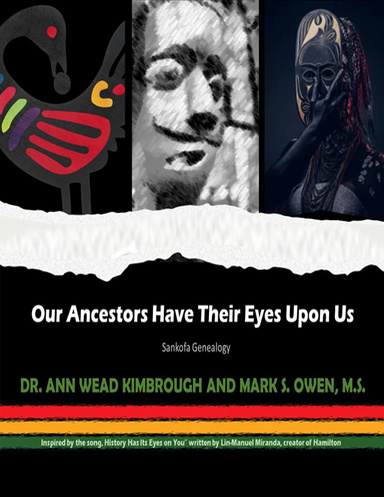
Sankofa Genealogy workshop attendees are asked to purchase the companion workbook. Go to our website and select “Genealogy Store.” You will be able to download your copy after selecting the book cover image (see below) to pay for your book. All proceeds offset our free and low-cost, year-round genealogy consulting services. Kimbrough and Owen are the co-authors and Veverly Byrd-Davis is the book designer and illustrator of the cover.
As a preview to the first workshop, we will explore the “natural” and online ways to find your ancestors whose heritage is from the African diaspora. Participants will also learn helpful tips and receive encouragement from the valued benefit of locating and celebrating our individual and collective Black family ancestries.
Don’t you love Black History Month? Although February is the shortest month in days of our calendar year, it is nonetheless a time to pause, respect and relish the fantastic achievements of African American, Black and Caribbean ancestors whose works and lives were largely ignored or never revealed.
That’s where your great genealogy research comes in. This month, hopefully the multitude of U.S. and global Black History Month recognitions, will prompt you to uncover new finds from your family. Tour museums. Visit special sites. Listen to great lectures. Watch broadcasts on public broadcasting and other media channels that provide insight on the lives that were courageously and well lived.
Thanks to the creation of and steadfast lobbying of Dr. Carter G. Woodson, we celebrate Black History Month. Woodson was the second black person to receive a doctorate degree from Harvard University, received two degrees from the University of Chicago, and a bachelor degree in Literature from Berea College. He also studied at the Sorbonne in Paris.
Today, some may shrug our shoulders about Woodson’s academic, literature, social and educational achievements. Yet, pause for a moment and think about when and where and how he accomplished so much after being born to former slaves and in poverty in 1875 to former slaves in Virginia. He worked smart during the era with remnants of the slave codes and other racial threats to his life. Yet, he authored several books, founded major organizations, and although he was never married and had no children, Woodson’s influence is an integral part of Black families around the globe.
Here are a few of the exciting happenings this month to honor Black History, beginning with the Good Genes Genealogy Services workshop:
Good Genes Genealogy Services is presenting its 3rd annual Sankofa Black Genealogy Workshop in partnership with Hillside International Truth Center. It’s free and you will be encouraged to purchase our workbook. Coming soon!
Please add your Black History Month events and the Good Genes Genealogy Services team will continue to update the great events throughout the month of February 2023.
MONDAY, JANUARY 30, 2023 I GIVE THANKS FOR MY ANCESTORS
From Hillside Truth International Center, Atlanta, GA
Individually and collectively, we are part of a never-ending story. The story has no beginning and no end. Our Ancestors are the keepers of the stories and the secrets. Our Ancestors are reminders of the sacredness of our individual and collective lives. Their truths were passed on to us and continue to live in and through us. We can always tap in and receive the wisdom of their life experience, which is alive and well in our DNA. I listen to the whispers of my Ancestors and the echoes of their souls. I am grateful to know that I am a part of a spiritual lineage that is anchored in divine wisdom. I am guided to do what is right and honorable. I am part of the chain of life. The stories I inherited and tell today liberate those who come tomorrow. Thank you, Faith, in me, through me, as me, around me, through the Christ within. And so it is.
Daily Thoughts from the HillCopyright: Hillside International Truth Center, Inc.Bishop Dr. Jack L. Bomar – Executive BishopBishop Dr. Barbara L. King – Founder Renew/Subscribe: https://HillsideInternational.org/bookstore
With the elders is wisdom; and in length of days, understanding. Job 12:12
A founder of the 109-year-old international Black male fraternity, Phi Beta Sigma Fraternity, Inc., was long “missing.” He is now found.
For serious genealogy researchers, it is a joyful and encouraging example of how customized techniques resulted in a fraternity victory and for Black genealogy research.
“He got lost,” said Rev. William Major during a Founders Day program in metro Atlanta. “Through genealogy research … he was found. He died in 1981,” Major said.
Major’s remarks were emotionally delivered in honor of the three founders of Phi Beta Sigma during the 2023 Metro Atlanta Founders Day program that included the fraternity’s sister organization, Zeta Phi Beta Sorority, Inc. The two Black Greek-Letter entities are the only ones constitutionally bound in its founding. Dr. Ann Wead Kimbrough of Good Genes Genealogy Services, Inc. is a member of Zeta Phi Beta Sorority, Inc.
Major and Kimbrough
Rev. William Major, left, and Dr. Ann Wead Kimbrough at their Fraternity’s and Sorority’s Founders Day observance in Decatur, GA. (Photo: Provided by Ann Wead Kimbrough)
On Jan. 9, 1914, on the campus of Howard University in Washington, D.C., Brown, along with A. Langston Taylor and Leonard F. Morse, founded Phi Beta Sigma Fraternity, Inc. Today, the international organization is comprised of more than 150,000 college-educated and professional men, predominantly of African American origin. Since its inception, Phi Beta Sigma has been open to men of all race, religion, class and national origin.
Charles I. Brown, third from left, with his two other founders (right of him) and members of the Alpha Chapter, Phi Beta Sigma Fraternity, Howard University
The fantastic search for the Phi Beta Sigma Founder Brown is well documented. What makes the search for Brown remarkable: Full use of available research resources. Flexibility and strategy are the keys to success in genealogy and ancestry research. In one blog, these words are instructive to all researchers:
THE SEARCH FOR CHARLES I. BROWN
The purpose of this blog is to gather information relating to Charles I. Brown. A most honorable founder of Phi Beta Sigma. We by no means claim a patent on the subject, nor are we seeking to upstage those who have done research prior to ours. We are willing to accept any and all help with this project. This is a plea to all brothers if you have any information, be it rumor, gossip or speculation please post it here.
http://charlesibrown.blogspot.com/
Details of the successful search
That is valuable content within the search-for-Brown blog:
Founder Brown is said to have been born in Topeka, Kansas in 1890. Census records show that his father was Rev. John M. Brown and that his mother was Maggie M. Brown. However, records at Howard University from 1910 have Founder Brown living at 1813 Titan Street in Philadelphia, Pennsylvania. He was very cordial and very popular with the student body and Howard University Administration. He is credited with choosing the 9 charter members of Phi Beta Sigma Fraternity. Founder Brown founded the Delta Chapter of Phi Beta Sigma at Kansas State University in Manhattan, Kansas, on April 9, 1917, and through oral interviews was a teacher at the Kansas Industrial School for Negroes in Topeka, Kansas.
Census records and oral interviews have showed us that Founder Brown was alive in the Topeka, Kansas area until 1931. Some believe that he was a casualty of the First World War; others believe that he moved.
https://charlesibrown.blogspot.com/
While there are several aspects of Brown’s life that has not yet been fully restored, it is heartening to known that his remains were claimed by his beloved fraternity and he was given a proper memorial service. His legacy is worth reading.
CHARLES I. BROWN August 27, 1885 – December 21, 1981
Ann of the Good Genes Genealogy Services team began her interest in family genealogy at the age of 10. After asking her mother and paternal grandfather separate questions about their childhoods, siblings, families and more, Ann did not receive the replies she expected. In both cases, I could hear crickets (old schoolers will get the reference).