PRESENTED BY VALERIE TOLIVER IN THE FORM OF A COLLAGE
The great family legacy of Valerie Toliver
During the month of February 2022, Good Genes Genealogy Services presented three Saturday virtual classes involving family ancestry and genealogy.
Theme: “Walk With Our Ancestors
Participants: Adults.
Assignment: Express families’ histories in varied formats. Others showcased their various projects. All shared with classmates to spark deeper ancestral questions, comments.
Here’s Valerie Toliver’s compelling story about her journey:
Genealogy project
February 19, 2022
My History, A journey Through Time
This collage encompasses my journey from my homeland, Africa! In doing the African Ancestry DNA test, it was determined that my matriclan test (my mother’s maternal roots) results were for the Yoruba Tribe in Nigeria. A female cousin on my father’s side did the matriclan test as well. Her results determined the maternal roots for my father’s family. The results were the Yoruba and Hausa tribes also of Nigeria. Thus, I have included the flag of Nigeria as well as the symbols for both Yoruba and Hausa on my collage.
In my genealogy research over the years, I have been able to uncover 5 enslavers of my maternal and paternal ancestors. I have this list of surnames included in my collage. At this time, I have verified only one of the enslavers as being a DNA connection. My maternal great-great grandfather was enslaved and fathered by a member of the Shields family who originated in Scotland/Ireland. I don’t have a picture of the enslaver, but I have included pictures of one of his son’s and grandson’s. I also have included a picture of the DNA match that I have with one of his descendants, my 4-6th cousin. Their family shield, along with the copy of the will showing the sale of my ancestor to a 2nd enslaver is on the collage as well. I’m continuing to research the other 3 enslavers for my family. I have included a copy of the slave list for one enslaver and a reimbursement for funds owed to one of the enslavers for allowing my ancestor to serve in the United Stated Colored Troops. The signage used to lure more of the Black people, both enslaved and free, to serve in the Civil War is depicted in my project as well.
The culmination of items included are: pictures of my maternal and paternal ancestors, churches they attended, cities and states they lived in, articles from the “colored news “, the gravestones of my enslaved great-great grandfather and great-great grandmother, my grandfather’s barn and the stone memorial erected at my mother’s childhood church listing the members that have transitioned since 1870. My mother cut the ribbon for this historic wall only a few years prior to her transition in 2020. At the time, she was the oldest member in age and years of attendance that still attended the church.
This project started out just as a small collage to acknowledge Black History Month. It became much more as I stood in my truth about who I am and how I came to be.
I am my ancestors’ wildest dreams. I am God’s child.
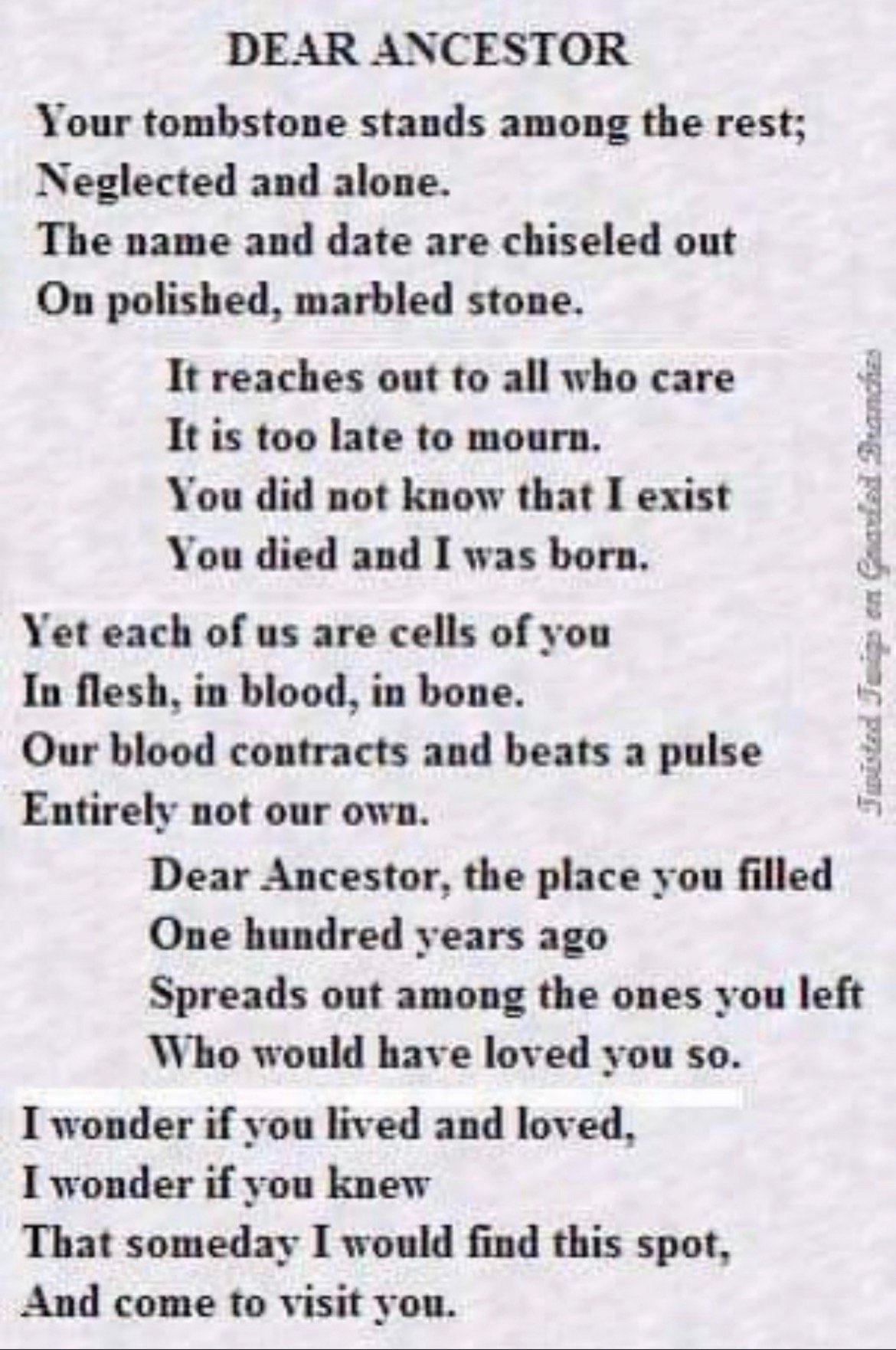
Read Rev. Sandy Rodgers‘ tribute in honor of our ancestor! Congrats to all class members who are willingly expressing their appreciation to our ancestors by producing creative works today.
I am taking a different narrative to receiving tips on where to find freebies to aid in genealogy research: Let’s freely give back a gratitude of thanks to a man who quietly helped a cherished civil rights favorite.
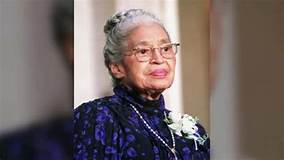
Rosa Parks would have been a 109 years old this month. Mike Ilitch transitioned two years ago.
Rosa Parks in her arrest photo on left; entrepreneur and philanthropist Mike Ilitch, right photo.
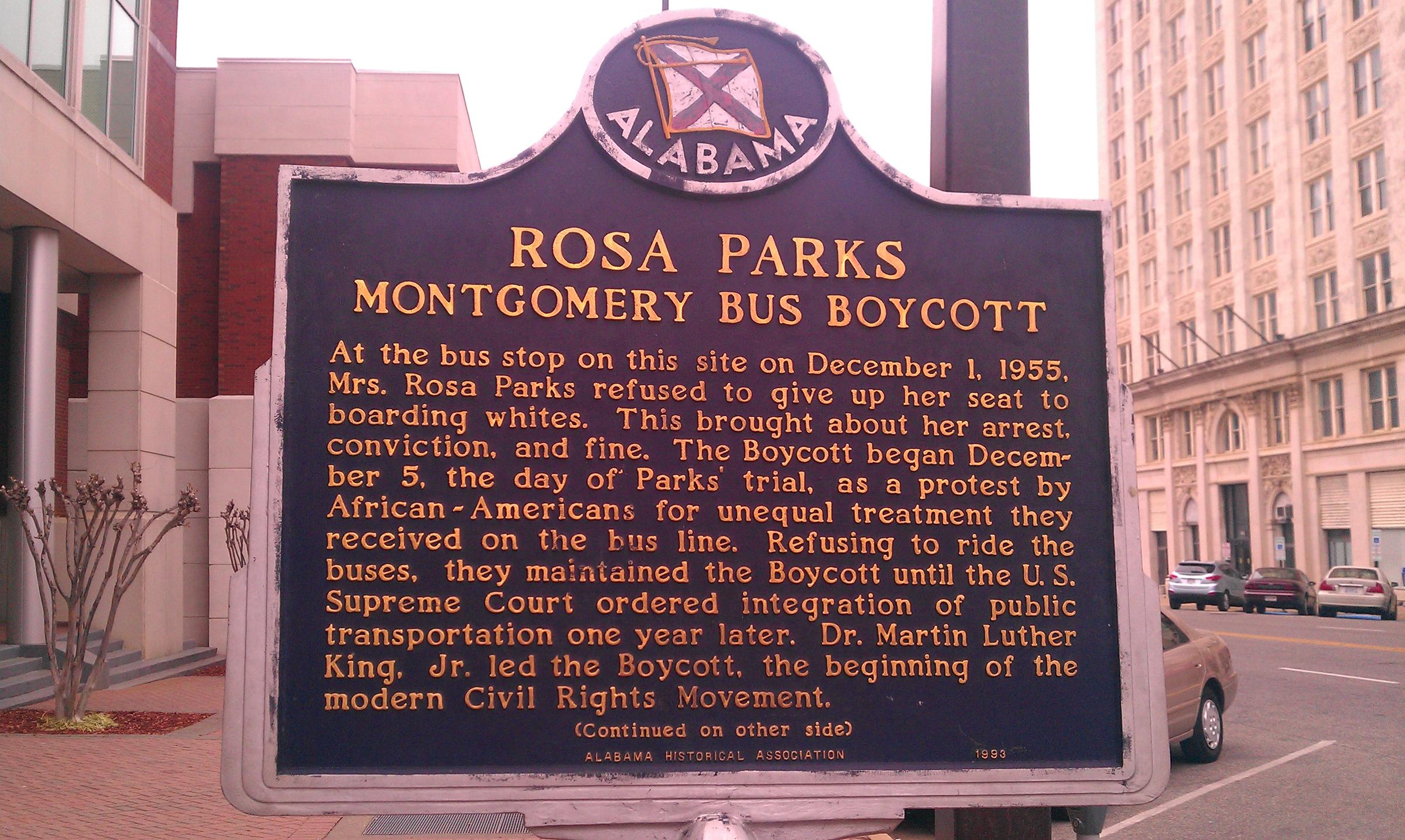
Rosa Parks
This marker in Alabama summarizes the brave act by Mrs. Parks.
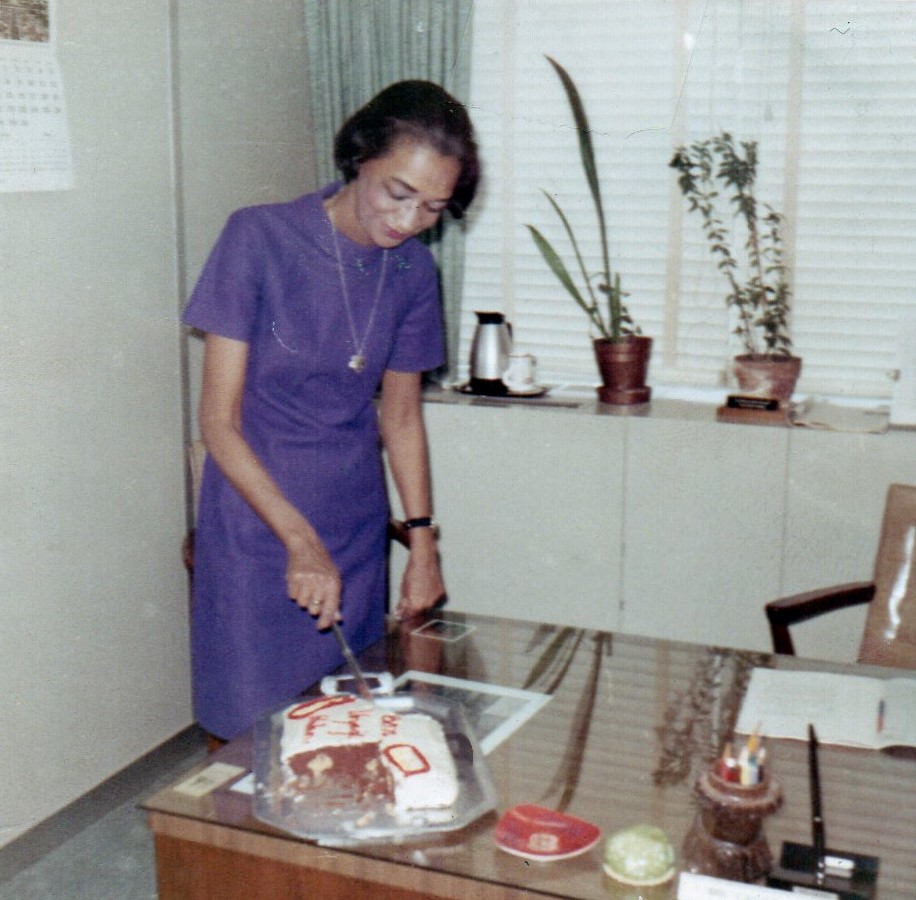
The forever Actress, Musician, Clothing Designer, Seamstress/Tailor, Theatre Director, Opera lover … our Grandmother “Mama Helen” Mary Wilkes Owen Douthy, Omaha, Nebraska 1963
Mama Helen’s Omaha (Nebraska) Central High School yearbook photograph, Class of 1935.
Mama Helen retired from SAC Headquarters, Offutt Air Force Base in 1969.
To summarize my maternal grandmother’s life: She did the most.
In the winter months during 1963, my Maternal Grandmother, Helen Mary Wilkes (and also spelled Wilks), was donning a thinly clad garment and acting in the Greek tragedy, “Antigone.” That in of itself is nothing spectacular.
That is, except that “Mama Helen” (as were told by her to call her), in 1963 was also a mother of adult children and a high school student while working as an unnamed “Hidden Figure” at the Strategic Air Command Headquarters, Offutt Air Force Base in nearby Bellevue, Nebraska. She was not supposed to be a “brain” at Offutt where she worked as administrative assistant to the scientists. She was actually an astute mathematician with an amazing intellect with exemplary secretarial skills.
Mama Helen was not supposed to be on the theatre stage at her age, 45, in a supporting role to help build her acting repertoire. She was not supposed to understand the Greek language and read Latin. She was not supposed to be old enough to be the mother of the play’s director. After all, she was a black woman who should have been content to remain hidden as a white-collar worker albeit with tremendous skills outside of the workplace. I often traveled with her from North Omaha to theatres around the city and developed my love for Latin, global travels and writing.
Thankfully, Mama Helen was never content being confined to what the so-called societal norms were in Omaha and across the nation. She would always tell me about her travels around the world. She was the super volunteer for the Presbyterian Church (U.S.A.). She played the organs at various churches on Sunday, often for no pay as she considered it her tithe to the church and unto God. Monies were stretched in the household, according to my mother, Angeline Cecil Owen Wead, the oldest of six children born in five years to Mama Helen and Grandpa Eugene Owen, II. Mama Helen was mostly the single parent in their household as my grandfather was off to build his hopes of a Hollywood career as a dancer and singer.
Thankfully, the village that was led by our Great-Grandmother Edna Lou Wilks Robinson, worked. Mama Helen received significant assistance from Grandmother Robinson.
In later years, Mama Helen was voted into the prestigious Omaha Central High School Hall of Fame. In this tribute to Mama Helen when she was inducted in the Hall of Fame that also honors Warren and Susie Buffett, my Dad, Dr. Rodney S. Wead, countless athletic, political, academic, world leaders and more, Mama Helen was remembered:
“Helen loved music and the arts and volunteered with Opera Omaha, Omaha Community Playhouse, Center Stage, and Chanticleer Theater. She served on the Nebraska Arts Council and Omaha’s Human Relations Board.
Helen passed away in 2008 at the age of 90.”
Upon Mama Helen’s retirement, she devoted her time to a program that she earlier developed to help single women develop skills to become secretaries, assistants and other related jobs inside of offices. She conducted the classes at a local community center.
Create a social media post honoring your ancestor
Steps to help you to share stories about your ancestors
Walk with your ancestors by researching their lives.
Narrow down your work to focus on one ancestor.
Once you locate periodicals, broadcast reports, historical data on military cards, death certificates and more about your ancestor, take the time to capture where the information leads you to build the rest of the story.
Honor your ancestor. Take a moment and offer a wonderful prayer for her/his walk before you. Look for similarities between your life and the ancestor’s.
Share your results so that others may benefit from their stories. It also helps to establish your interests in activities.
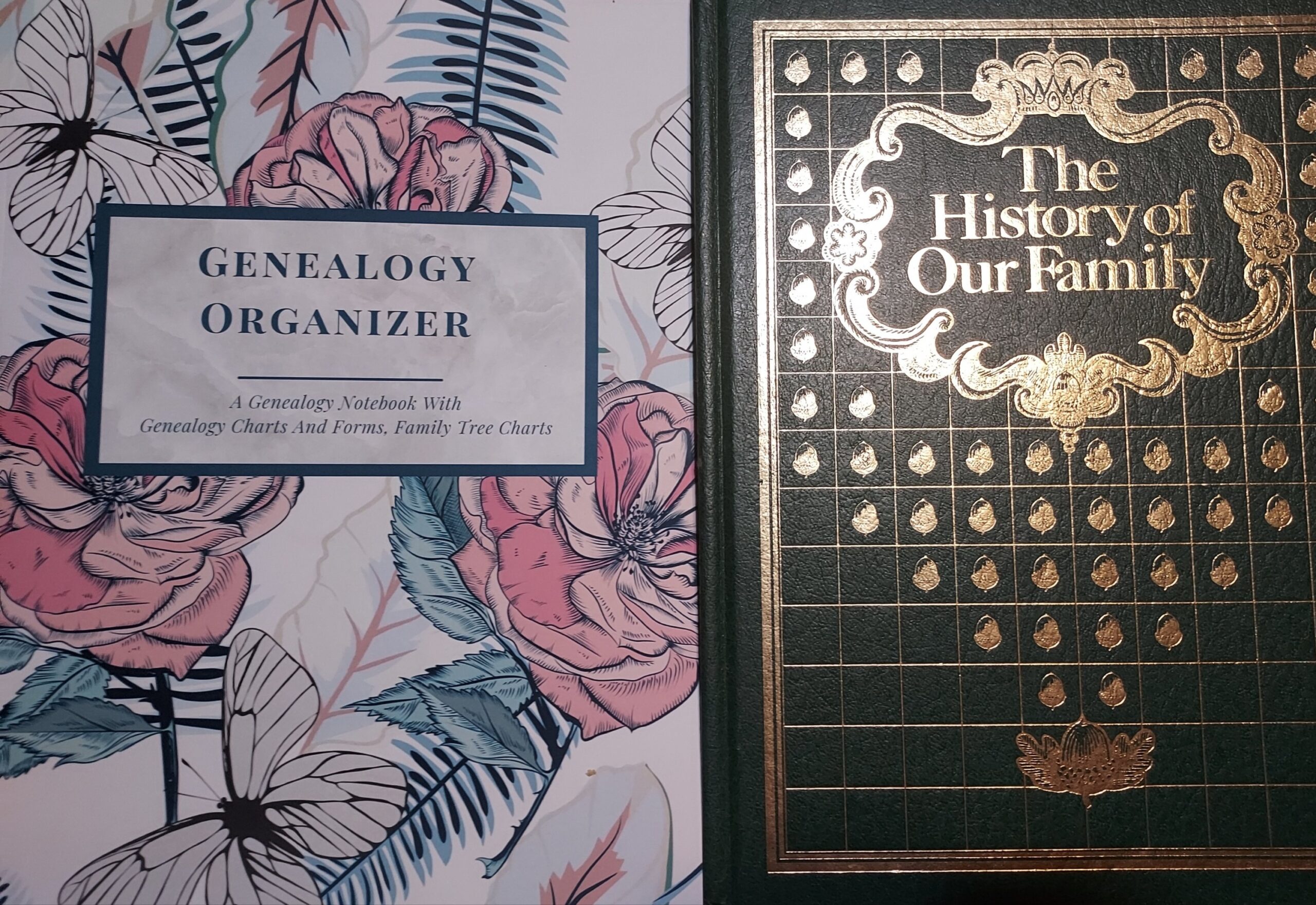
Two of my many hardcover books for family ancestry and genealogy
There are many electronic helpers to keep us organized and efficient in our generational family tree building.
I utilize about 6 different electronic research sites to initiate and maintain records about loved ones who have transitioned a those of us still on earth.
I also love the preservation of records and my handwriting in books creates a special record for future generations to hopefully cherish, evaluate and aid in the ease of family research.
Keeping handwritten records is also a great defense against others invading your family trees with inaccurate information. The family tree invasion is more commonplace today and new restrictions are being established to maintain privacy and integrity of the research.
This post about freebies usually appears on Fridays. In honor of a great week by all who have contacted Good Genes Genealogy Services, here’s your day-before treat:
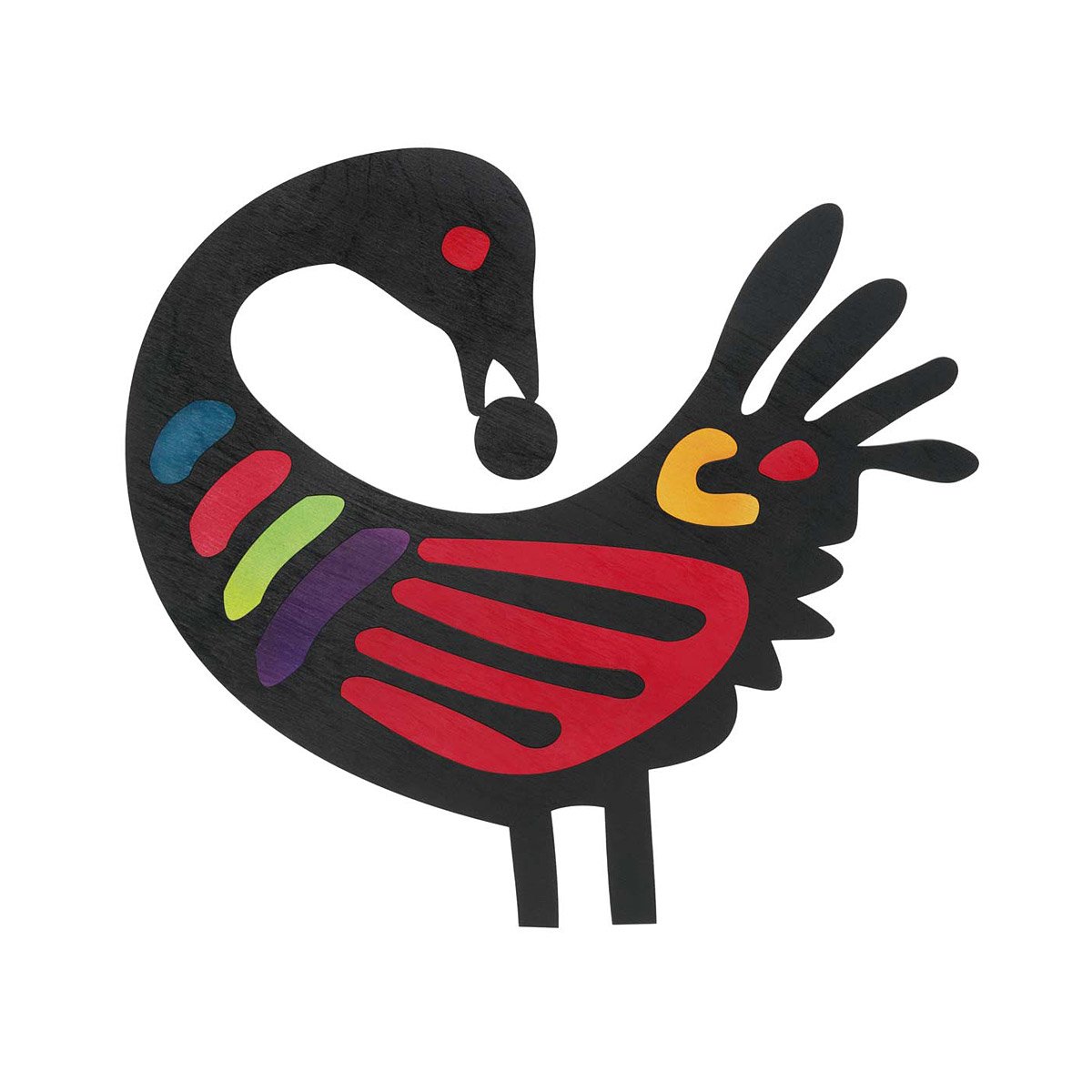
Like the Ghanianhttps://www.uncommongoods.com/product/sankofa-wall-art Sankofa bird, Good Genes Genealogy Services is looking back to gather research from former and current workshops to help all move forward with their family ancestry research.
During January and February 2022, the Good Genes Genealogy Services team provided five (5) workshops. The free workshops for the DeKalb County Public Library, and the Saturdays-in-February workshops where the proceeds are fully donated to our host, Hillside International Truth Center, certain references were named.
The following is a compilation of the referenced genealogy materials:
Free or Limited Trial Genealogy Sites (a sampling)
This site is dedicated to genealogy research for African Americans. https://afrigeneas.com
According to its website, “Ancestry.com LLC is an American genealogy company based in Lehi, Utah. The largest for-profit genealogy company in the world, it operates a network of genealogical, historical records, and related genetic genealogy websites.” https://ancestry.com
Part of the Library of Congress website, Chronicling America has searchable images of US newspapers from 1792-1963. https://chroniclingamerica.loc.gov
It is based in the UK and already has released the 1921 Census. The site is a compilation of media and government reports. There is a 14-day free trial. https://www.findmypast.com/
Search over 10 billion global historical records, birth, marriage and death records from 32 countries, 25 million pages of historical newspapers dating back to 1803, and more than 6.3 billion names – all with a 14-day free trial. Use it free for two weeks and cancel if it’s not for you. https://www.myheritage.com.
The USGenWeb Project is comprised of volunteers who provide free genealogy websites for genealogical research in every county and every state of the United States. It is a non-commercial site and wants to provide free genealogy access for everyone. http://www.usgenweb.org/
Access free digitized images of newspapers, books, films, maps, personal narratives, photos, prints, and drawings.https://www.archives.gov/
This site is free, yet it does ask if you wish to make a donation to keep its access free. Here’s the website announcement “Trace your roots for FREE with our searchable database containing thousands of identified and mystery photos for genealogy enthusiasts looking for long-lost family. Anyone who finds a photo of a direct ancestor that is owned by the archive will receive the photo for free. If the historic photos you find pique your interest in genealogy, you can continue your research by doing a family search here.” https://deadfred.com/
If your ancestors were Jewish, this website has more than 20 million records from all over the world to help you trace your Jewish heritage. https://www.jewishgen.org/
Access free digitized images of newspapers, books, films, maps, personal narratives, photos, prints, and drawings. Home | Library of Congress (loc.gov)
This is an activist group of historians, genealogists, researchers, and open government advocates, Reclaim the Records identifies information that should be in the public domain but has been restricted by the government, archive or library that holds it. https://www.reclaimtherecords.org
Genealogy Conferences
This site bills itself as “ConferenceKeeper.org is the most complete calendar of genealogy events — anywhere! Here you will find hundreds to thousands of genealogy webinars, workshops, seminars, conferences, podcasts and more, from genealogy societies, libraries, and other organizations all around the world.” It’s true. https://conferencekeeper.org/conference-keeper/
You may also be interested in the following conferences:
The Institute of Genealogy and Historical Research (IGHR) – hosts an annual Expo in Athens, GA, gagensociety.org
It is billed as the larges family genealogy conference in the world. It’s the virtual, RootsTech 2022 • FamilySearch
Genealogy Research in Military Records
The National Archives holds Federal military service records from the Revolutionary War to 1912 in the National Archives Building in Washington, D.C. See details of holdings.
Military records from WWI – present are held in the National Military Personnel Records Center (NPRC), in St. Louis, Missouri, See details of holdings.
The National Archives does not hold state militia records. For these records, you will need to contact the appropriate State Archives.
THE best and “free” source in genealogy research begins at your friendly neighborhood library. One library system that is used by Ann is the DeKalb County Public Library. Having a library card gives you access to services such as “Ask a Librarian” and broader research sites. Anyone may also request library cards in former home libraries across the nation. DeKalb County Public Library (dekalblibrary.org)
Nonpopulation census records can add “flesh” to the bones of ancestors and provide information about the communities in which they lived. Agriculture, mortality, and social statistics schedules are available for the census years of 1850, 1860, 1870, and 1880. Manufacturing schedules are available for 1820, 1850, 1860, 1870, and 1880. These records are arranged by state, then by county, and then by political subdivision (township, city, etc.). Schedules of business are available for 1935 for the following industries: advertising agencies, banking and financial institutions, miscellaneous enterprises, motor trucking for hire, public warehousing, and radio broadcasting stations.
State censuses can be as important as the federal census to genealogists but, because they were taken randomly, remain a much-under-utilized resource in American genealogy. State censuses often can serve as substitutes for some of the missing federal census records – most notably the 1790, 1800, 1810, and 1890 censuses. Many state censuses also asked different questions than the federal census, thus recording information that cannot be found elsewhere in the federal schedules. While not all states took their own censuses, and some have not survived, state and local census records can be found in many locations. Most states which took censuses usually did so every 10 years, in years ending in “5” (1855, 1865, etc.) to complement the federal census. These state census records are most often found at the state archives or state library. Many are also on microfilm through a local Family History Center of the Church of Jesus Christ of Latter-day Saints and online via commercial genealogy databases. State Censuses – History – U.S. Census Bureau
Addendum
Inaugural 2021 Genealogy Book published by Good Genes Genealogical Services
Researching genealogy and family histories are exciting activities. Equally thrilling are the research results coming to life in the form of podcasts, blogs, puzzles, articles, affirmations, proclamations, presentations, stage plays, films, clothing and other expressions of our ancestors’ rich legacies.
Here’s a partial listing of the Black History Month programs, activities and other recognitions throughout the United States:
President Thomas Jefferson and Sally Hemings Descendant Gayle Jessup White – African-American Burial Ground, Monticello
Good Genes Genealogy Services offers a hands-on, virtual series of workshops with the proceeds benefiting Hillside International Truth Center. Learn how to move your research into multi-media productions, products and services. The bonus is the honoring of our ancestors with an in-person circle of release and love. See below to register.
How to attend and be present for the future
Remember to bring along a notepad, whether electronic or paper. My youngest son brings his Braille notetaker.
Listen to the genealogy and ancestry points of information that relate to your current and future research.
Ask questions and make comments about what matters to you. At one of my recent online seminars, a participant asked that I return to former slides to review the listing of great resources for genealogy research.
Provide feedback to the event host. The feedback and especially the recommendations for topics of future topics, remain important to event hosts.
Relax and release so that you may enjoy and learn from every activity and program.
About 12 years ago, I received important advice from an Arkansas special collections librarian. She asked me to share my paternal family’s history as I discovered it — bit by bit.
I recall telling her that I did not have much to report on my grandfather, Samuel Luster Weed (now Wead), and his family who lived in Helena, Arkansas during the bloody summer of 1919 in the Delta region. She said, “even if you have one page to share, share it.” This librarian was responsible for my brick wall breakthrough as she found Big PaPa Wead. I am forever grateful.
A rare photo of my grandfather, Sampson Luster Wead in the 1950s at a civil rights protest.
Start where you are. That is the straight-forward message I received from Rhonda. It applies to new and seasoned genealogy and family ancestry researchers.
Thank you, Rhonda.
I have been repeating that refrain since then. I will repeat it again soon during the annual Sankofa Genealogy monthlong celebrations hosted by Atlanta, Ga.’s Hillside International Truth Center. During our Saturday Sankofa Genealogy workshops, our emphasis is to encourage participants to show their work. Do as Rhonda wisely advised me, share their stories. As the Ghanian Sankofa bird teaches us, reach back to retrieve what is lost while moving forward as its body shows.
www.shokopress.com
Start where you are … again.
Start where you are.
I recently received an email prompt from the TV network, NBC. It showcased a story about a lady who “struck” black family genealogy gold by linking her family’s past to that of Abolitionist Harriet Tubman. Another NBC story that aired a year ago was also a great bright light. It featured a boy dressed up like his favorite news anchor who became an ancestor. It is an example of starting where you are. I am sure that Rhonda is proud. I am.
Tips for starting where you are in family research
Begin with your research question or purpose. It could be you are looking to find at least one family member from your mother’s or father’s ancestors.
Ask questions among family members, even if you are repeating yourself. You may be surprised with their new responses to you.
Seek the help from a librarian, a historian, a genealogist and newspaper by utilizing surnames that you are familiar with. Make sure you spell the surname at least seven different ways.
If you are seeking a female ancestor, know that her married name may cause many brick walls. Seek her maiden name, albeit it is usually a tough search.
Publish, write, speak or produce a video. Create a one-page document as I did to break the ice of publishing my research, thanks to Rhonda.
February is the perfect month to journey with our ancestors. For the second year, Good Genes Genealogy Services LLC, will offer a series of Saturday morning, live and virtual workshops that follow the principles of the Ghana, Africa Sankofa bird.
Your donation benefits the programming of Hillside International Truth Center.
“Sankofa” is a Ghanaian word that translated means “Go back and fetch it.” It also refers to a mythical bird whose feet are firmly planted forward while its head is turned backwards carrying a precious egg in its mouth. It symbolizes the belief that the past serves as a guide for planning the future. It represents a people’s quest for knowledge with the implication that the quest is based on critical examination, and intelligent and patient investigation.
February is known as the month of love, is marked by the American Heart Association, and is the USA’s Black History Month of recognition and celebration. The power of love is always with me. The recent deaths of loved ones from matters of the heart impact my soul. The annual recognition of Black History Month honors our ancestors — whether African American, Irish American, Afro Caribbean American and more.
Tips for a worthwhile attendee to this workshop series:
Be open and receptive to learning new facts about our ancestors;
Expect to receive reminders and prompts about ancestry and genealogy;
Challenge yourself to move your basic or lengthy family ancestry research to production;
Be prepared to participate fully in the Sankofa Genealogy classes, especially in weeks three (3) and four (4); and
Enjoy the classes and if possible, the in-person ancestral healing ceremony on the last Saturday of February.
A word of gratitude: The workshops conducted by Mark S. Owen and Ann Wead Kimbrough, are made possible through the collective production team of ministers. They are Bishop Jack Bomar, Drs. Marian Gamble and Tony Burks II, Revs. Sharon Hodnett and Senay Johnson.