Some countries and indigenous tribes allow individuals to obtain citizenship based on their genealogy. In Ireland and in Greece, for example, an individual can become a citizen if one of their grandparents was born in that country, regardless of their own or their parents’ birthplace. In societies such as Australia or the United States, by the 20th century, there was growing pride in the pioneers and nation-builders. Establishing descent from these was, and is, important to lineage societies, such as the Daughters of the American Revolution and The General Society of Mayflower Descendants.
Modern family history explores new sources of status, such as celebrating the resilience of families that survived generations of poverty or slavery, or the success of families in integrating across racial or national boundaries.
Private individuals research genealogy out of curiosity about their heritage. This curiosity can be particularly strong among those whose family histories were lost or unknown due to, for example, adoption or separation from family through divorce, death, or other situations. In addition to simply wanting to know more about who they are and where they came from, individuals may research their genealogy to learn about any hereditary diseases in their family history.
There is a growing interest in family history in the media as a result of advertising and television shows sponsored by large genealogy companies. This, coupled with easier access to online records and the affordability of DNA tests, has both inspired curiosity and allowed those who are curious to easily start investigating their ancestry.
A small community, e.g., a single village or parish, such as in a one-place study; or a particular, often famous, person. Bloodlines of Salem is an example of a specialized family-history group. It welcomes members who can prove descent from a participant of the Salem Witch Trials or who simply choose to support the group.
Genealogists and family historians often join family history societies, where novices can learn from more experienced researchers. Such societies generally serve a specific geographical area. Their members may also index records to make them more accessible or engage in advocacy and other efforts to preserve public records and cemeteries. Some schools engage students in such projects as a means to reinforce lessons regarding immigration and history. Other benefits include family medical histories for families with serious medical conditions that are hereditary.
I was moved by a newspaper columnist’s description of the great flood in the 1940s that invaded my hometown, Omaha, Nebraska and neighboring city, Council Bluffs, Iowa. What led me to this article was an active conversation I was having with my parents about a time when the entire community pulled together to help one another.
My Dad and his buddies were drafted to help build structures to help fend off the water disaster that paralyzed the area for several weeks.
As I listened to their separate remembrances, I was scanning the flooded areas via today’s Internet. There were empty spaces where houses and businesses once stood, while stronger structures remaining upon the soggy grounds.
What was my fantastic tool to locate the historical Iowa and Nebraska? It’s the Freebie Friday “My Genealogy Hound.” It’s a great website with more than 2,100 historic county maps from throughout the United States. I’ve found it helpful when I was researching my ancestors in Georgia. I wanted to see where my paternal family lived in Helena, Arkansas in 1919, and our (Good Genes Genealogy team) maternal relatives’ homes and businesses in Springfield, Missouri between 1900 and 1945.
Some maps don’t allow the researcher to drill down and find every old road that I was seeking. Yet, most of the county maps give me a great sense of the areas.
The 1904 map of Springfield, Greene County, Missouri.
There’s at least one county map for every county in the states of Alabama, Arkansas, Connecticut, Delaware, Georgia, Illinois, Indiana, Iowa, Kansas, Kentucky, Louisiana, Maine, Maryland, Massachusetts, Michigan, Mississippi, Missouri, Nebraska, New Hampshire, New Jersey, New York, North Carolina, Ohio, Oklahoma, Pennsylvania, Rhode Island, South Carolina, Tennessee, Vermont, Virginia and West Virginia.
Only partial lists exist for the remaining U.S. states. Within all states, more county maps are regularly added.
On this annual day of Epiphany, it is also the birth of my most cheriished ancestor. Today, Jan. 6, 2022, would have been my Paternal Aunt Beverly Ann Wead Blackburn Jones’ 85th birthday. She transitioned in 1973 at the age of 36. I was 15 years old. It was the first family death that left an indelible mark upon my life.
My father’s baby sister, my mother’s best friend, my dear ancestor Aunt Beverly, has taught me so much over the nearly 49 years since her transition. Many of our ancestors have that ability to guide us through our genealogy journeys. My advice: Let them.
Aunt Bev’s Grave Marker in Forest Lawn Memorial Park, Omaha, Nebraska
Aunt Beverly is more than the grave marker of her birth and death dates. She was a standout scholar, athlete and civic citizen that began in her high school years. She continued with similar activities in college and added accomplishments that included journalist, sorority member and U.S. Senate recognized achiever. She was twice married, had three children during her first marriage, owned businesses and hosted many recreational and entertainment activities for children and teenagers in our hometown of Omaha, Nebraska.
The summary of Aunt Beverly’s life from our family tree on ancestry.com’s website
When I wrote about my dear Aunt Beverly a year ago, I did not have the family details that I have since retrieved. Thanks to Aunt Beverly, I offer the following genealogy tips that lead to more discoveries in our ancestry searches:
Update ancestor’s information. Review the ancestor’s information for updates that are often added through online sources. I found new information relevant to Aunt Beverly’s ancestry data. A closer look at the 1940 U.S. Census data for Aunt Beverly’s/my Dad’s family showed that their Dad/my grandfather completed one year of high school.
Review linked ancestor’s information. While reviewing your ancestor, follow her or his lineage for the same purpose of online updates. I found new and rich updates about my ancestors who are Aunt Beverly’s father, grandfather, great-grandfather and great-grandmother’s information.
Resist the tendency to keep your original research. Often, we don’t want to release our early research about our ancestors after we find new documents that provide validity. For instance, my great-great grandmother’s birth year and location were incorrect on my family tree. Documents were recently released that gave accurate results based on Fannie Robinson Wade’s recently found birth certificate from 1841.
4. Verify new information. Using my paternal great-great grandmother’s data, I verified her birth year by reviewing the 1880 U.S. Census for her age at that time. I also found two other trees that included Fannie Robinson Wade as part of their research. The reconciled birth year information appears to be accurate.
5. Select a routine day or date to review and update ancestral information. I use my ancestors’ birthdays, marriage anniversaries, holidays and death anniversaries to pause and review existing information for updates. With Aunt Beverly, I review her life’s story on her birthday and in June of each year.
The how-tos that I presented can be expanded by each researcher reading this WordPress blog and social media post. Share your ideas to help others and the Good Genes Genealogy team to gain new research techniques.
This column is reprinted from WeadWriteAwayandGenealogy
Author: Learning family histories
Our genealogy traces our family from western and central Africa and western Europe. Our ancestors entered the United States at the Virginia and Georgia Ports. First cousins Mark Owen and Ann Lineve Wead (it is protocol to use the maiden names of females in genealogy searches) are responsible for writing this blog. Although Ann has been involved in genealogy research while searching for certain ancestors since the age of 10, the cousins began deeper research of their families during the COVID-19 Pandemic Year of 2020. Devoting as much as 6 hours some evenings to the methodical training and research of genealogy, the cousins completed the year 2020 by earning genealogy certificates. Join us. @goodgenesgenealogy on wordpress and fb, twitter Sign up for our blog and enjoy the journey. View all posts by Learning family histories
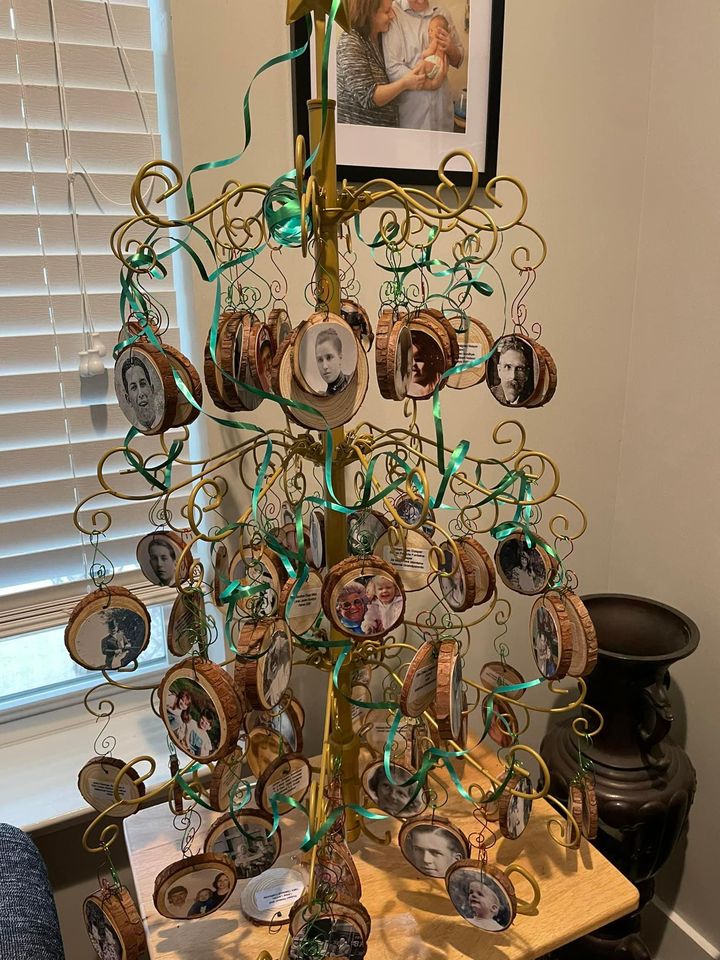
One of my facebook genealogy page colleagues gifted her children with their individual family trees. Now that the winter holidays are over, this idea is perfect for 2022 family reunions.
A real tree for families
My colleague said the most often asked question is where to purchase the tree stand? She offered this bestchoiceporducts site.
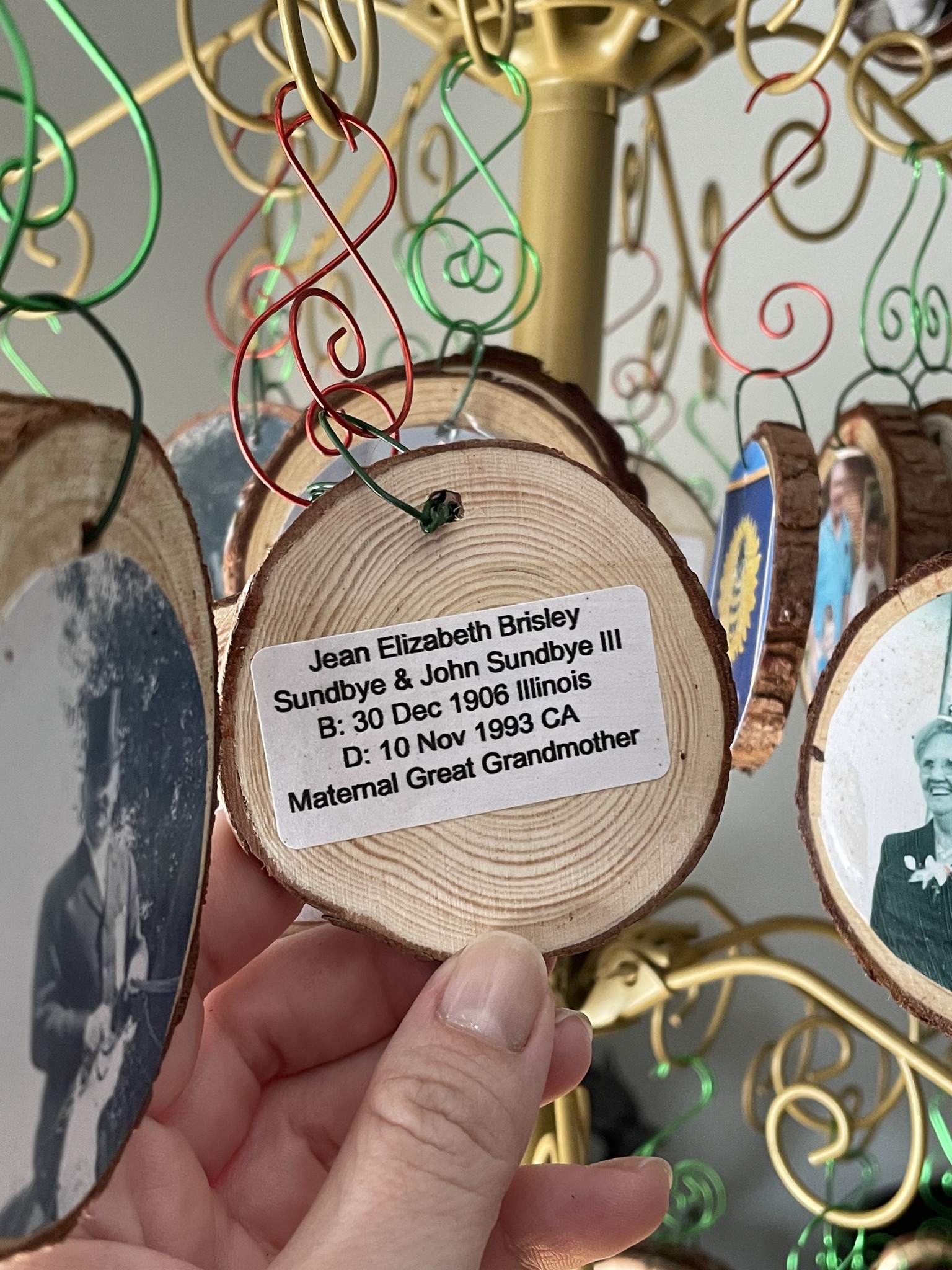
Here is the back of one of the branches for you to consider how to list your ancestors.
This example by Sheila Bousson is a great capture of an ancestor.
How to make this happen for your family? Be creative by using this example as your foundation of an idea that brings new meaning to our genealogy phrase, “family tree.”
Ancestry.com just posted a new message on my DeKalb County Public Library account. In short it states that its free genealogy research resources are for use only in the library and not at home.
Here’s the new message:
Ancestry Library Edition is a new genealogy research tool that provides library patrons instant access to a wide range of resources for genealogical and historical research. Ancestry Library Edition includes records from the U. S. Census; military records; court, land and probate records; vital and church records; directories; petitions for naturalization; passenger lists and more!Ancestry Library Edition is not for home use. To access this database, please ask for more information at your local library.For libraries wishing to arrange a free trial, please call ProQuest Sales at 1‑800‑521‑0600, extension 3344.For initial account setup or account preferences, contact ProQuest Customer Service.For authentication issues connecting or logging in, contact ProQuest Technical Support.
My genealogy sense is that ancestry.com will again alter this policy as the health pandemic contribute to limited indoor visitations and closings of some facilities.
Stay tuned in 2022 to our blogs and social media on how to benefit from free genealogy offerings.