One hundred and 40 years ago under the hot Atlanta sun, a group of African American women formed an assocaition and staged a major labor organizing effort that was leadng toward a general strike. Such a strike would have shut down Atlanta’s business and political establishments, according to reports in the Atlanta Constitution newspaper and the Magazine of History.
Their well organized work stoppage campaign attracted newspaper attention across the country. Some 25 states and the area now known as the District of Columbia, provided coverage of the single city strike.
Article appeared in the Record Union newspaper, Sacramento, Calif.From the Times and News paper in Eufaula, Ala.
By the end of their work stoppage, here is what the women endured and achieved:
July 21
Washing Society begins its recruitment tactics.
Door-to-door recruitment of washing women.
July 26
Atlanta City Council announces it will tax all women belonging to an association.
Sarah A. Collier was charged $20 and she did not pay it. Her name was added to the chain gang list.
August 3
A letter signed by five (5) Washing organizations, comprised of 486 women wrote to the Mayor of Atlanta, Jim English. They agreed to pay the $25 and $50 licenses that were proposed by the Mayor and Atlanta City Council and in its letter stated “then we will have full control of the city’s washing at our own prices, as the city has control of our husbands’ work at their prices. Don’t forget this. We hope to hear from your council Tuesday morning. We mean business this week or no washing.”
August 16
Atlanta City Council approved a resolution for a $25 tax for the washing women to continue their work.
Their demands were met and the ladies went back to work.
Want to learn more?
Read more about the Atlanta washerwomen and other Labor Day stories in the September 2021 e-book, available on Amazon, Nook and other platforms.
” Our ancestors planted us in rich, fertile soil. They fertilized our soil with their energy, thoughts, and deeds. They fought for us. They struggled for us. They set standards, values, and examples of how to calibrate the moral compass. They left a legacy of self-determination, cooperative economics, faith and hope, and plenty of happiness and love. They showed their strengths and weaknesses. They showed compassion. They had their highs and lows. Most importantly, they gave us life. I am grateful for you, Ancestors. Thank you for the legacy of a robust, vibrant, rich, and healthy life. I embrace your insights and foresights. As with all generations, there is a “rise-up to meet.” Your foundation is strong. I feel it at every turning point. I continue to grow into your footprints. I am grateful for your mind and heart. Thank you, Understanding, in me, through me, as me, around me, through the Christ within. And so it is.”
Behold, the Lord your God has given the land before you; go up and possess it, as the Lord God of your fathers has said to you; fear not, neither be terrified.Deuteronomy 1:21
Daily Thoughts from the HillCopyright: Hillside International Truth Center, Inc.Bishop Dr. Jack L. Bomar – Executive BishopBishop Dr. Barbara L. King – Founder
I grew up in a city where rage, lies, and fears led to the savage killing of a disabled African American man who was accused of accosting a “Karen.” It was 1919. I never knew the story growing up in my hometown of Omaha, Nebraska.
If we must die—let it not be like hogs Hunted and penned in an inglorious spot, While round us bark the mad and hungry dogs, Making their mock at our accursed lot. If we must die—oh, let us nobly die, So that our precious blood may not be shed In vain; then even the monsters we defy Shall be constrained to honor us though dead! Oh, Kinsmen! We must meet the common foe; Though far outnumbered, let us show us brave, And for their thousand blows deal one deathblow! What though before us lies the open grave? Like men, we’ll face the murderous, cowardly pack, Pressed to the wall, dying, but fighting back!
“During the Red Summer of 1919, white mobs repeatedly targeted Black World War I veterans and servicemen.
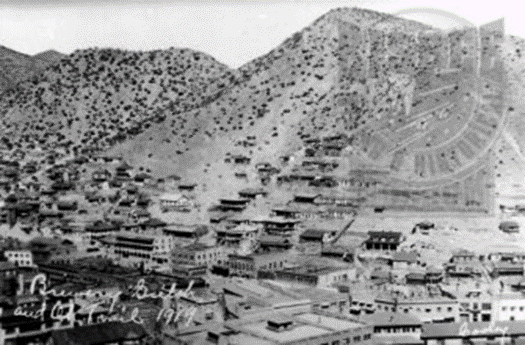
On July 3, 1919, active members of the Army’s segregated 10th Cavalry Regiment (“Buffalo Soldiers”) were in Bisbee, Arizona, to participate in the town’s Independence Day parade. In the early 20th century, Bisbee was a mining town with a history of racial stratification and unrest. The white residents actively discriminated against Arizona’s Mexican, Chinese, and African American laboring communities. It was a “sundown town” for Chinese Americans, and Black laborers had limited employment options.
With tensions high and discrimination rampant, it is not surprising that a fight broke out between a white policeman and a handful of Black soldiers in Brewery Gulch. According to a New York Times report about the violence in Bisbee, local white law enforcement “planned deliberately to aggravate the Negro troops so that they would furnish an excuse for police and deputy sheriffs to shoot them down.”
Add to the anxious times in the United States due to a slumping economy and fears of many white residents in the South who saw the emptying of their workforce during the Great Migration. Meanwhile, scarier and violent white residents met the new African American immigrants in the North with fears of taking jobs and integrating neighborhoods.”
Yet, I never knew about such heinous crimes in 1919 in my hometown of Omaha, Nebraska. Neither did my parents while they were growing up in the city nearby the Missouri River. My Dad, a college history major, learned of the horrors many years later. Perhaps my grandparents were aware since the paternal and maternal ancestors were making their way from the racially charged South to the Great Plains of Nebraska when the “Red Summer” was in full effect.
I never knew that the streets that I walked on in downtown Omaha, Nebraska – my hometown – in front of the Douglas County Courthouse were the scene of unspeakable deadly anger in 1919. I learned of the Red Summer during my college years. Somehow, the Red Summer facts unfolding to me as a college coed did not include Chicago or Omaha. It was 20 years later when I learned the horrific truth about the unlawful burning of a man’s body in front of an enraged white male mob. The crime committed by the 41-year-old rheumatism man who could not harm a fly: Allegedly assaulting a white woman.
Some of the crowd grinned while watching the burning of Will Brown’s body; Omaha, Nebraska, Sept. 28, 1919, Courtesy Nebraska State Historical Society, RG2281-69.
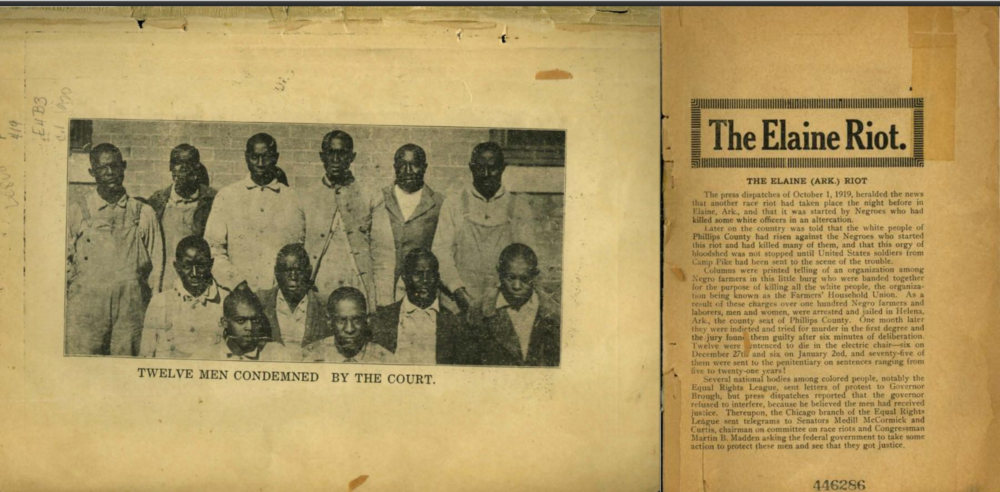
This series of racially disgusting tirades began in the spring in Georgia and continued through the summer and into October, ending with the most violent acts in Elaine and Helena, Arkansas. That area in the Arkansas Delta was where my ancestors lived. My grandfather, Samuel Luster Weed (later Wead), was 15 years old during the Red Summer, and he witnessed the infliction of horrors upon his family and neighbors. Somehow, his mother, Corrie Lee Weed, could get her children – especially her five sons – out of southeast Arkansas. Her husband, my great-grandfather, apparently was not as fortunate. Lost in the rubble of the riots, he remains one of the “brick wall” ancestors.
In all, more than 30 U.S. cities housed the race riots born from small, questionable activities to human rights freedoms. Cities included Charleston, South Carolina; Longview, Texas; Pittsburgh, Pennsylvania, Bisbee, Arizona; Washington, D.C.; Chicago; Knoxville, Tennessee; Omaha, Nebraska; and Elaine, Arkansas. More than 100 African Americans were lynched and killed in other ways. Two years later, Tulsa, Oklahoma, was one of the worst attempts to eradicate African Americans simply because they were considered prosperous.
Stringing together the stories and tragedies of the summer of 1919 has prompted thousands of media stories, numerous books, and articles in search of documenting and analyzing the war zones across the country.
Source: Chicago History MuseumSource: Unknown
The Good Guys
Hate is often colored by skin tone. Blacks can hate whites as much as whites hate their counterpart. Yet, there are always glimpses of a heartfelt and hearty word and works by people who fought against lynching, hate, and widespread discrimination against African Americans before 1919 and during Red Summer. Yet, some civility existed, as the photo below illustrates:
Couple moving during the 1919 Chicago Race Riots. Photograph by Jun Fujita, courtesy of Chicago History Museum, ICHi-65492
Your assignment: Sort through history books, statues, and historic sites in your hometown or nearby locations. Find out how and why racial riots occurred, and write about your findings.
It was also the year of the Compromise of 1877, the non-written agreement by Congress resulting in a trade for a presidential seat to remove federal troops from the South. That granted home rule for Southern states, and it ushered in the era of Jim Crow to keep blacks under control akin to centuries for slavery.
The following spring, in March 1878, about 150 African Americans also arrived in Nicodemus. Some were horrified at what they viewed since settler’s homes were not yet built. Many persons left, yet those who remained began their building and sowing seeds for the future.
The third and final African American settlers arrive in Nicodemus
In 1879, a new group of African Americans arrived, and they became known as the Exodusters to Nicodemus. They were part of the Great Migration of African Americans to the West and North. Among the 1879 Nicodemus pioneer settlers were the Sayers family. About 90 years later, a famous Sayers descendant of Nicodemus (although born in a hospital in Wichita, Kansas), Gayle, joined the National Football League’s Chicago Bears. Sayers, whose family’s surname is listed among the original 1879 pioneer settlers, grew up in Omaha, Nebraska. He was among the several professional athletes who had roots in Nicodemus. Sayers became the youngest person inducted into the NFL Hall of Fame, earning multiple high honors for his football skills at Kansas State University and the NFL. He transitioned in 2020 at the age of 77.
AP File Photo
Nicodemus descendant and Kansas running back Gale Sayers is pictured in this file photo from 1962.
African Americans claim new towns: Westward Ho!
There were many African American towns established in the West in the post-slavery era yet are long forgotten. There’s the town of Blackdown in New Mexico, nearby Roswell, established by African American settlers in the early 1900s. Boley, Oklahoma, was based around the same turn of the century, and it grew to become the largest city for African Americans. It met with the usual demise of economic downtown and terrorism by racist strategies. Today, only a highway sign and granite market exist as reminders of Dearfield, Colo., founded in 1910 as an all-black town near Denver. It thrived as a farm town with the amenities of the city during its heyday. Women and children were integral to its success, according to historians. A little-known town was established in the state north of Nebraska that provides a rich and unusual history of its settlement.
The Nicodemus story is rich in culture, oral and physical history and festivities. Every year the end of July and through early August, the Nicodemus descendants and friends return to the sparsely populated town to honor its historical existence.
To learn more about Nicodemus and other once Western towns known for their African American-dominated population, check out Good Genes Genealogy’s inaugural monthly e-book, set to debut by August 1, 2021. Stay tuned.
A recent weekend webinar about slave history in the physical building of the University of Georgia in Athens, supports the extended research that traces African Americans’ involvement on campuses across the nation.
Like me, many researchers rejoice when we locate our ancestors who attended colleges during post-slavery and during Jim Crow. Yet, as much attention should be directed to researching the ties African Americans and Afro Caribbeans have to universities and colleges through enslaved conditions. It may require that enslavers are researched first to link African American ancestors to the slave labor that was lent to building these institutions.
Your assignment: Hit the books at colleges and universities where African American ancestors lived. You will go to the head of the class based on your findings.
Ultimately, who are we? Based on our twisted and tangled family histories, African Americans and Afro Caribbeans are the ones whose ancestors were sold and traded to satisfy enslavers’ mortgages and other sales.
We want to get answers to this question about ‘who are we?’ as we remove bricks and tree forests to answer our questions. If you have not already considered submitting to a genealogy DNA test, it will become increasingly necessary to fully engage in the scientific credible or best estimates of family trees.
A snapshot of the ancestral roots of Dr. Ann Wead Kimbrough
“Everyone’s DNA cocktail is not the same,” said noted genealogist Nicka Sewell-Smith during a recent webinarThe Annual Forgotten Patriots and Daughters of Color Luncheon, where she provided compelling evidence of the benefit of mixing DNA results into the difficult research stages to secure her family’s missing links.
The Good Genes Genealogy Services team is 100 percent DNA tested. Based on the results from both founders, it will provide a better reading of the Owen-Weed-Wead-Owens family tree that is colorful mixture of European, African and U.S. ancestors. There is so much to learn about DNA research and results and I invite readers of this blog to consider reading another favorite blog to learn just a little bit more aobut the possibilities of nailing better estimates on your families’ histories.
Stay tuned to this blog to learn about the Aug. 1, 2021 e-book by Good Genes Genealogy. It will go more indepth about four subjects each month.
Some 30 years before the United States’ Emancipation Proclamation was signed, 800,000 slaves in the British colonies were declared freed.
“August First” or Slavey Abolition Act, marks the day in 1834 when it became illegal to own slaves in British colonies — yet with a four-year transition to full freedom for our Afro Caribbean brethren.
There are so many memorable and little-known facts about the real July Fourth for many former slaves. Learn about August First and more in the debut monthly e-book by Good Genes Genealogy Services on August 1, 2021. Details will be revealed soon!
Stay close to this blog and keep researching your family’s great history. We’re here to help you on your journey.
I often call us history detectives. That is, as researchers of often neglected or distorted history recounts, we must be vigilant to get the stories corrected about our ancestors whose career choices may seem odd to some individuals.
For instance, our cousin, Ronald Bartee, retired from law enforcement after several years of stellar service including being the head of the Nebraska Parole Board. Even thirty years ago, “Ronnie” was among a few senior Black administrators in law enforcement. Today, some 3,000 men and women in nearly 60 U.S. chapters around the country, comprise NOBLE –– National Association of Black Law Enforcement Executives. Thousands more are rank-and-file Black law enforcement officers.
Yet, often Black citizens in the U.S. and abroad are characterized as the least likely to become ‘Black and Blue.’ A troubling assertion in a recently published article in the Chronicle of Higher Education, shores up the ‘Black v. Blue’ beliefs. There is a statement, without attribution, that implies Black Colleges and Universities and/or Black people are not interested in law enforcement careers:
“… their decisions might raise eyebrows: The Black students attending a historically Black college had trained to become cop.” (from RACE ON CAMPUS A Historically Black College Wants to Change the Face of Policing By Katherine Mangan Lincoln University in Missouri is the first HBCU to house a police academy,” June 29, 2021).
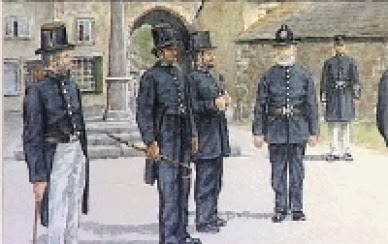
Historical records describe different results as 1837 marked the year that the first known Black officer joined a police force. Pictured below are the first black officers sworn in during an Atlanta, GAceremony in 1948.
Atlanta’s First Eight Black Police Officers. Seated R to L: Claude Dixon, Henry Hooks, Johnnie Jones, Ernest Lyons, Robert McKibbens, John Sanders, Willard Strickland and Willie Elkins. all sworn in on April 30, 948. Source: Georgia State University Library
First black police officer was John Kent in 1837 who was hired and assigned to northwest England. His image is below.
· 1867: The African-American police officers are appointed to the police department in Selma, Alabama; they would be followed in 1868 by officers in Jackson, Florida, and in 1870 by officers in Houston and Galveston, Texas.
· 1870: New Orleans, Louisiana has 177 African-American officers, and three of five police board members were African American.
· April 12, 1870: Officer William Johnson of Jacksonville, Florida becomes the first recognized African-American police officer killed in the line of duty.
· 1875: Bass Reeves is appointed as the first African-American Deputy U.S. Marshal.
· 1916: Georgia Ann Robinson becomes the first African-American woman police officer, serving in the Los Angeles Police Department.
· 1928: Dr. Louis Tompkins Wright is the first known African-American police surgeon. He would later become president of the NAACP Board of Directors.
· 1941: William B. Lindsay becomes the first known African-American state trooper, hired by the Illinois State Police.
· 1966: Sheriff Lucius Amerson is one for the first elected African-American sheriffs, serving in Macon County, Alabama.
· 1972: The National Black Police Association is chartered.
· 1976: The National Organization of Black Law Enforcement Executive (NOBLE) is founded.
· 1988: Willie L. Williams becomes one of the first African-American police commissioners. He serves in Philadelphia and would subsequently become the first African-American commissioner of the Los Angeles Police Department in 1992.
***(provided by the National Law Enforcement Officers Memorial Museum)
Deep into our genealogy research about ancestors we knew and others we learn more about through our “detective” work, there are lots of opportunities for spiritual understanding and growth.
I know.
Seek balance. Forgive what you know such as learning an ancestor was imprisioned or moved away for work and never returned to the community where the researcher lived. Negative remembrances place us in mental and spiritual jails.
Give a pass to the ancestors and be willing to dig deeper to recover all of the facts. Sometimes history got it wrong. In Elaine and Helena, Arkansas — the home of my paternal ancestors — the headlines of the day reported one thing. Uncovering of history revealed something else.
Example of “wrong” reporting in the Arkansas Gazette
Example of “getting it right” reporting by historic and brave activist Ida B. Wells Barnett
Be willing to pass through those genealogical brick walls. Pass the test and know that life for our ancestors requires putting ourselves in their moments in time.
Enjoy the reseach and love the process. Merge the good past to your great future.
SATURDAY, JUNE 26, 2021I RELEASE THE PAST
(From Atlanta, GA’s Hillside International Truth Center’s “Daily Thoughts from the Hill”
Our past miss-steps are a part of where we are. Life’s challenges are lessons from which we can learn. But when the outcome is not what we expected, consciously or subconsciously, it can shake our belief. So we may tend to play it safe, but see God in it. God is available. God cannot disappear from your life any more than you can disappear from yourself. God is Life and the life of God is in you. Let the past stay in the past and move forward. I do not live in the past; I let the past live there. Divine vision shows me abundance without fear. Nothing controls me, including my past. My imagination shows me how God would have me see my life. I live in the now. Thank you, Imagination, in me, through me, as me, around me, through the Christ within. And so it is. Forgetting those things which are behind, I strive for those things which are before me.Philippians 3:13
Daily Thoughts from the HillCopyright: Hillside International Truth Center, Inc.Bishop Dr. Jack L. Bomar – Executive BishopBishop Dr. Barbara L. King – Founde
Deep into our genealogy research about ancestors we knew and others we learn more about through our “detective” work, there are lots of opportunities for spiritual understanding and growth.
I know.
Seek balance. Forgive what you know such as learning an ancestor was imprisioned or moved away for work and never returned to the community where the researcher lived. Negative remembrances place us in mental and spiritual jails.
Give a pass to the ancestors and be willing to dig deeper to recover all of the facts. Sometimes history got it wrong. In Elaine and Helena, Arkansas — the home of my paternal ancestors — the headlines of the day reported one thing. Uncovering of history revealed something else.
Example of “wrong” reporting in the Arkansas Gazette
Example of “getting it right” reporting by historic and brave activist Ida B. Wells Barnett
Be willing to pass through those genealogical brick walls. Pass the test and know that life for our ancestors requires putting ourselves in their moments in time.
Enjoy the reseach and love the process. Merge the good past to your great future.
SATURDAY, JUNE 26, 2021I RELEASE THE PAST
(From Atlanta, GA’s Hillside International Truth Center’s “Daily Thoughts from the Hill”
Our past miss-steps are a part of where we are. Life’s challenges are lessons from which we can learn. But when the outcome is not what we expected, consciously or subconsciously, it can shake our belief. So we may tend to play it safe, but see God in it. God is available. God cannot disappear from your life any more than you can disappear from yourself. God is Life and the life of God is in you. Let the past stay in the past and move forward. I do not live in the past; I let the past live there. Divine vision shows me abundance without fear. Nothing controls me, including my past. My imagination shows me how God would have me see my life. I live in the now. Thank you, Imagination, in me, through me, as me, around me, through the Christ within. And so it is. Forgetting those things which are behind, I strive for those things which are before me.Philippians 3:13
Daily Thoughts from the HillCopyright: Hillside International Truth Center, Inc.Bishop Dr. Jack L. Bomar – Executive BishopBishop Dr. Barbara L. King – Founde